Skip to content

NTN Testbeds: Overview

TOSSI runs five NTN testbed scenarios: one geostationary and four low-earth-orbit, all on a single Linux host with no radio hardware. This page is the map. It says what each one demonstrates and links to its documentation.

If you are new to NTN as a technology, start with NTN: An Introduction, which covers orbits, payload types and what 3GPP changed to make 5G work over a satellite link.
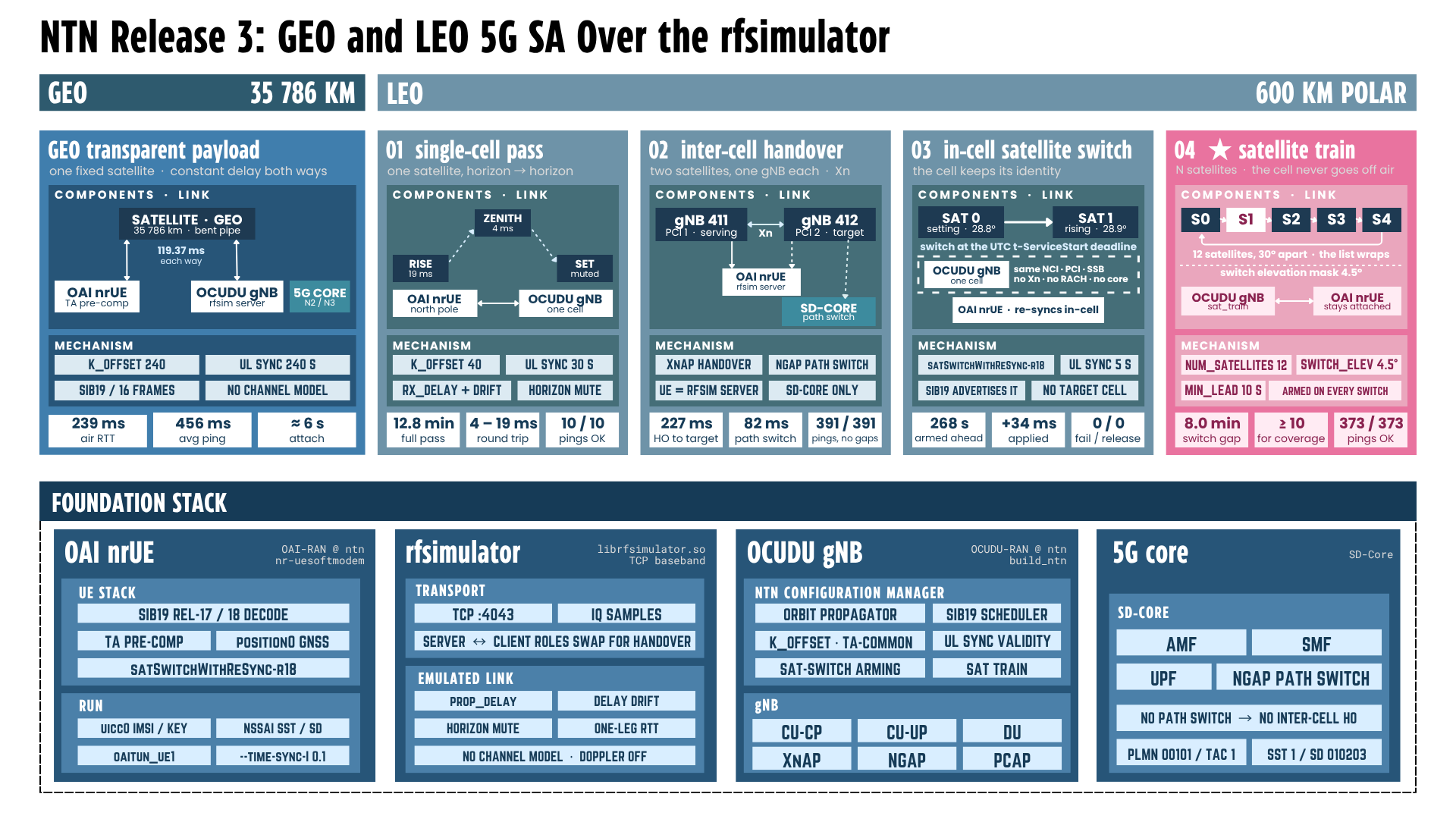
NTN Release 3, GEO and LEO 5G SA over the rfsimulator. A GEO panel on the left describes a transparent payload with one fixed satellite at 35 786 km and constant delay both ways, an OAI nrUE doing timing advance pre-compensation, an OCUDU gNB as rfsim server and a 5G core over N2 and N3, with 119.37 ms each way. Its mechanisms are K_offset 240, UL sync 240 s, SIB19 every 16 frames and no channel model, and its measured results are 239 ms air round trip, 456 ms average ping and about 6 s to attach. Four LEO panels follow for a 600 km polar orbit. Panel 01, single-cell pass: one satellite from horizon to horizon, rising at 19 ms, zenith at 4 ms and muted at setting, with mechanisms K_offset 40, UL sync 30 s, rx_delay plus drift and horizon mute, giving a 12.8 min full pass, 4 to 19 ms round trip and 10 of 10 pings. Panel 02, inter-cell handover: two satellites with one gNB each, gNB 411 on PCI 1 serving and gNB 412 on PCI 2 as target over Xn, the OAI nrUE as rfsim server and SD-Core doing the path switch, with mechanisms XnAP handover, NGAP path switch, UE as rfsim server and SD-Core only, giving 227 ms handover to target, 82 ms path switch and 391 of 391 pings with no gaps. Panel 03, in-cell satellite switch: the cell keeps its identity as SAT 0 setting at 28.8 degrees hands to SAT 1 rising at 28.8 degrees at the UTC t-ServiceStart deadline, same NCI, PCI and SSB with no Xn, no RACH and no core, the UE re-syncing in-cell, with mechanisms satSwitchWithReSync-r18, UL sync 5 s, SIB19 advertises it and no target cell, giving 268 s armed ahead, 34 ms to apply and zero failures or releases. Panel 04, satellite train: N satellites so the cell never goes off air, showing S0 through S4 with 12 satellites 30 degrees apart and a wrapping list, a 4.5 degree switch elevation mask and the OCUDU gNB keeping the OAI nrUE attached, with mechanisms num_satellites 12, switch elevation 4.5 degrees, min lead 10 s and armed on every switch, giving an 8.0 min switch gap, at least 10 satellites for coverage and 373 of 373 pings. A foundation stack band across the bottom lists the four shared components: the OAI nrUE from OAI-RAN at branch ntn with SIB19 Rel-17 and 18 decode, timing advance pre-compensation, position0 GNSS and satSwitchWithReSync-r18; the rfsimulator with TCP port 4043 transport, IQ samples, server and client roles that swap for handover, and an emulated link providing prop_delay, delay drift, horizon mute and one-leg round trip with no channel model and Doppler off; the OCUDU gNB from OCUDU-RAN at branch ntn with an NTN configuration manager covering the orbit propagator, SIB19 scheduler, K_offset and TA-common, UL sync validity, satellite switch arming and satellite train, plus CU-CP, CU-UP, DU, XnAP, NGAP and PCAP; and the 5G core, SD-Core with AMF, SMF, UPF and NGAP path switch, noting that without path switch there is no inter-cell handover, on PLMN 00101 with TAC 1 and slice SST 1 and SD 010203.
Figure 1: the NTN Release 3 testbeds. One GEO scenario and four LEO scenarios, over a shared foundation stack.

The testbeds

TestbedWhat it demonstratesHeadline result
GEO NTN Testbed (rfsim)A transparent-payload geostationary link, 35 786 km, with a constant 119.37 ms delay each way. Full 5G SA attach and user-plane traffic.239 ms air round trip, attach in ~6 s
LEO NTN Testbed (rfsim)A 600 km polar orbit across four scenarios: a single pass, an inter-cell Xn handover, a one-shot in-cell satellite switch, and a satellite train that never lets the cell go off air.227 ms handover, 373/373 pings across switches

The LEO page covers four scenarios in one document, because they share an orbit model, a configuration set and a run harness:

#ScenarioThe mechanism
1Single-cell passOne satellite, horizon to horizon, 12.8 min, with the link muted at setting
2Inter-cell handoverXnAP handover between two gNBs plus NGAP Path Switch, so the PDU session survives
3In-cell satellite switchsatSwitchWithReSync-r18: the cell keeps its NCI, PCI and SSB while the satellite behind it changes
4Satellite trainThe same switch, armed again after every switch, so the cell stays on the air indefinitely

The foundation stack

All four testbeds run on the same components: an OAI nrUE, an OCUDU gNB, the rfsimulator carrying IQ samples over a TCP socket in place of the air interface, and a 5G core (SD-Core or OAI CN5G). The base stack, without the NTN specifics, is documented in the rfsimulator Multi-UE Testbed.

What NTN adds on top is the orbit: the gNB propagates a satellite state vector, broadcasts it in SIB19, and drives the emulated channel from the same propagator, so the delay the uplink experiences is exactly the timing advance the UE derived from the broadcast.

Roadmap

The testbeds are built in stages, each adding one capability to the one before it. Satellite handover is the current release: stages A and B are shipped and documented above, and stages D and E are planned.
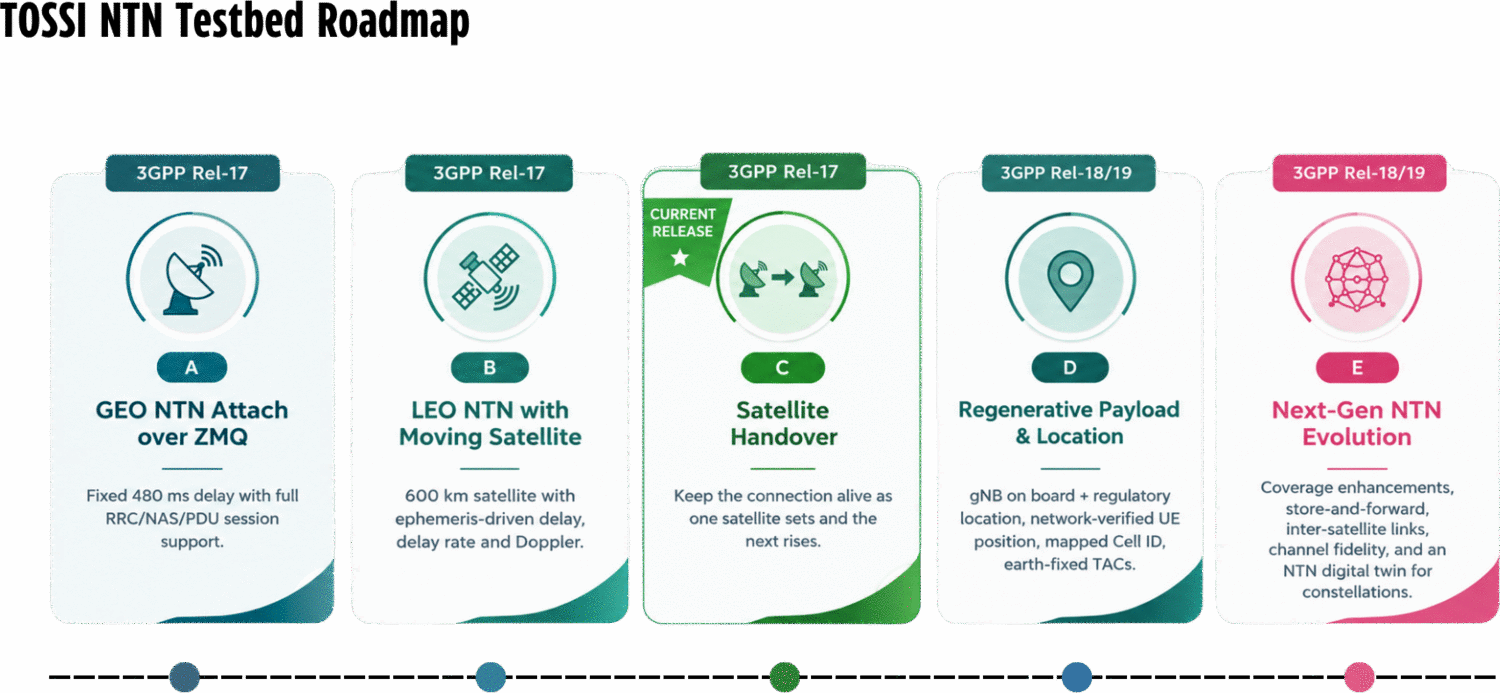
The NTN testbed roadmap as five cards. Stage A, GEO NTN attach over ZMQ, 3GPP Release 17: a fixed 480 ms delay with full RRC, NAS and PDU session support. Stage B, LEO NTN with a moving satellite, Release 17: a 600 km satellite with ephemeris-driven delay, delay rate and Doppler. Stage C, satellite handover, Release 17, marked as the current release: keep the connection alive as one satellite sets and the next rises. Stage D, regenerative payload and location, Release 18/19: gNB on board plus regulatory location, network-verified UE position, mapped Cell ID and earth-fixed TACs. Stage E, next-generation NTN evolution, Release 18/19: coverage enhancements, store-and-forward, inter-satellite links, channel fidelity, and an NTN digital twin for constellations.
Figure 2: the NTN testbed roadmap. Stage C, satellite handover, is the current release.
StageCapability3GPPStatus
AGEO NTN attach, fixed 480 ms delay with full RRC, NAS and PDU session supportRel-17Shipped
BLEO NTN with a moving satellite: ephemeris-driven delay and delay rate (service-link Doppler emulation is implemented but off by default)Rel-17Shipped
CSatellite handover: keep the connection alive as one satellite sets and the next risesRel-17Current release
DRegenerative payload and location: gNB on board, network-verified UE position, mapped Cell ID, earth-fixed TACsRel-18/19Planned
ENext-generation evolution: store-and-forward, inter-satellite links, channel fidelity, an NTN digital twinRel-18/19Planned

The earlier ZMQ testbeds

The GEO and LEO testbeds were originally built on ZMQ, with the propagation delay applied by a Python relay between the UE and the gNB. Both have been migrated to the rfsimulator, which applies the delay itself and removes the relay entirely. The original pages are kept for reference: GEO NTN Testbed (ZMQ) and LEO NTN Testbed (ZMQ).