Blog
TOSSI · JOURNAL
Blog
Announcements, release notes, and project updates from TOSSI — the open, vendor-neutral RAN integration project.
 Cloud Native Telecom Certification
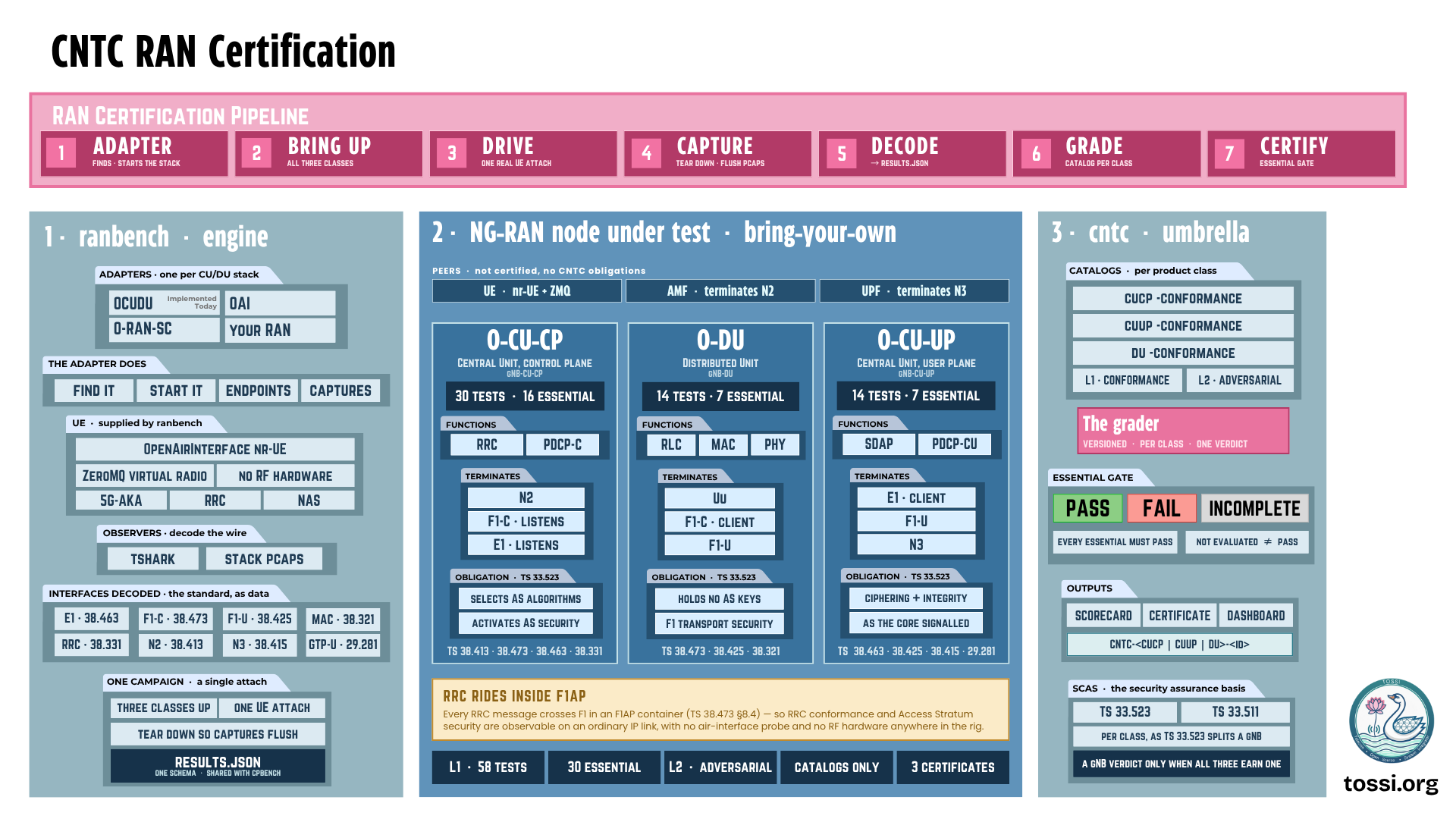
CNTC: Reproducible Certification for OCUDU 5G RAN
A gNB bringing up a cell does not prove standards compliance. CNTC RAN Certification grades a split gNB across N2, F1-C, E1, F1-U and N3 from wire evidence, on a single Linux host with no RF hardware, because every RRC message crosses F1 inside an F1AP container. Validated against a live OCUDU split gNB: the O-DU certified all 7 essential requirements, while both CU classes failed on a ciphering downgrade to the null cipher NEA0.
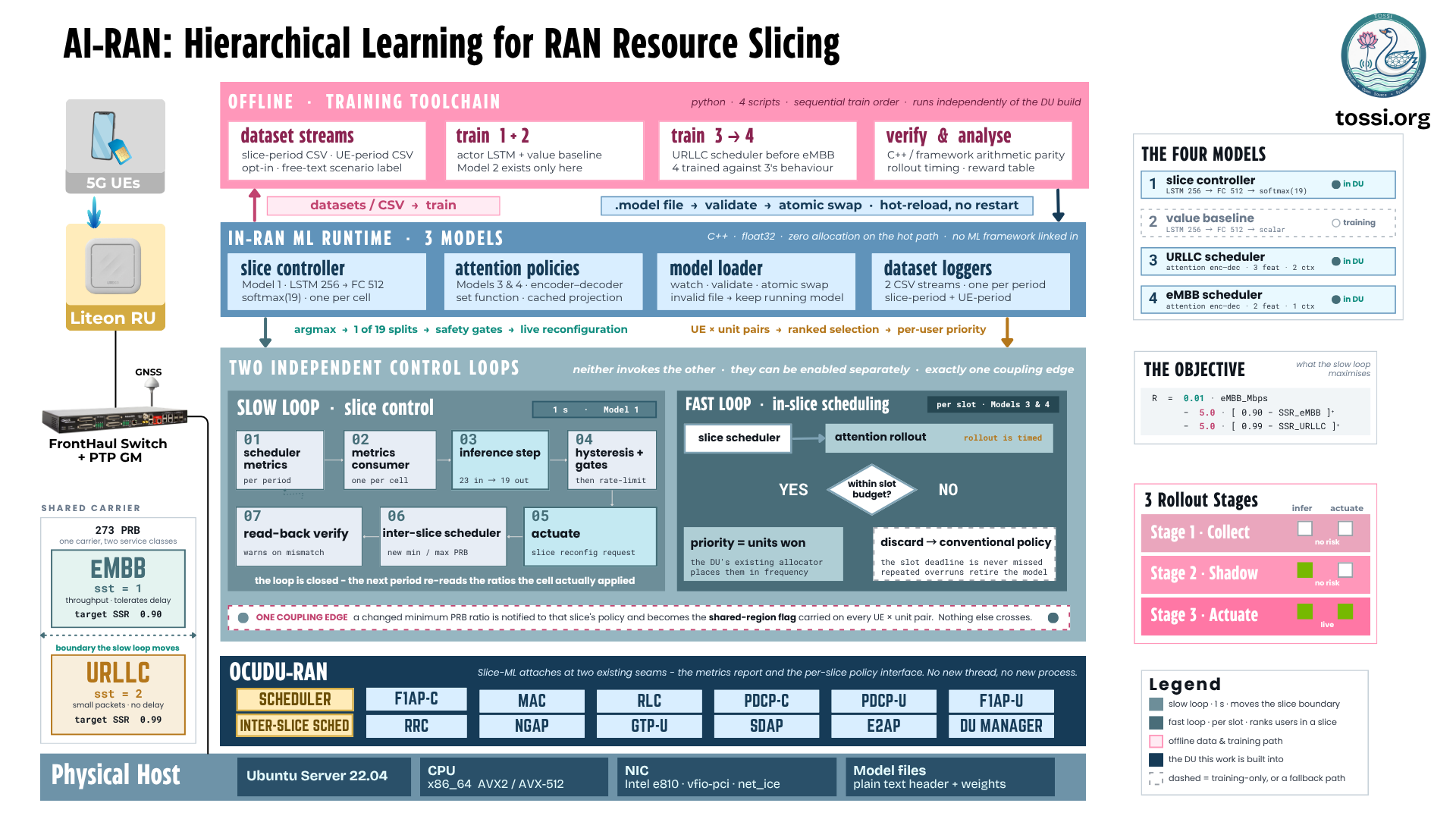 Slice-ML: Intelligent RAN Resource Slicing with Hierarchical Deep LearningThe RAN must continuously decide how much radio capacity each slice receives, and how it is shared among users inside. Slice-ML solves both at their own timescales: an LSTM controller moves the PRB boundary between eMBB and URLLC once per second, while per-slot attention schedulers rank users within each slice. Running in the OCUDU-RAN DU with no ML framework linked in, it lifted URLLC SLA satisfaction 62% and cut backlog 15%.Read more →
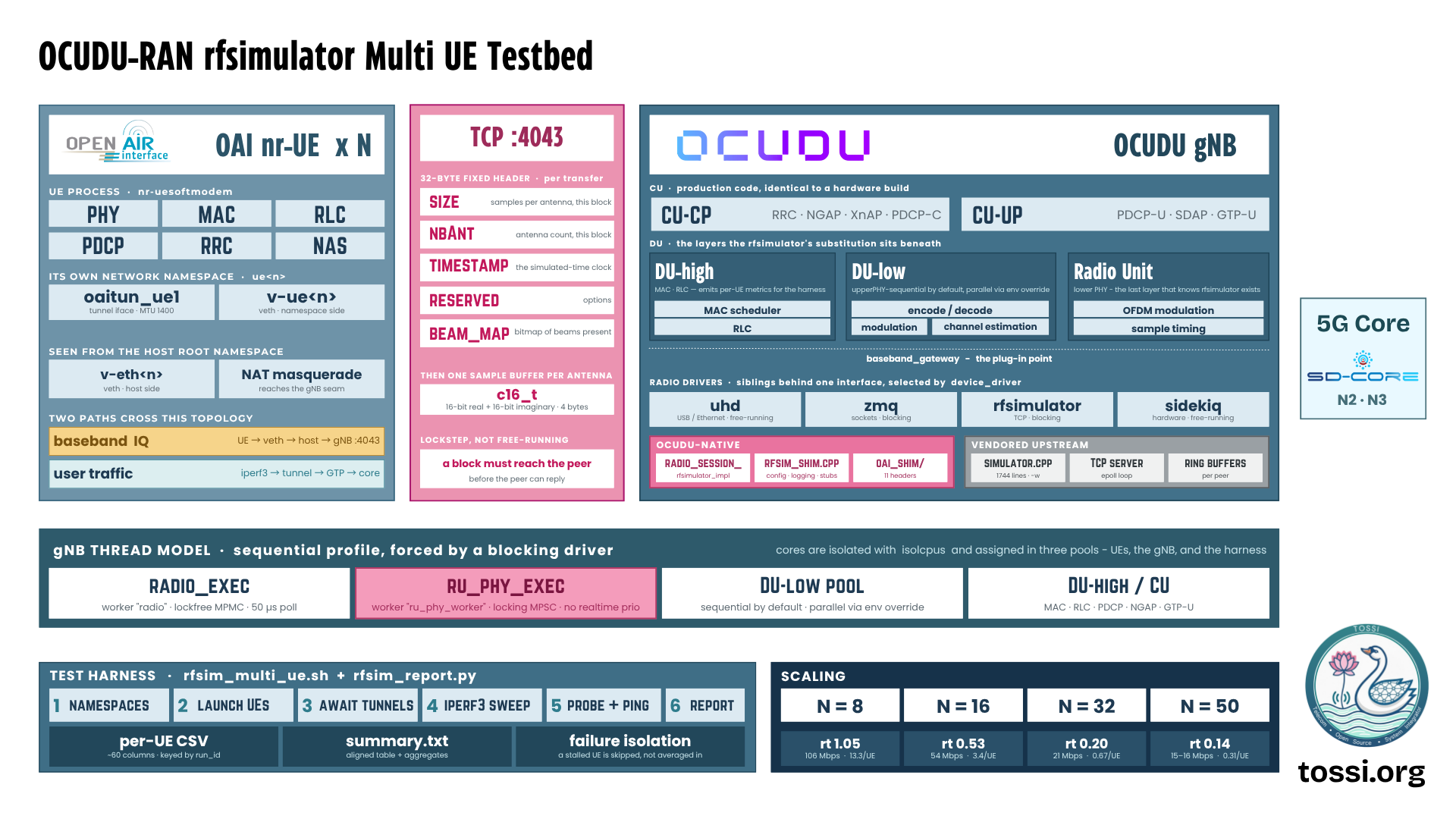 OCUDU-RAN rfsimulator: A Scalable Multi-UE Foundation for AI-RAN and 6GRealistic AI-RAN research needs many UEs competing for the same radio resources, not a handful of software UEs on a bench. The OAI rfsimulator is now a native OCUDU-RAN radio driver alongside UHD, ZeroMQ and Sidekiq, validated with 50 concurrent UEs on one gNB and one machine. Multi-user behaviour moves into the radio simulation path itself, and optimisation lifted 8-UE downlink throughput from 67.05 to 106.25 Mbps.Read more →CNTC: Reproducible Certification for OCUDU 5G RANA gNB bringing up a cell does not prove standards compliance. CNTC RAN Certification grades a split gNB across N2, F1-C, E1, F1-U and N3 from wire evidence, on a single Linux host with no RF hardware, because every RRC message crosses F1 inside an F1AP container. Validated against a live OCUDU split gNB: the O-DU certified all 7 essential requirements, while both CU classes failed on a ciphering downgrade to the null cipher NEA0.Read more →
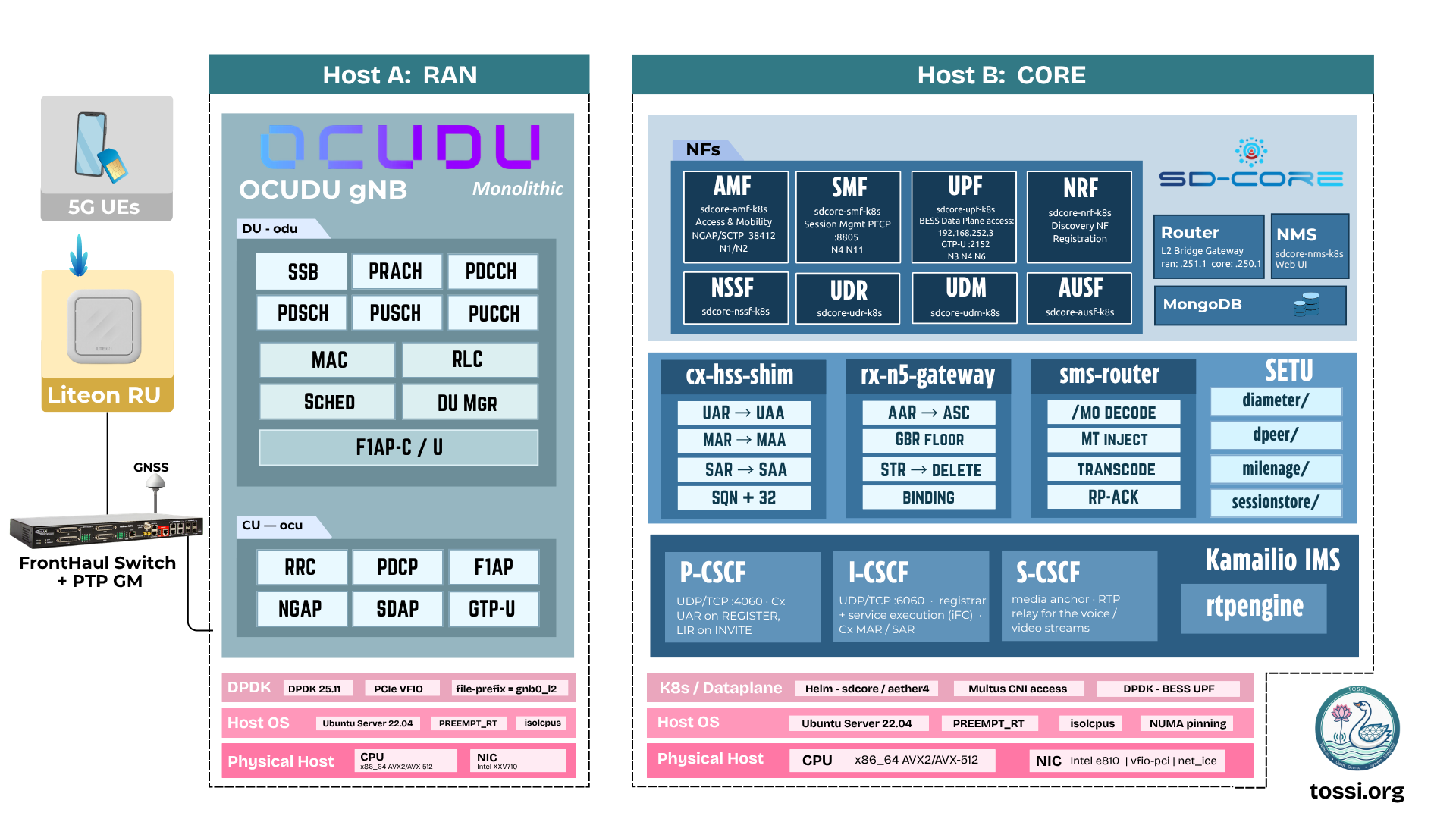 SD-Core with IMS: Voice, Video and Messaging through Kamailio and SETUAn open 5G core and an open IMS cannot make a phone call between them: the IMS asks for subscriber keys and bandwidth over Diameter, and a 5G core answers the same questions over HTTP/2 service APIs. SETU bridges that gap, presenting Kamailio with the HSS and policy server it expects while answering from SD-Core itself. The result is voice, video and messaging on commercial handsets over a real 5G SA radio, with no HSS, no policy server and no SMS centre in the deployment.Read more →
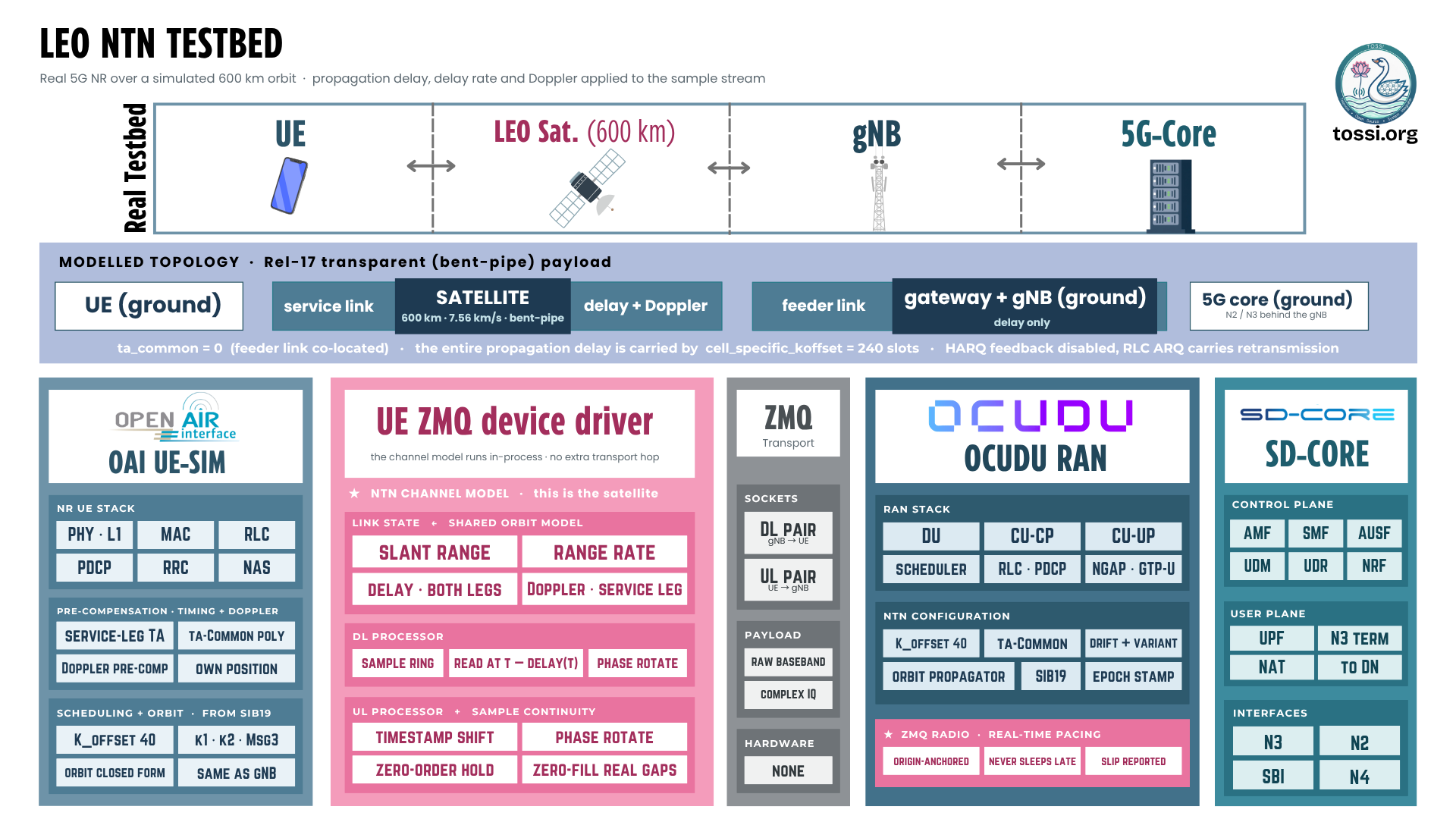 NTN Testbed Release B: LEO NTN, a 5G Connection Through a Moving SatelliteRelease A established the foundation: a complete 5G Standalone network operating over a simulated geostationary satellite link on a single machine, without radio hardware or satellite capacity. Release B changes the problem. The satellite now moves.Read more →
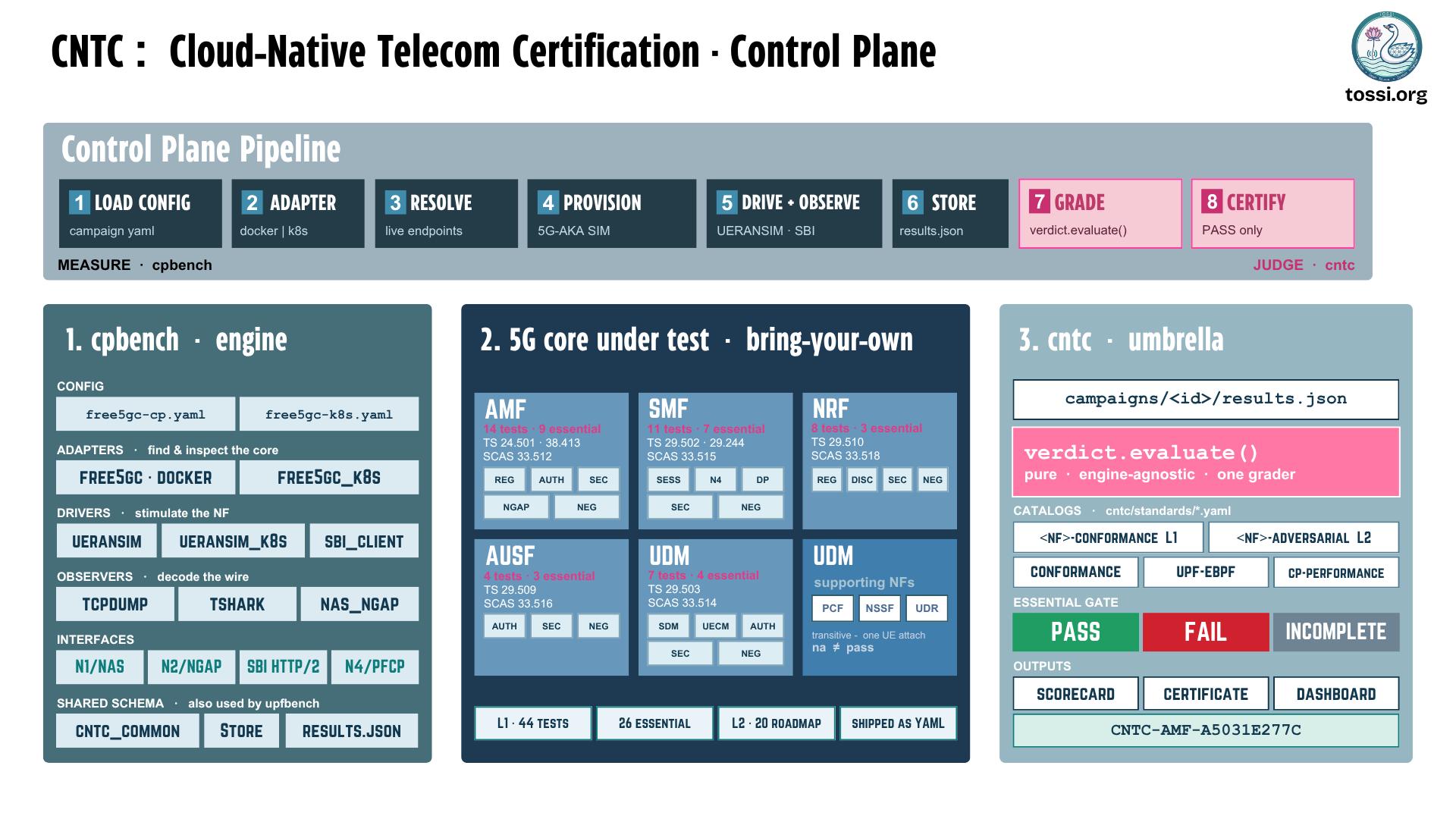 Extending CNTC: Turning 3GPP and SCAS Requirements into Reproducible 5G Core Control-Plane CertificationCNTC extends Cloud Native Telecom Certification to the 5G core control plane: 44 automated tests across AMF, SMF, NRF, AUSF and UDM, each mapped to a 3GPP protocol and SCAS security spec, driven over real N1/N2, N4 and SBI interfaces and graded into a PASS, FAIL or INCOMPLETE verdict per network function. Validated live against free5GC on Docker and Kubernetes.Read more →
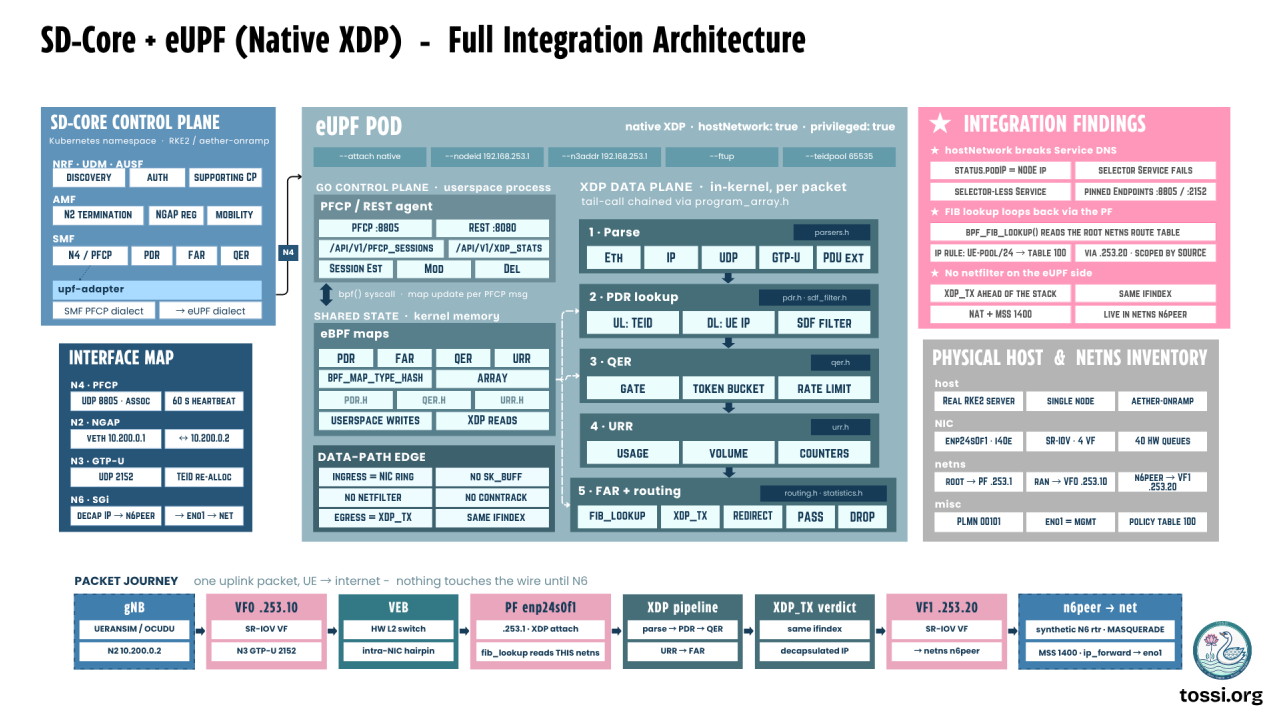 eUPF with SD-Core: PFCP Subscriber Metering and In-Kernel Quota EnforcementA high-performance 5G User Plane Function must do more than forward packets. We integrated Aether SD-Core with eUPF, an eBPF/XDP user plane, and completed PFCP Usage Reporting Rule support end to end: the SMF configures a subscriber data limit over PFCP, and eUPF measures traffic and enforces the quota inside the Linux kernel's XDP fast path — validated live with a 900 MiB threshold and a 1 GiB hard quota across multiple independent subscribers.Read more →
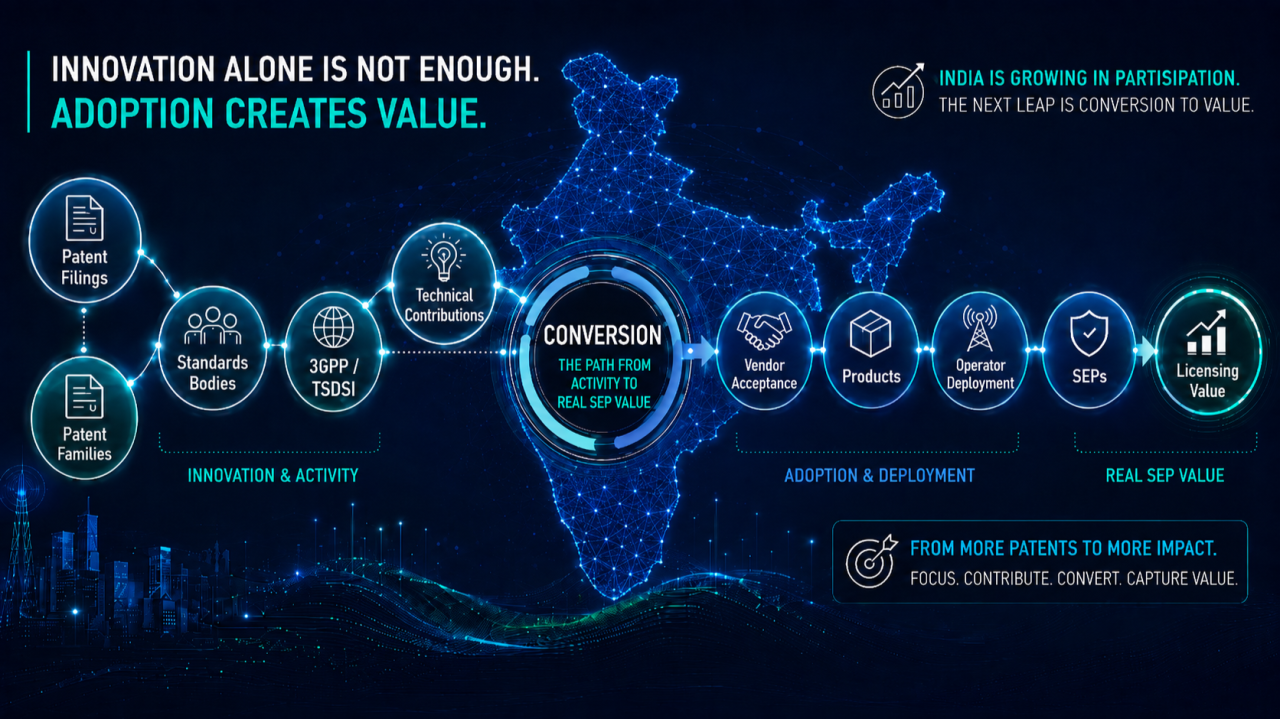 India's 7,700 5G/6G Patent Filings: Big Numbers, Bigger Questions, and the Road to Real SEP ValueThe Bharat 6G Alliance reports 7,700+ 5G/6G patent filings, 1,787 Indian 3GPP participants and 2,943 technical contributions in 2025. These are real signs of a growing ecosystem, but a patent filing is not a granted patent, and a declared SEP is not a verified one. A preliminary claim-1 review of 17 TSDSI-declared Indian publications found 4 materially mapped, 3 partial, 8 directed to alternative solutions and 2 not relevant. The gap is not intent. It is conversion.Read more →
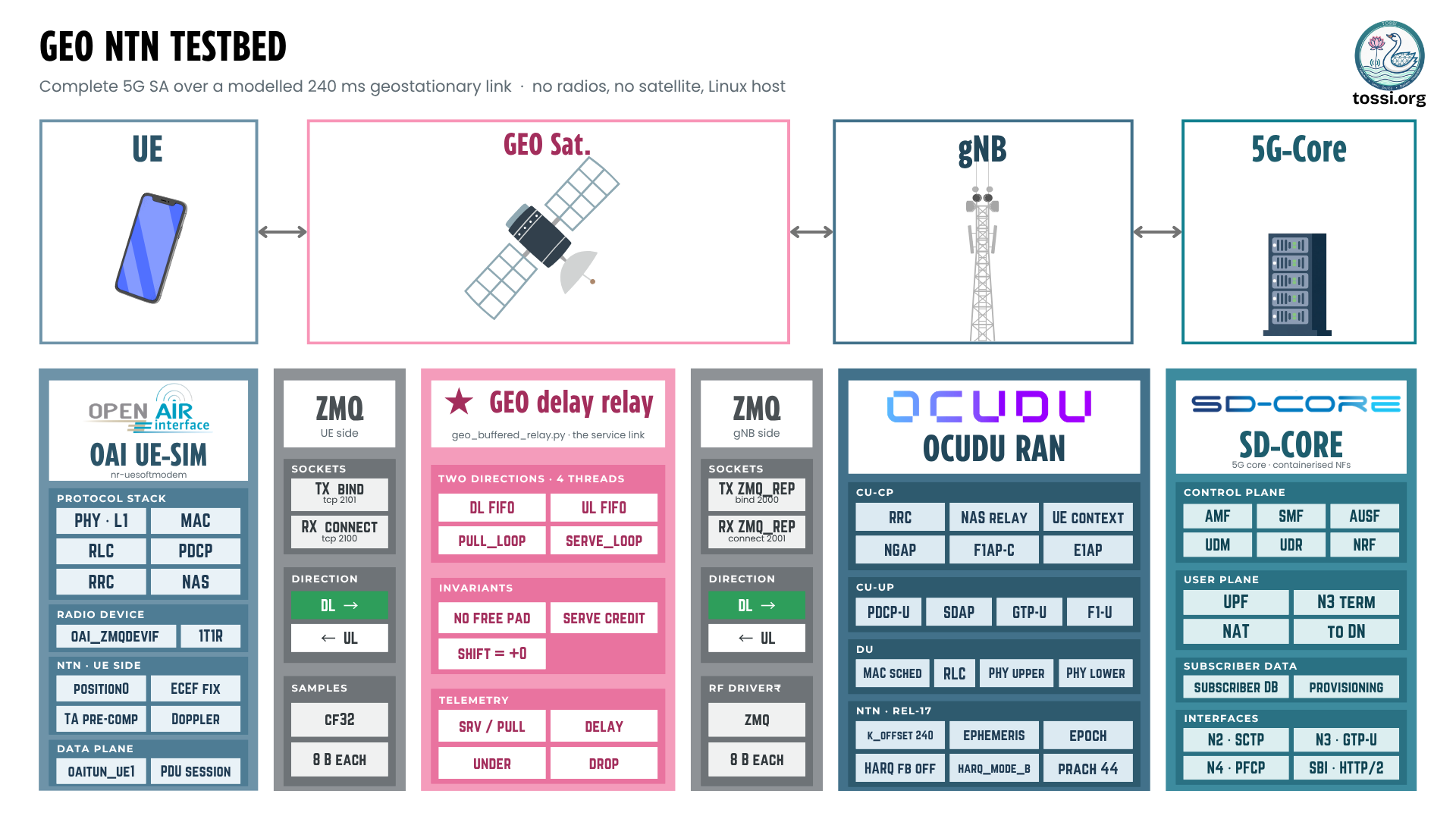 NTN E2E Testbed Release: GEO NTN with OCUDU RAN and OAI UE SimulatorValidating NTN behaviour has traditionally required satellite capacity, RF equipment or specialised channel emulators. This release is an end-to-end GEO NTN testbed that runs a complete 5G Standalone network over a simulated geostationary satellite link, on a single machine, with no radio hardware and no satellite: OCUDU RAN with 3GPP Release 17 NTN, an OAI UE Simulator over ZMQ, a sample-exact GEO delay relay, and a 5G core, under a genuine 240 ms round trip.Read more →
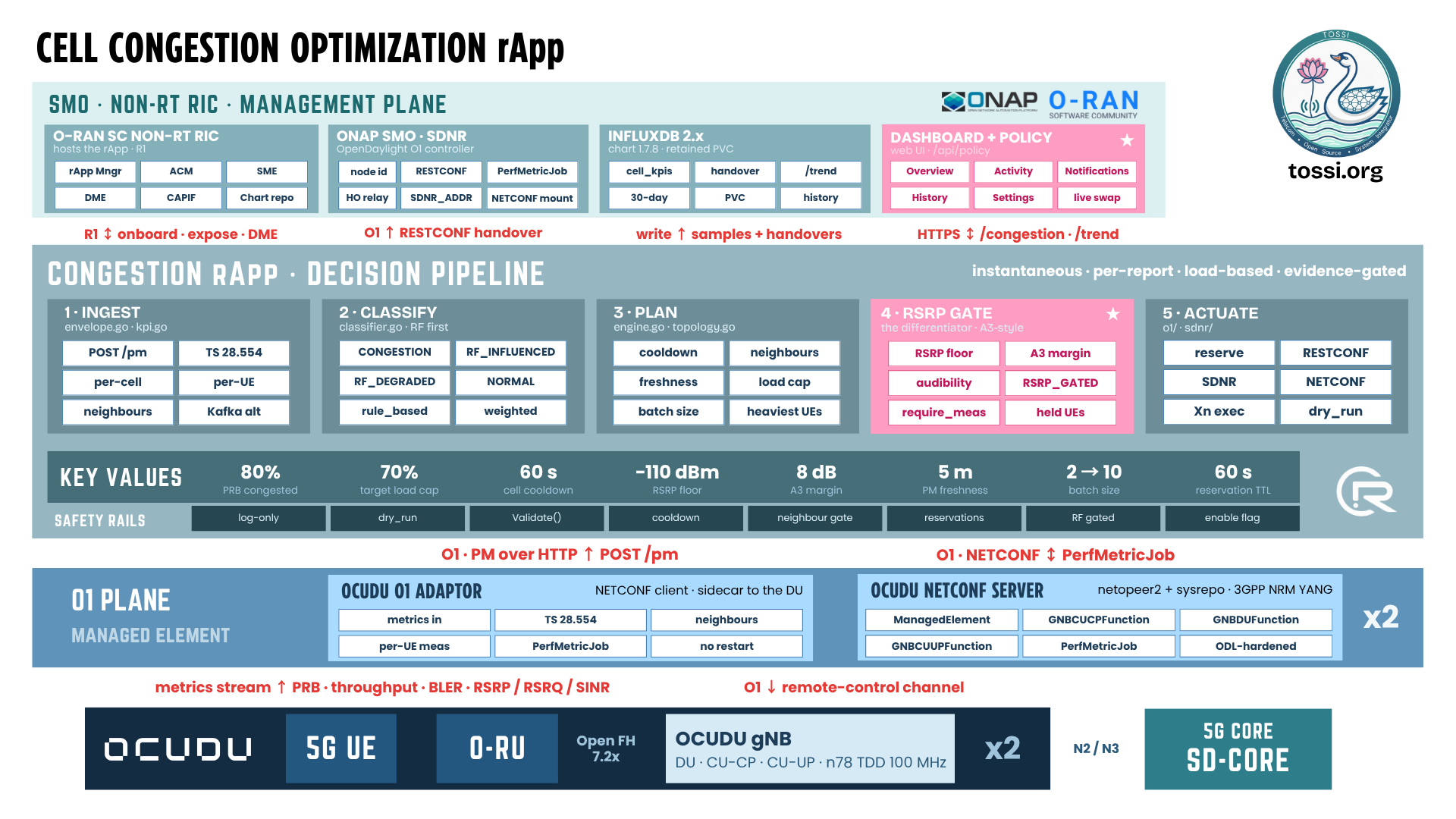 OCUDU Closed-Loop rApp for Cell Congestion OptimizationThe real test of Open RAN is whether a live RAN, an SMO, a Non-RT RIC and an rApp can complete an end-to-end control loop through standardized O-RAN interfaces. Using the OCUDU RAN ecosystem and the coRAN LABS Cell Congestion Optimization rApp, this demonstration closes that loop: detect PRB congestion from O1 telemetry, verify a signal-audible neighbour, and relieve the cell with a management-driven inter-gNB handover.Read more →
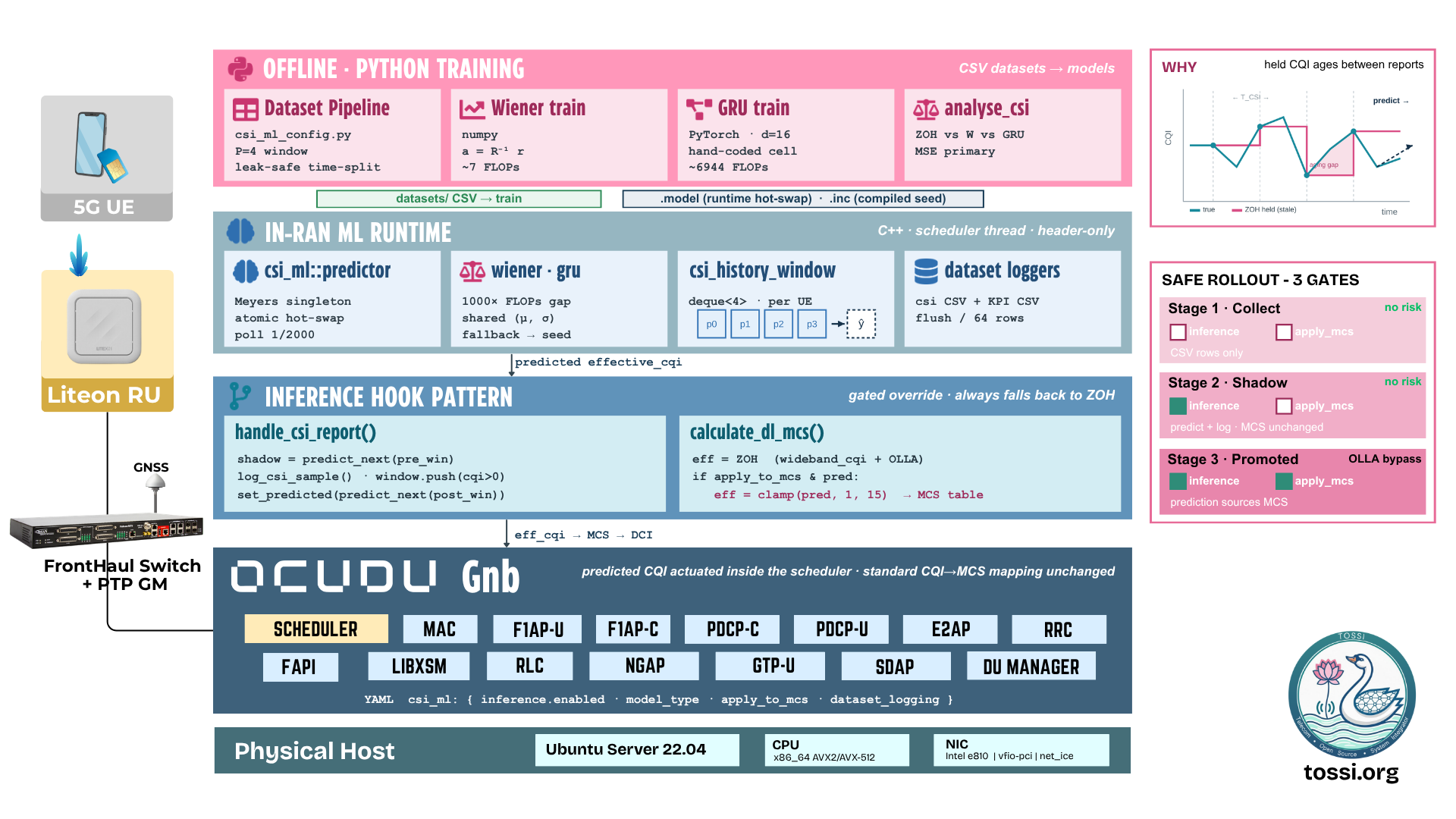 ML-Based CSI Prediction for Intelligent 5G SchedulingA 5G scheduler is only as effective as the channel information available when it makes a decision, and for downlink that information is often already stale. ML-based CSI prediction replaces the conventional hold-last-CQI assumption with a per-UE forecast of the next report, so the scheduler can act on where the channel is heading, not only where it was last measured. Two prediction engines, one framework, built on the OCUDU AI-RAN foundation.Read more →
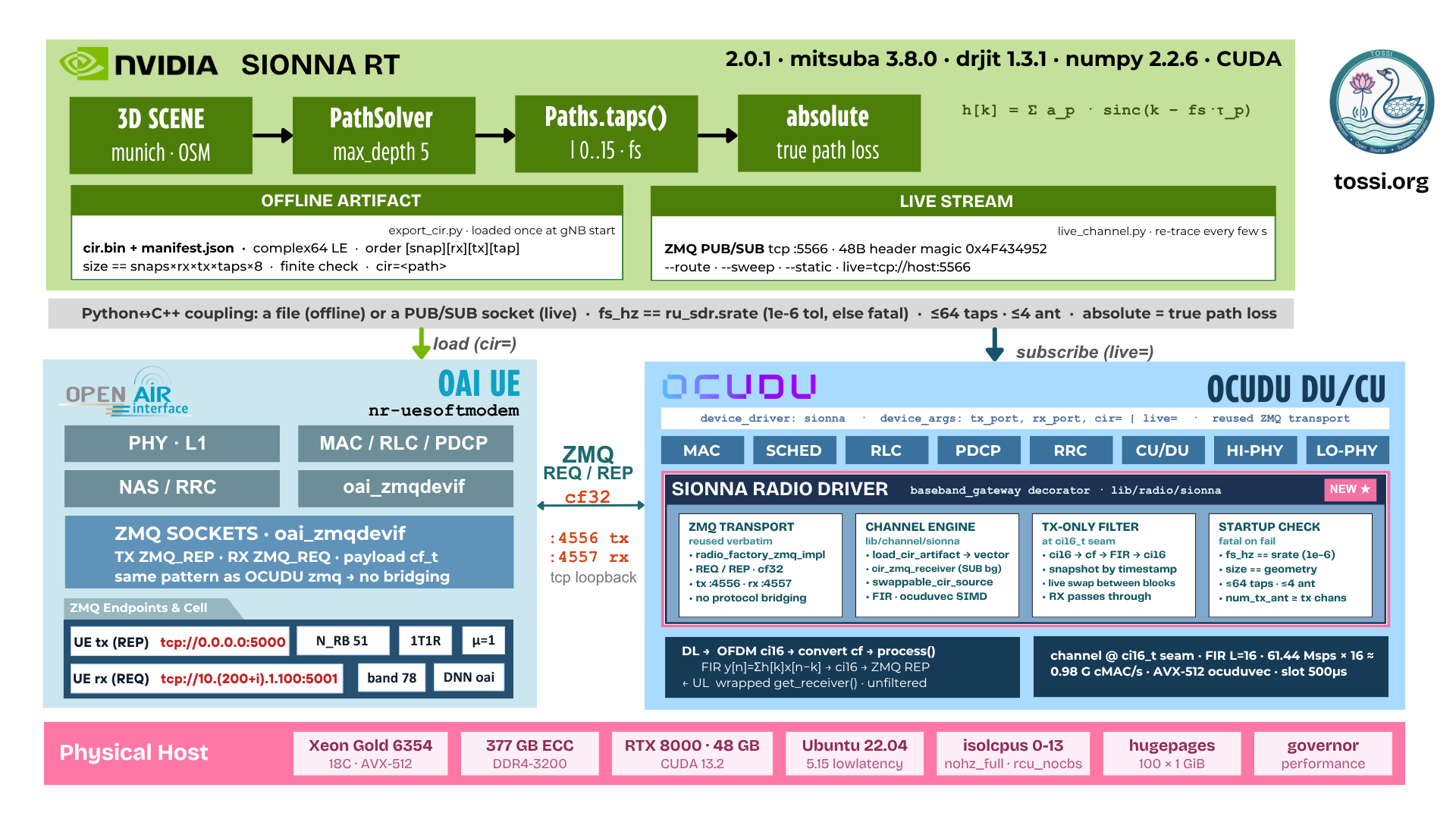 NVIDIA Sionna RT Integration in OCUDU: Deterministic Digital Twins for 6G and AI-RANStatistical channel models represent an average radio environment; they cannot reproduce the multipath signature of a specific site. Integrating NVIDIA Sionna RT with OCUDU RAN connects a 3D digital representation of the physical world to a live cellular stack, streaming deterministic ray-traced channels into a running RAN without a restart, a foundation for site-specific AI-RAN and 6G digital twins.Read more →
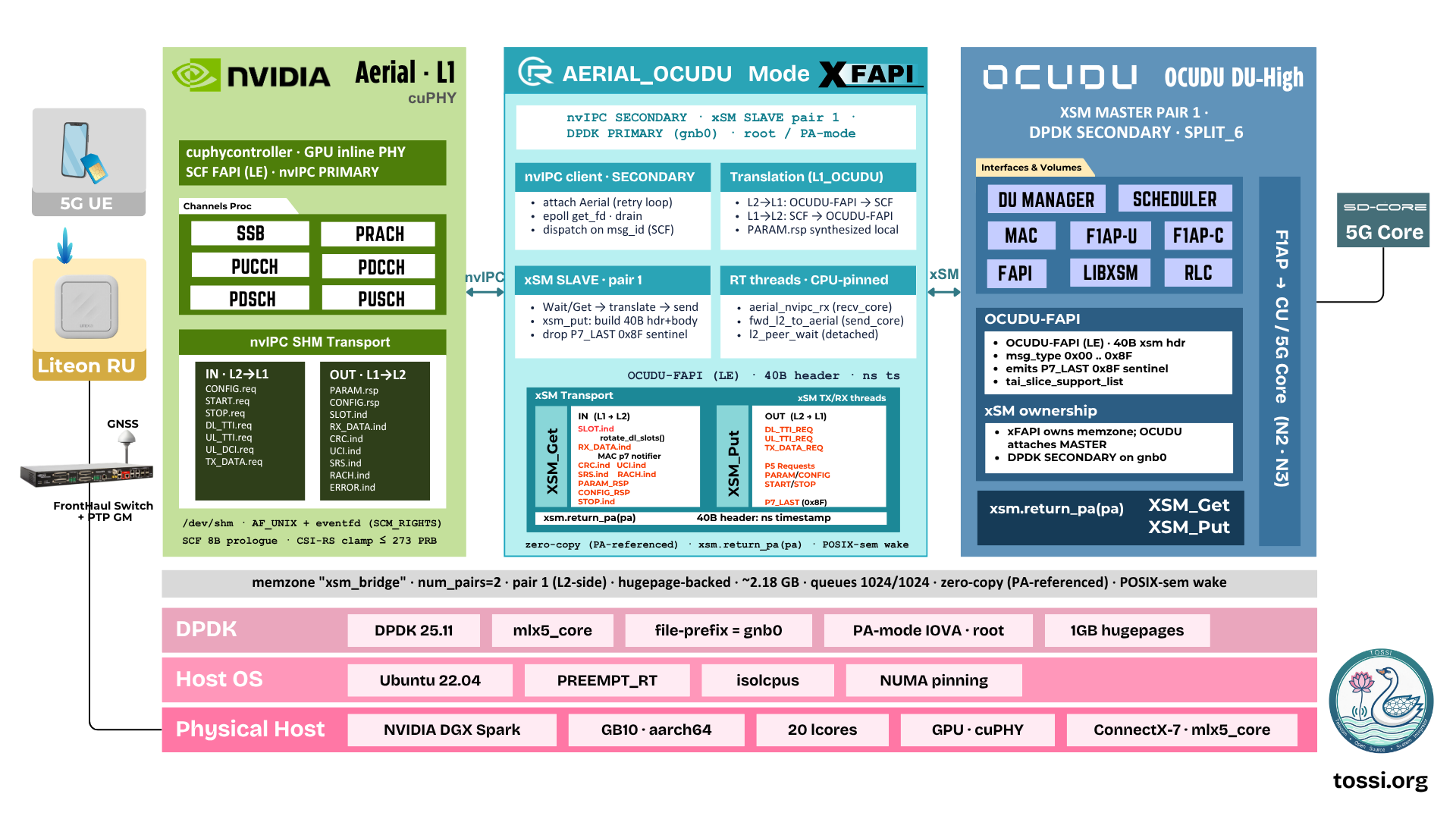 NVIDIA Aerial, OCUDU, and xFAPI: Building the Future of Open AI-RANMost AI-RAN discussions begin with computing power. The harder question is how much engineering effort it takes to make independently developed RAN components work together. The NVIDIA Aerial, OCUDU, and Duranta integrations through coRAN LABS xFAPI show a different way to design the Layer 1 to Layer 2 boundary, and reframe openness as replaceability.Read more →
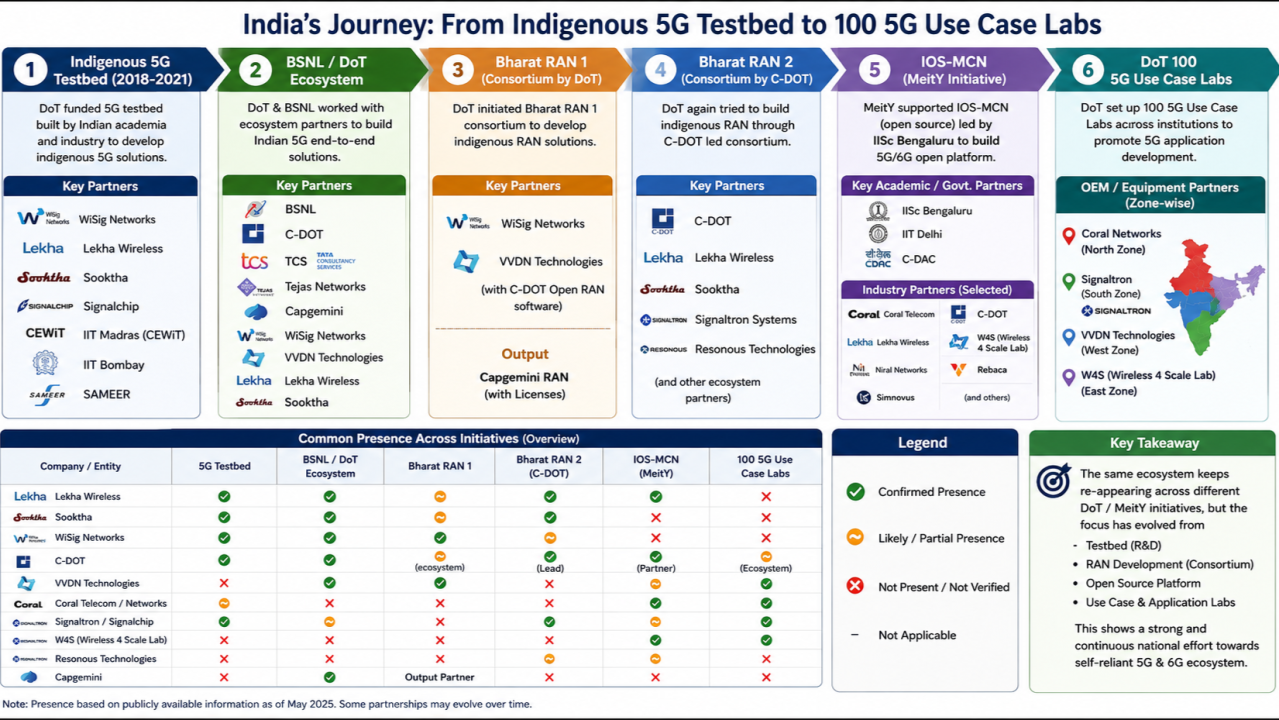 India's 5G Decade: Big Intent, Repeated Initiatives, and the Road to 6G OutcomesIndia's 5G journey from 2018 to 2026 moved through the Indigenous 5G Testbed, the BSNL/DoT ecosystem push, Bharat RAN 1 and 2, IOS-MCN, and 100 5G Use Case Labs, plus the 5Gi standards contribution. The intent and capability are real; the open question for 6G is conversion, turning testbeds, consortiums, and declared patents into deployed, operator-demanded products.Read more →
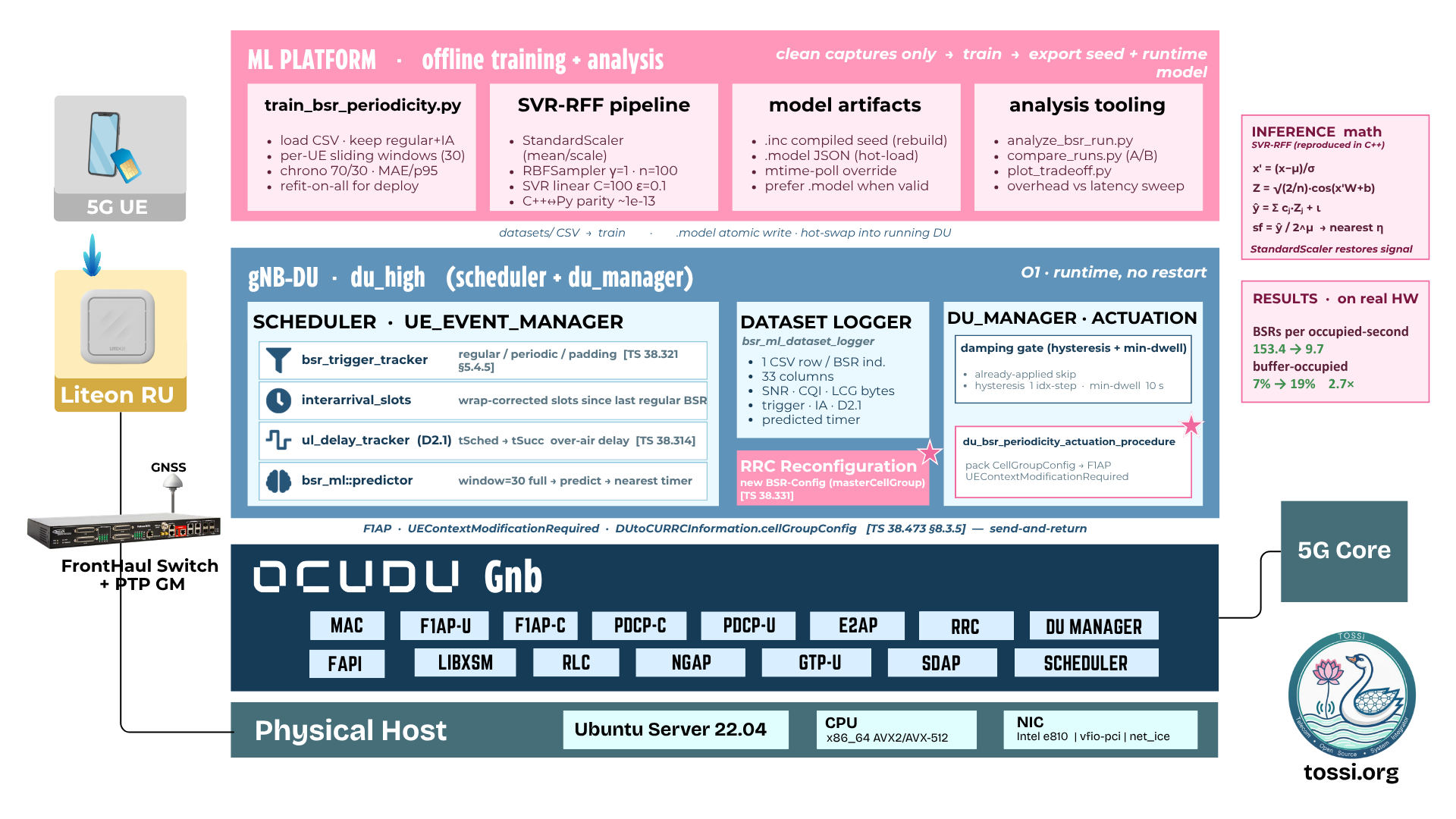 OCUDU AI-RAN: Building an Open Framework for Per-UE IntelligenceOCUDU AI-RAN brings intelligence natively into the Open RAN stack: data collection, model training, runtime inference, and standards-based deployment as reusable capabilities. The first application is adaptive per-UE Buffer Status Report (BSR) configuration, where the DU scheduler learns each UE's uplink traffic and tunes the periodicBSR-Timer over standard F1AP and RRC.Read more →
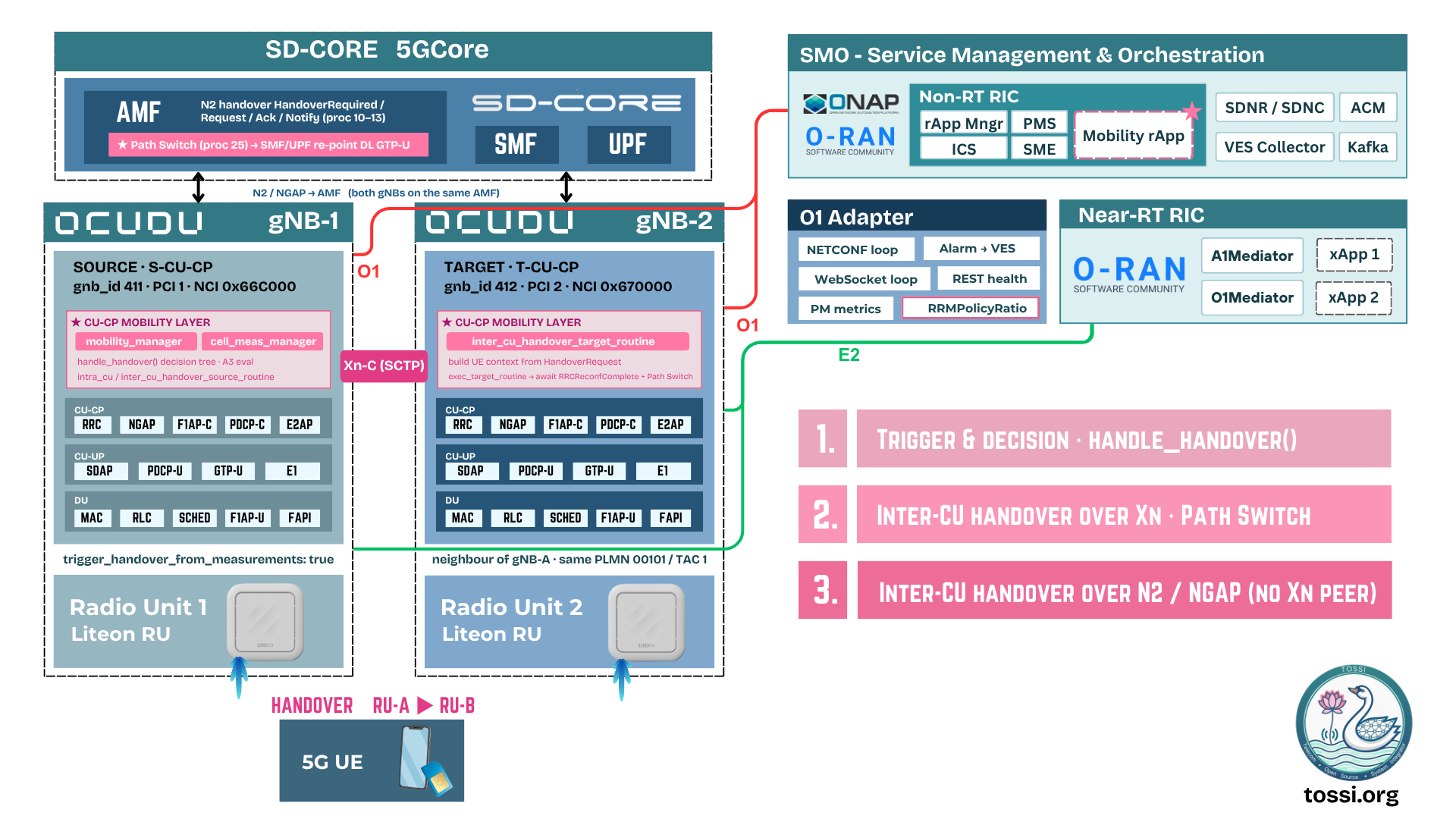 OCUDU RAN Advances Open RAN Mobility with Standards-Based Inter-gNB Handover and O-RAN O1 IntegrationTOSSI demonstrates standards-based inter-gNB handover and O-RAN O1 integration in a real Open RAN deployment built with OCUDU RAN, SD-Core, LiteON Radio Units, and commercial UEs. It validates both network-triggered and Event A3 measurement-based mobility, and exposes handover events and RSRP/RSRQ/SINR telemetry over O1 for xApps, rApps, and AI-RAN.Read more →
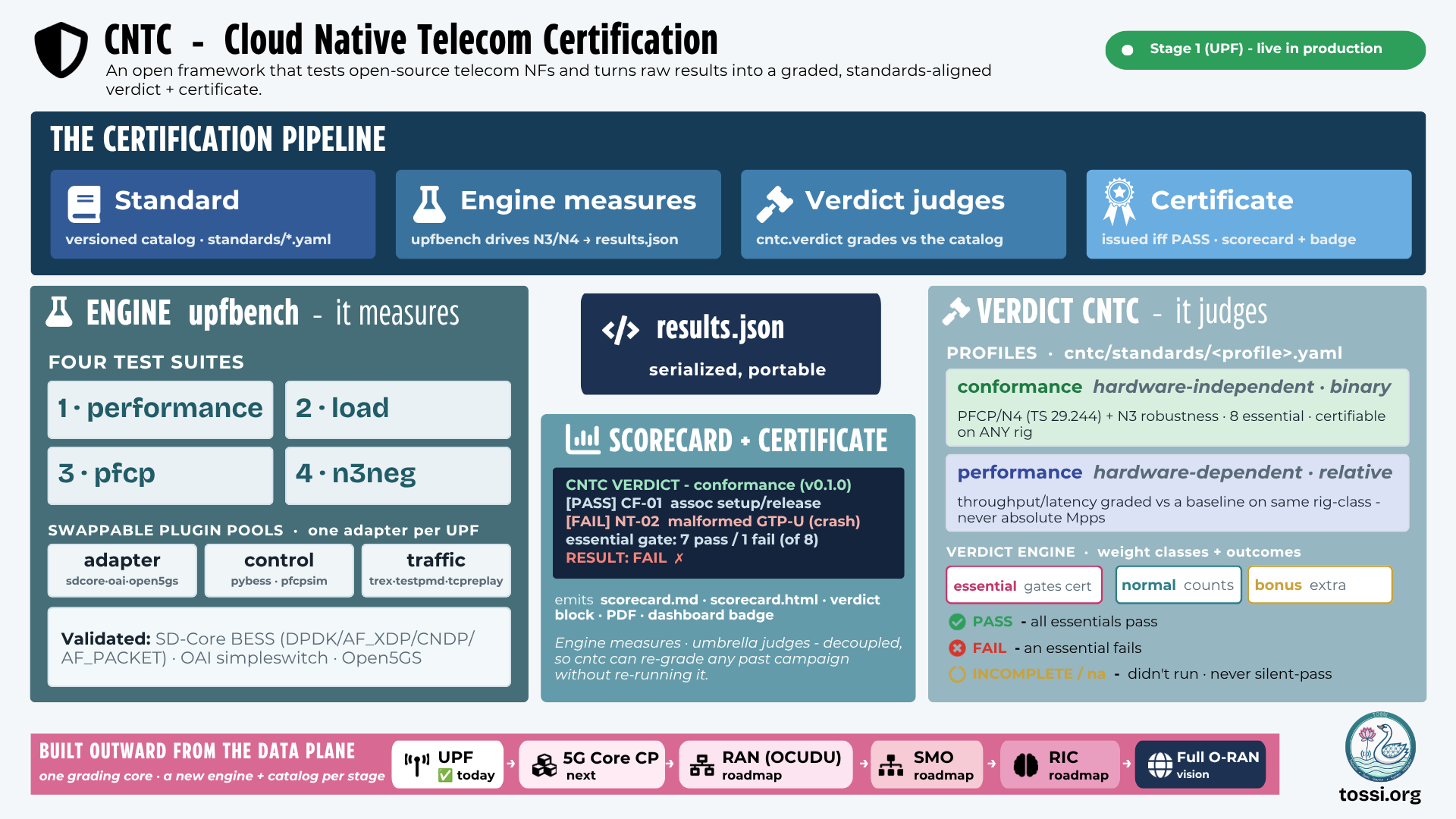 CNTC: Building Trust in Open Telecom, Beginning with 5G User Plane CertificationThe TOSSI Foundation introduces Cloud Native Telecom Certification (CNTC), an open, standards-driven certification framework for cloud-native telecom software. It begins with the UPF Certification Module: PFCP conformance, N3 robustness, performance, and load, graded by a Verdict Engine that issues a certificate only on a strict essential-test pass.Read more →
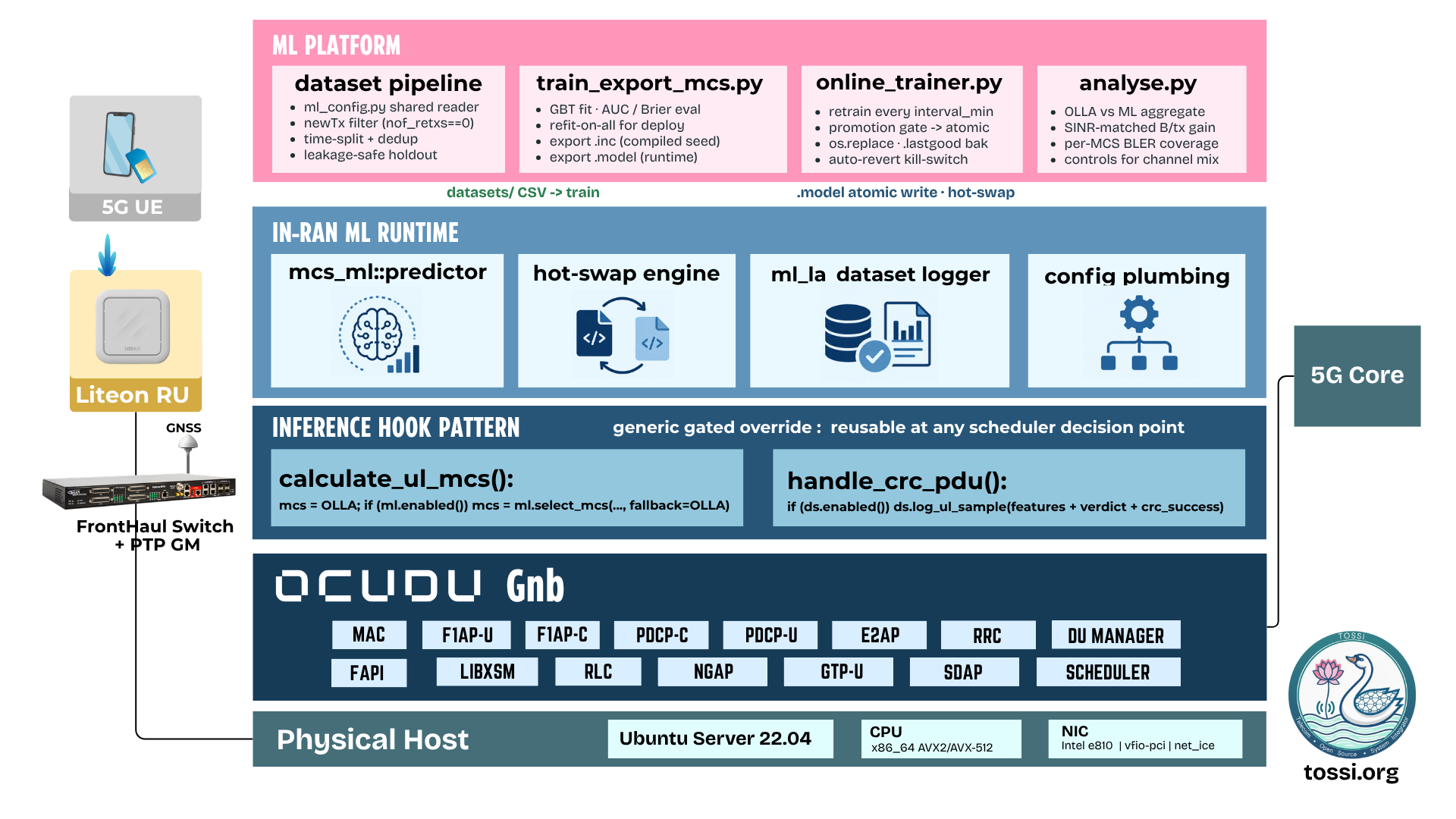 OCUDU AI-RAN Release 1: An Open Framework for Intelligent Link AdaptationAn open, end-to-end AI-RAN framework: live data collection, dataset generation, training, runtime inference in the DU scheduler, online learning, and OLLA fallback. The first application is ML-based uplink link adaptation, built on 900k+ real over-the-air transmissions.Read more →
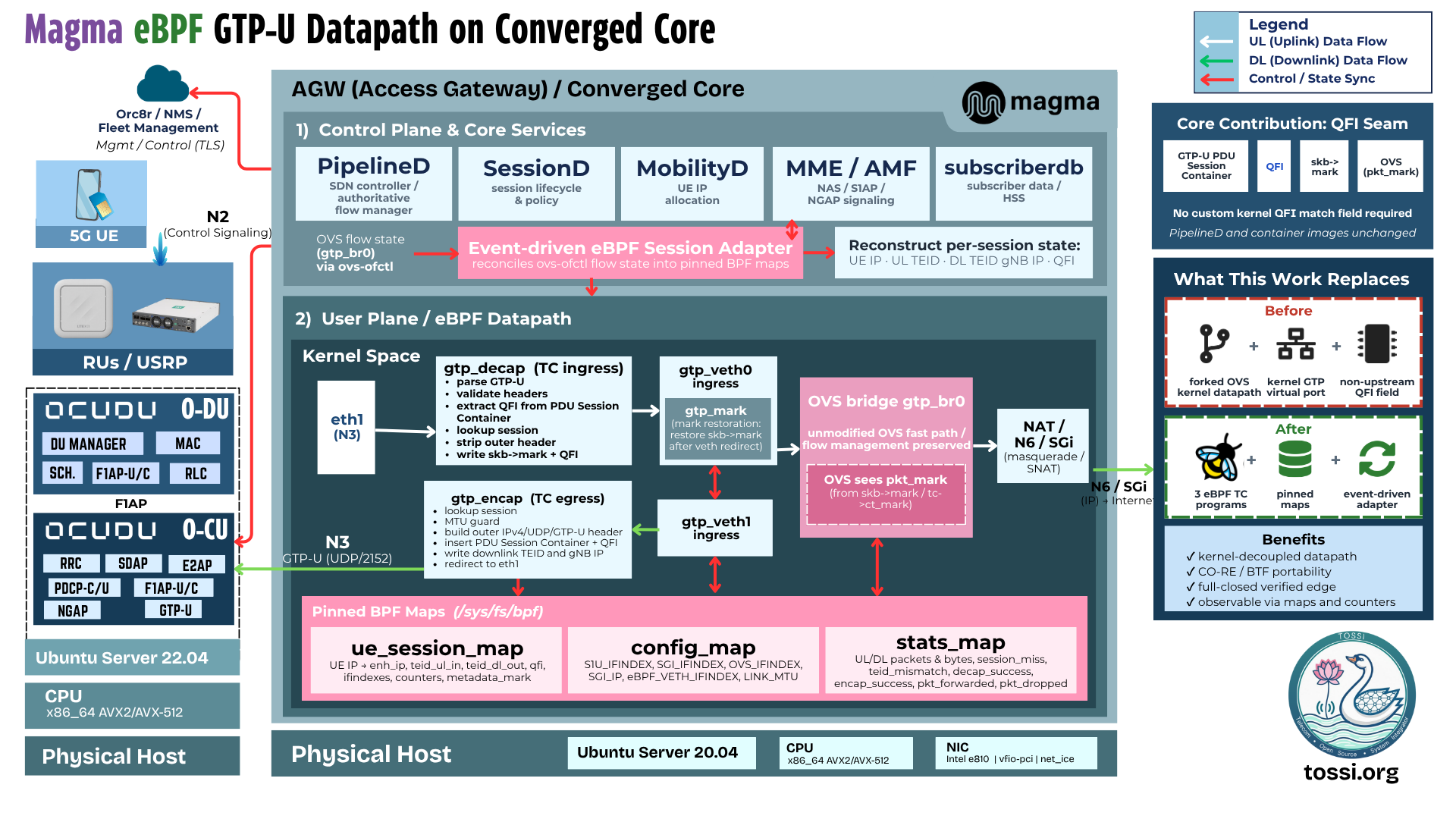 From Kernel-Locked to Cloud-Native: Rebuilding Magma's 5G User Plane with eBPFMoving GTP-U processing into three compact eBPF programs makes the Magma 5G Core user plane portable across Linux kernels, with Open vSwitch left completely unmodified and the control plane untouched.Read more →
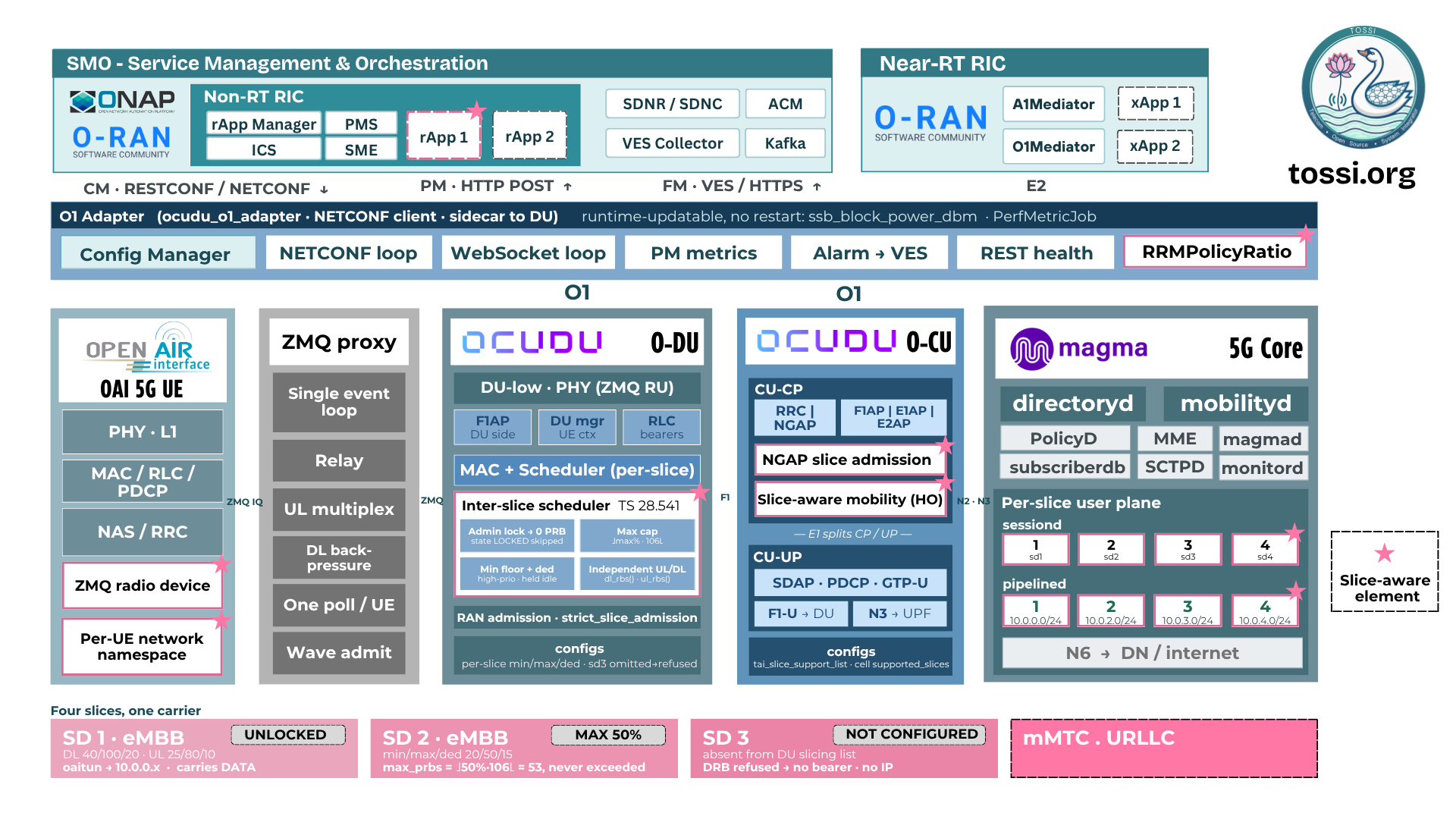 Building an End-to-End Open Network Slicing Ecosystem with OCUDUThe latest TOSSI release delivers a complete open-source network slicing platform: multi-UE orchestration, slice-aware OCUDU scheduling, Magma Core integration, O1-based live configuration, and an rApp development environment, all unified into a single ecosystem.Read more →
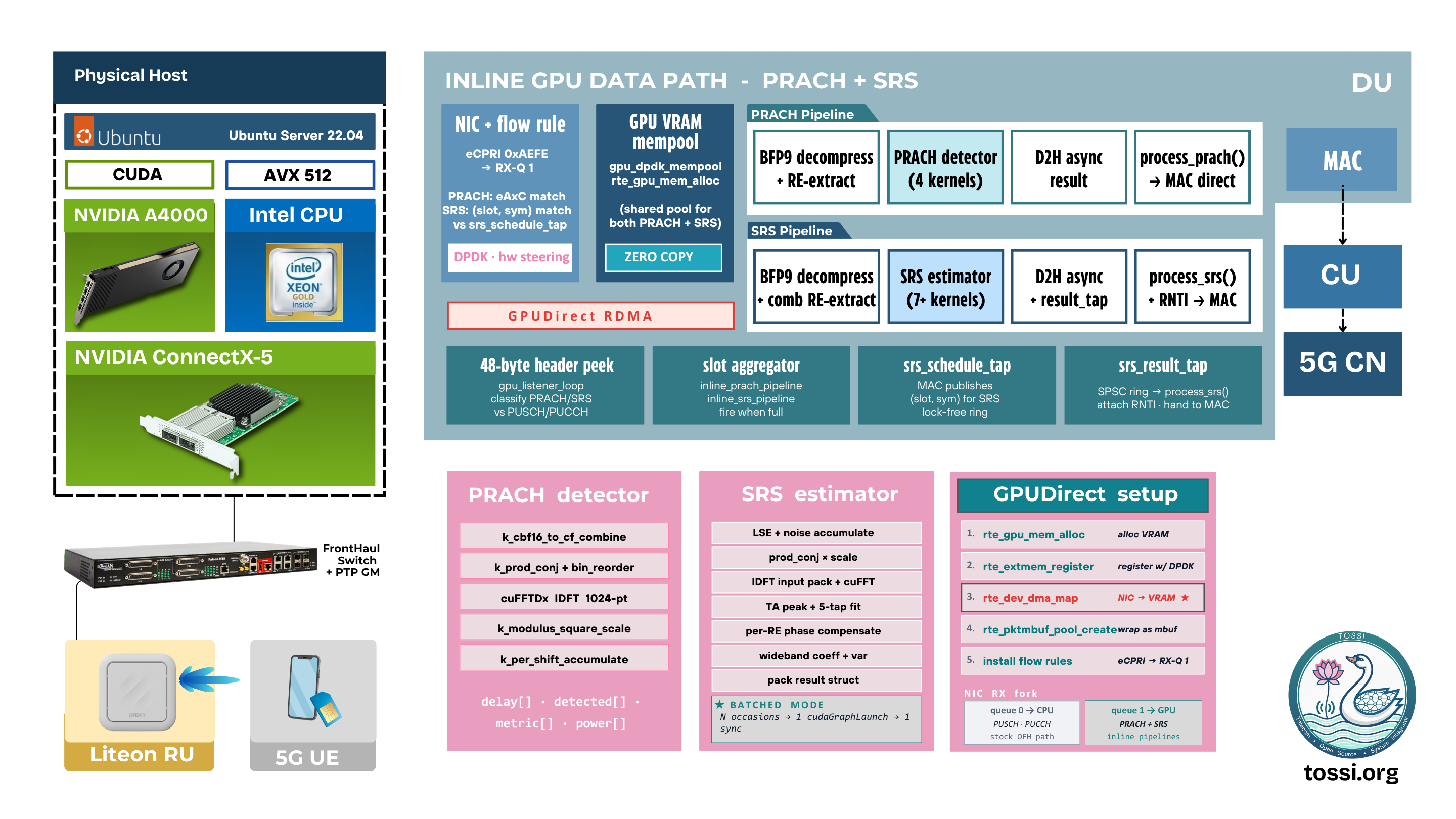 Building the AI-RAN Data Path in OCUDU: Inline GPU Processing for PRACH and SRSNVIDIA GPUDirect RDMA delivers fronthaul packets directly into GPU memory, with no host copies and no PCIe bottleneck. PRACH detection latency drops 70%, SRS achieves 20× acceleration at 256 UEs, all on a workstation-class RTX A4000.Read more →
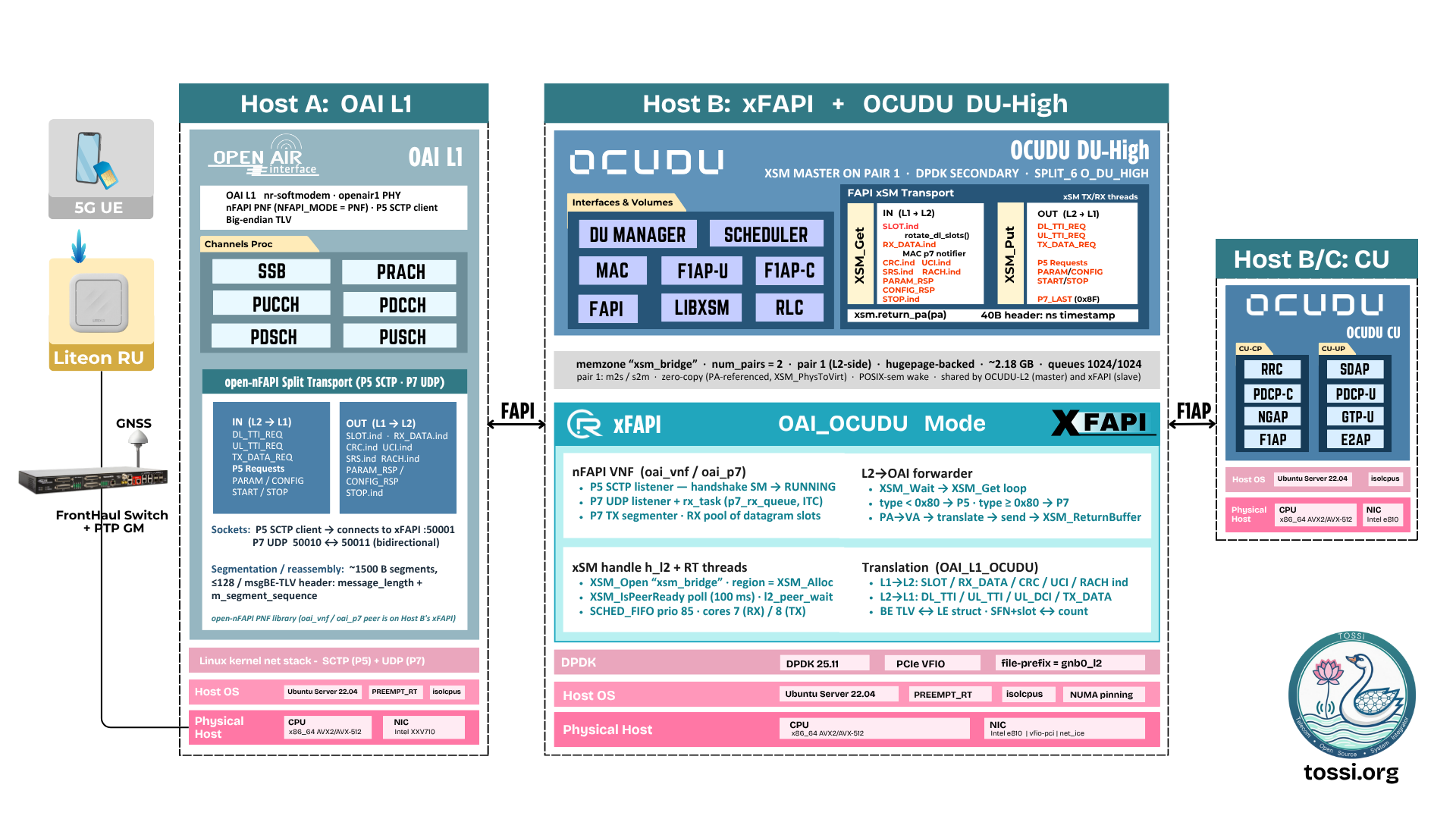 Bridging Open RAN Ecosystems: Integrating OAI Layer 1 with OCUDU Layer 2 Using xFAPIOAI Layer 1 (v2.4) and OCUDU Layer 2 (v26.04) interoperate through xFAPI Release 2.2 with no source changes to either project. All the integration logic lives inside xFAPI, validating Open RAN's core promise: independently developed components working together while preserving their native implementations.Read more →
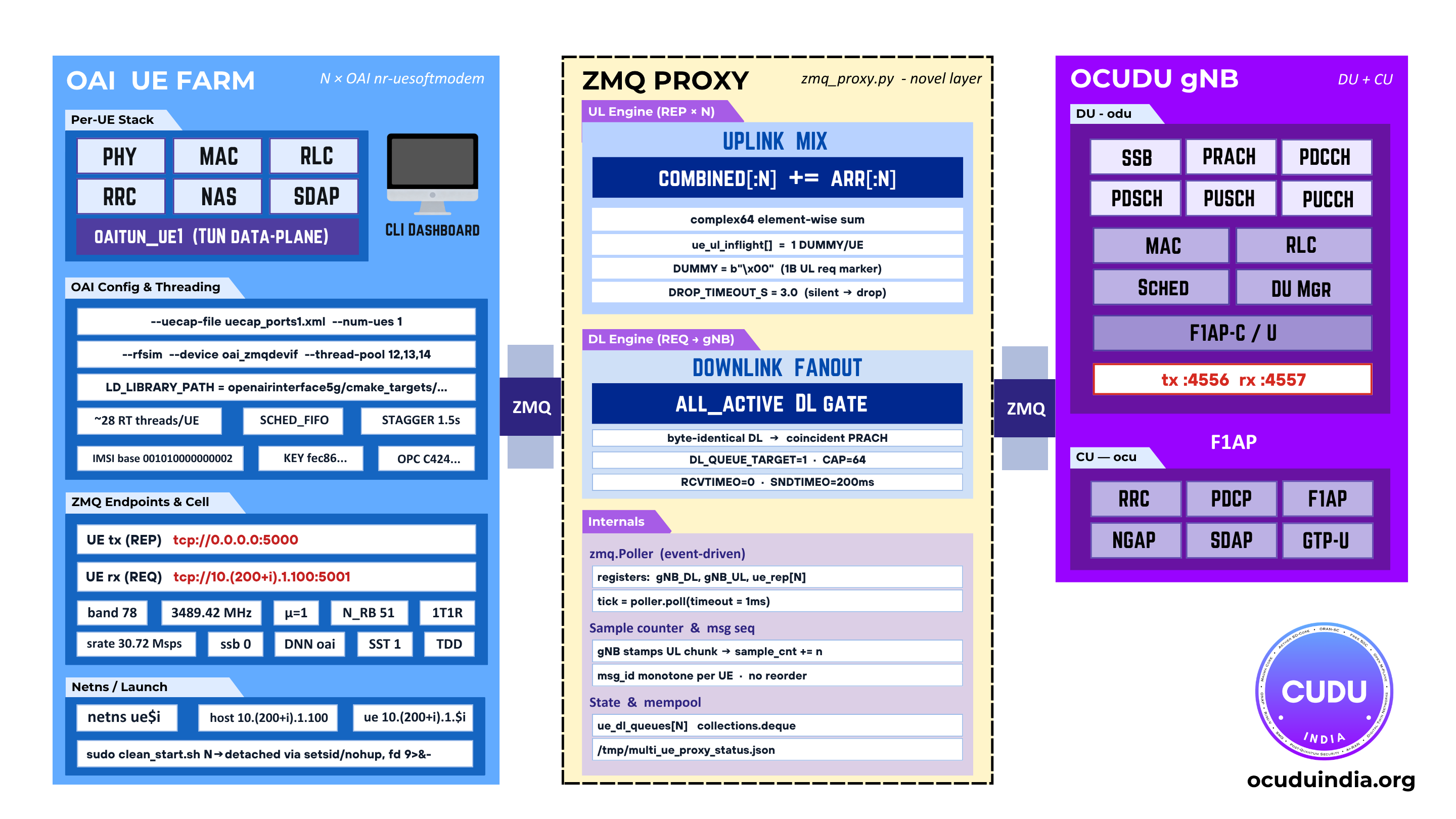 Scaling RAN Testing: From Single UE to Multi-UE SimulationOCUDU India extends OAI's new ZMQ-capable nr-uesoftmodem into a multi-UE testbed: N OAI UEs against a single OCUDU gNB, joined by a Python IQ-superposition proxy, per-UE Linux network namespaces, wave admission into the 5G CN, and a live Rust/ratatui dashboard.Read more →
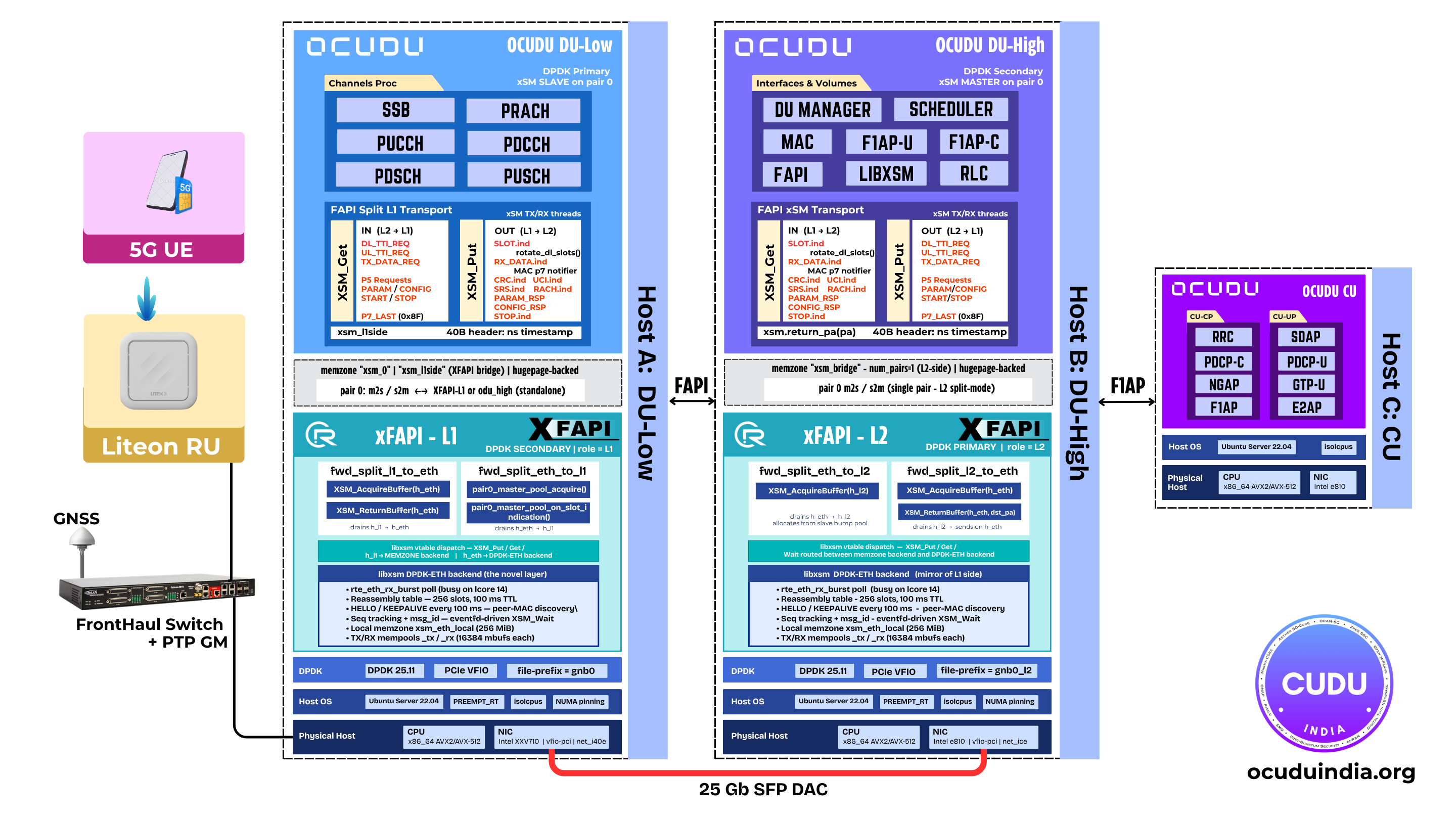 xFAPI: A FAPI L1/L2 Split for Open, Vendor-Neutral AI-RANOCUDU moves from a monolithic gNB to a fully operational FAPI L1/L2 split: odu_high and odu_low run as independent processes across the Small Cell Forum FAPI boundary, bridged by coRAN LABS' xFAPI translator. The boundary becomes open, portable, and vendor-neutral, a foundation for AI-RAN.Read more →
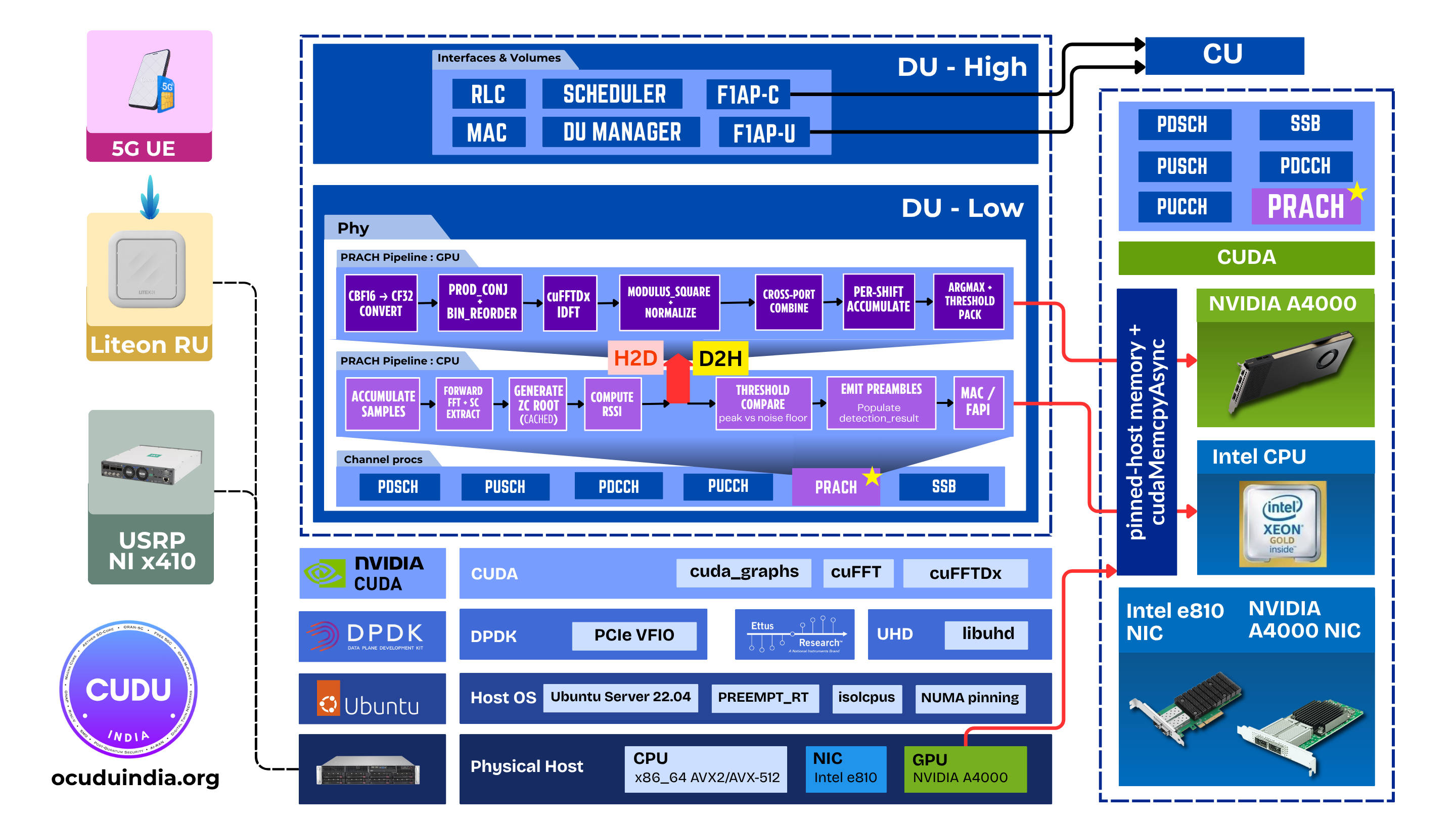 Hardware-Accelerated PRACH Detection: CUDA-Graph GPU OffloadA second hardware-acceleration path lands in OCUDU's upper-PHY: PRACH detection captured as a single CUDA graph on an NVIDIA GPU, with the IDFT running device-side via cuFFTDx. Two acceleration paths, two vendors, one binary.Read more →
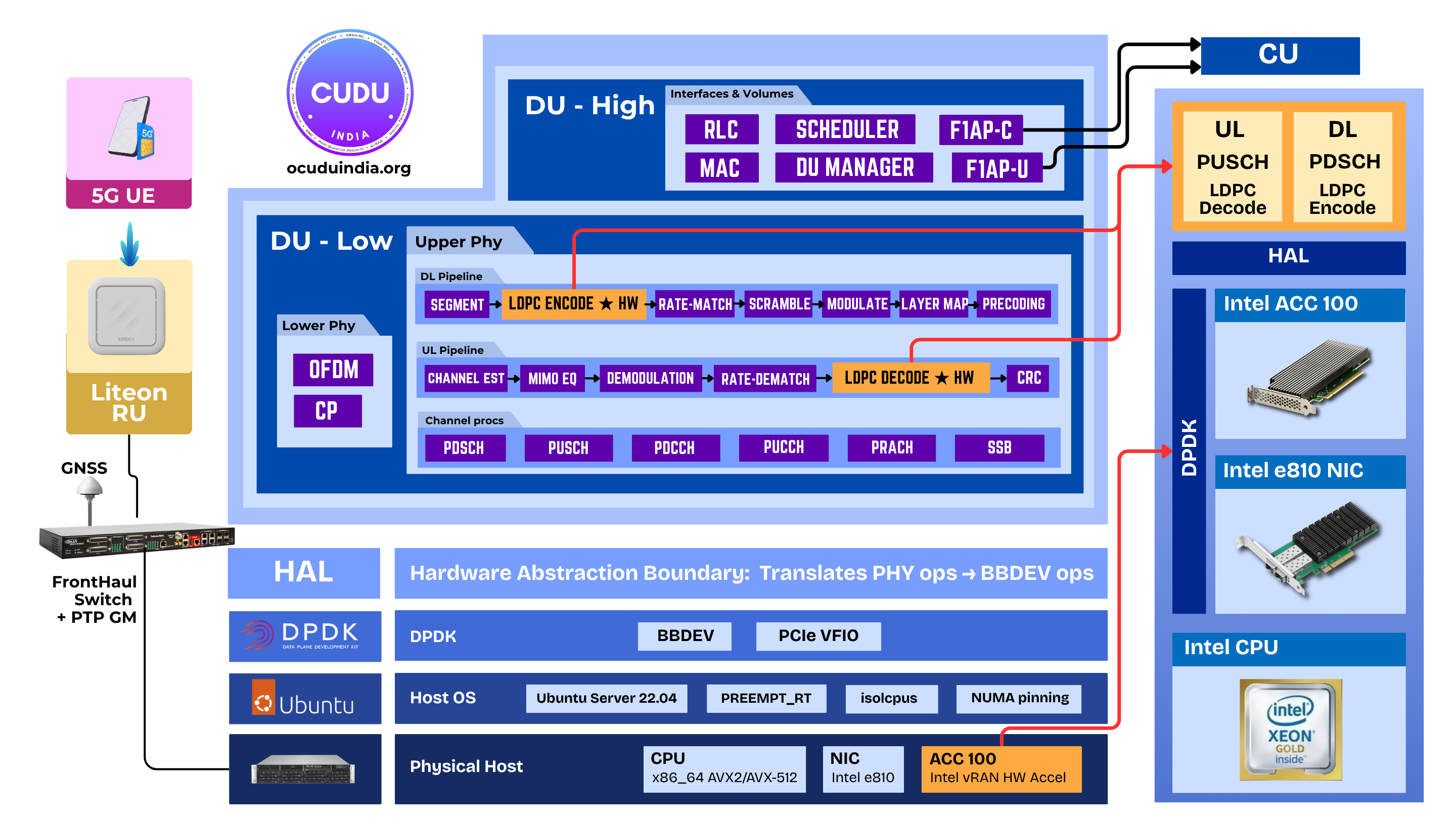 Offloading LDPC in PDSCH & PUSCH to Hardware AcceleratorsA BBDEV-based execution path for hardware-accelerated LDPC lands in OCUDU's upper-PHY, with a first reference backend on Intel ACC100 and a HAL designed to extend cleanly to next-generation accelerators.Read more →