
Policy
Telecom policy and standards
Analysis of telecom policy, standards participation and industrial strategy. The focus is on the distance between stated intent and measurable outcome: what a national programme funds, what reaches a standards body, and what ends up deployable in a production network.
These analyses are written from the position TOSSI works from, which is integration. A policy commitment becomes real when it can be built, tested against the standard and run by someone other than its author. That is the test applied here.
Analyses
2 pieces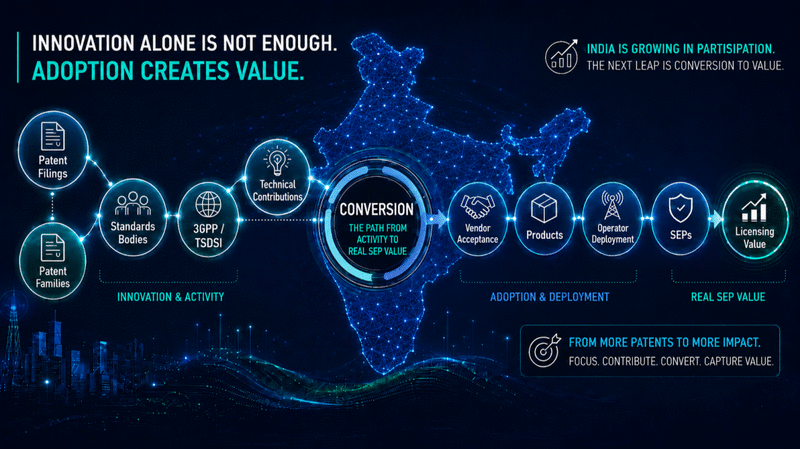 11 min readIndia's 7,700 5G/6G Patent Filings: Big Numbers, Bigger Questions, and the Road to Real SEP ValueThe Bharat 6G Alliance reports 7,700+ 5G/6G patent filings, 1,787 Indian 3GPP participants and 2,943 technical contributions in 2025. These are real signs of a growing ecosystem, but a patent filing is not a granted patent, and a declared SEP is not a verified one. A preliminary claim-1 review of 17 TSDSI-declared Indian publications found 4 materially mapped, 3 partial, 8 directed to alternative solutions and 2 not relevant. The gap is not intent. It is conversion.7,700+patent filings reported2,9433GPP contributions17declared SEPs reviewedRead the analysis
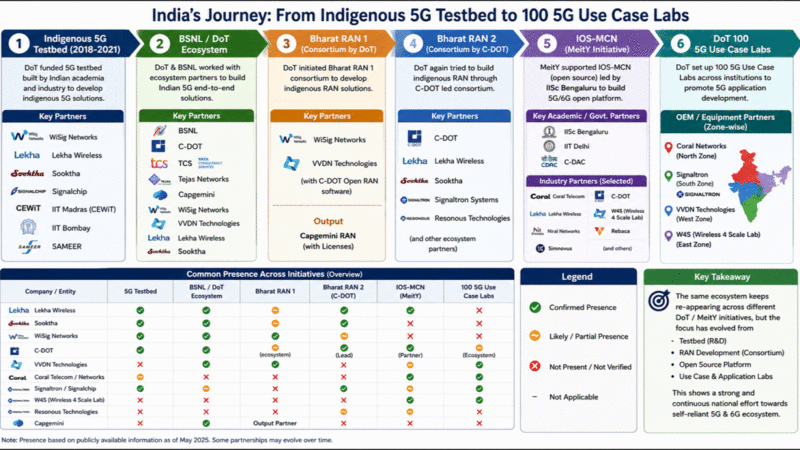 12 min readIndia's 5G Decade: Big Intent, Repeated Initiatives, and the Road to 6G OutcomesIndia's 5G journey from 2018 to 2026 moved through the Indigenous 5G Testbed, the BSNL/DoT ecosystem push, Bharat RAN 1 and 2, IOS-MCN, and 100 5G Use Case Labs, plus the 5Gi standards contribution. The intent and capability are real; the open question for 6G is conversion, turning testbeds, consortiums, and declared patents into deployed, operator-demanded products.2018-2026programmes traced1005G use case labs15declared 3GPP SEPsRead the analysis