Videos
Videos
Recordings, demos, and walkthroughs from the TOSSI project — end-to-end Open RAN interoperability, testing at scale, and GPU acceleration.
 Integration6:29
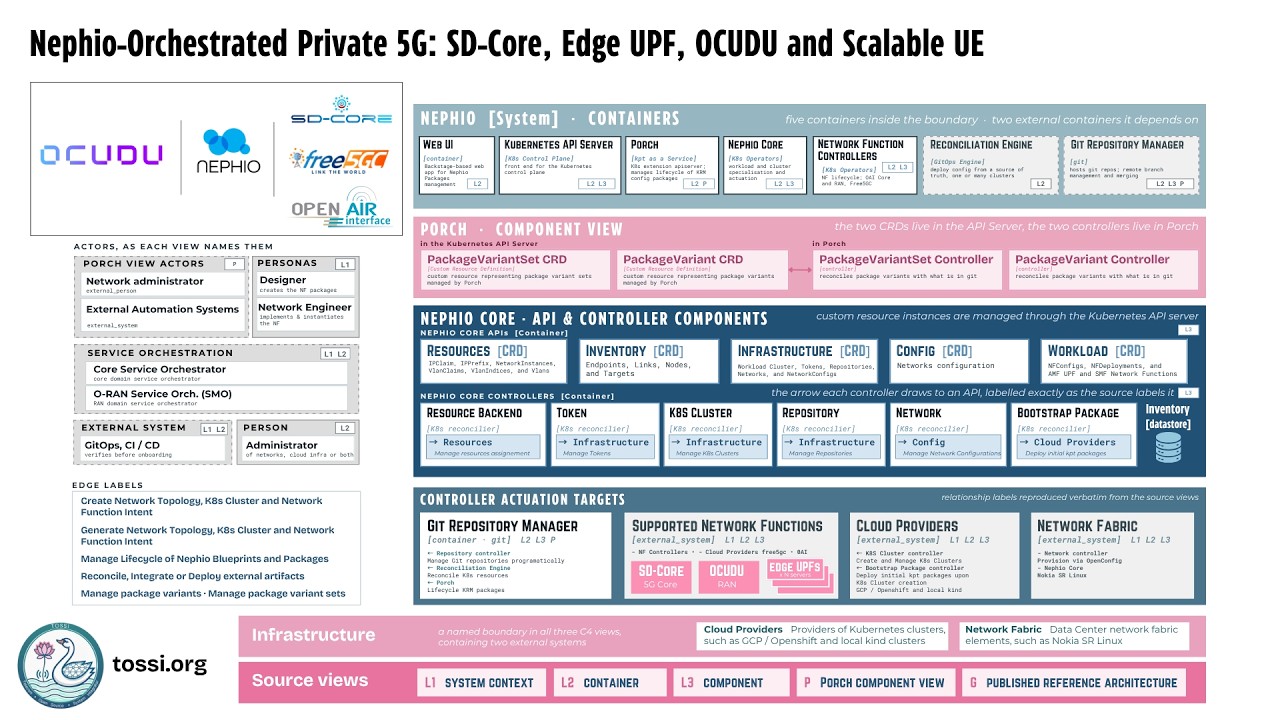
Nephio-Orchestrated Private 5G: SD-Core, Edge UPF, OCUDU and Scalable UE
This demonstration showcases an end-to-end integration for deploying a private 5G network from declarative intent using Aether 5G SD-Core, BESS edge UPF, OCUDU-RAN gNB, and Nephio, alongside Cluster API, BYOH, Config Sync, IPAM, and Cilium/Multus. A single `EdgeSite` intent triggers automated configuration derivation, Kubernetes provisioning on bare metal, network-function specialization, and reconciliation onto edge clusters. Orchestration extends to host datapath configuration, including routes and NAT settings, enabling complete traffic flow. The deployment was validated with 50 RF-simulated UEs successfully attaching, registering, establishing PDU sessions, and passing traffic, confirming continuous reconciliation across infrastructure components. The focus is on automating private 5G edge creation and maintenance through intent-based configuration management.
 AI-RAN7:31Sep 8, 2026OCUDU AI-RAN Release 4 : Hierarchical AI-RAN for Dynamic Network SlicingSlice-ML implements intelligent RAN resource slicing using hierarchical deep learning within the OCUDU-RAN Distributed Unit, enabling dynamic allocation for services with varying performance needs. The system operates at two timescales: a slower LSTM-based controller adjusts physical resource block (PRB) allocation between enhanced mobile broadband (eMBB) and ultra-reliable low latency communication (URLLC) slices, and a faster attention-based model prioritizes user equipment (UE) scheduling within each slice. Separate models are used for eMBB and URLLC, while the existing DU resource allocator handles final assignment. This lightweight C++ implementation performs ML inference natively without introducing framework overhead into the real-time scheduling path, supporting data collection, shadow operation, and runtime safety features with conventional scheduling as a fallback. Validated models can be hot-swapped without DU restarts, allowing for controlled deployment and continuous improvement.
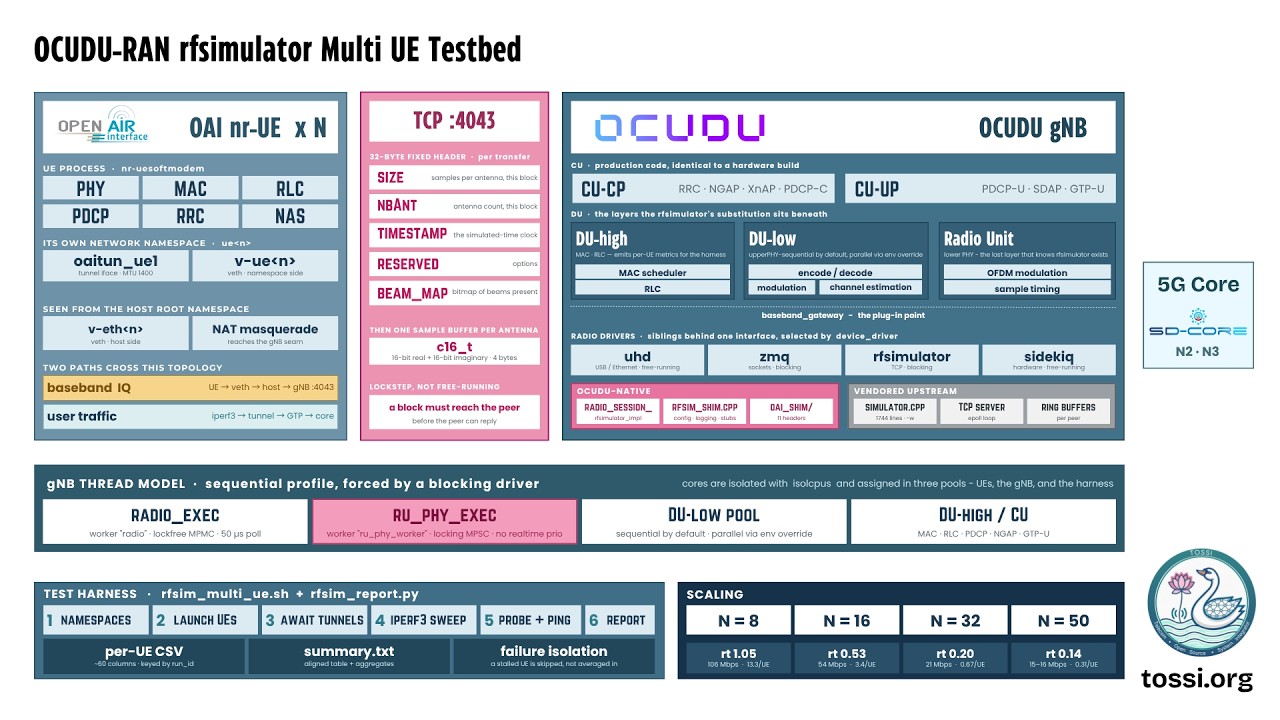 NTN7:52Sep 4, 2026OCUDU-RAN rfsimulator: A Scalable Multi-UE Foundation for AI-RAN and 6GThis release introduces native integration of OpenAirInterface (OAI) rfsimulator into OCUDU-RAN, enabling scalable multi-UE simulation through a single radio simulation endpoint. Building on the earlier ZMQ-based multi-UE setup, the new integration supports up to 50 concurrent OAI UEs connected to a single OCUDU gNB on one machine. The release includes: Multi-peer rfsimulator integration Slot-level sample combining across UEs Automated multi-UE testing Isolated UE network namespaces Concurrent DL and UL traffic testing Radio and lower-PHY performance optimisations At 8 UEs, aggregate DL throughput improved from 67.05 Mbps to 106.25 Mbps, a 58% improvement. At 50 UEs, 50/50 UE attachment was achieved with the OAI core. This provides a scalable software foundation for experiments across AI-RAN, intelligent scheduling, network slicing, NTN, digital twins and other 6G applications. Repositories OCUDU-RAN: github.com/TOSSI-Foundation/OCUDU-RAN� OAI-RAN: The TOSSI OAI-RAN repository referenced for this release is TOSSI-Foundation/OAI-RAN; I could not verify that exact repository from the current web results, so I would use the repository URL from your release documentation rather than risk publishing an incorrect link. � RFSIM_TECHNICAL_BRIEF.md
 Integration7:43Aug 29, 2026CNTC: Reproducible Certification for OCUDU 5G RAN | 3GPP, SCASCNTC RAN Certification provides a reproducible framework for verifying the conformance of 5G RAN deployments in CU/DU split mode, testing interfaces including N2, F1-C, E1, F1-U, and N3. The certification environment operates on a single Linux host and observes RRC and Access Stratum security activation by capturing IP link traffic, utilizing a software UE for end-to-end attachment procedures. Each RAN product class, O-CU-CP, O-CU-UP, and O-DU, is certified independently based on a defined set of requirements, with verdicts determined by wire captures, socket state, and process state, excluding product logs except for diagnostic purposes. Currently validated against OCUDU 5G RAN, the framework executed 58 Level-1 requirements, achieving certification for the O-DU class while identifying a security algorithm mismatch in the O-CU-CP and O-CU-UP classes. Requirements unable to be evaluated are marked as Not Applicable, and a certificate is only issued upon successful completion of all essential requirements for a given product class.
 5G Core7:02Aug 23, 2026SD-Core with IMS: Voice, Video and Messaging through Kamailio and SETUThis demonstration showcases a fully functional IMS voice service operating on an open 5G standalone core, enabling real VoNR and ViNR calls and SMS functionality using commercial handsets over a live 5G SA radio network. The deployment utilizes SD-Core as the 5G core and Kamailio as the IMS, bridged by SETU to translate between Diameter-based IMS signaling and HTTP/2 service APIs exposed by the core. SETU facilitates subscriber authentication and bandwidth allocation without requiring a traditional HSS or policy server, accessing subscriber data directly from the 5G core. The video presents successful registration, voice and video calls, and bidirectional SMS messaging, all achieved with minimal modifications to the stock Kamailio configuration. All components, including SETU and the modified SD-Core network functions, are publicly available for review and replication.
 NTN3:50Aug 11, 2026NTN E2E Testbed : Release B - LEO NTN A 5G Connection Through a Moving SatelliteThis demonstration establishes a complete 5G Standalone connection over a simulated low-Earth-orbit satellite link using software components without requiring radio hardware or actual satellite access. The testbed models a satellite orbit at 600 km with a velocity of 7.5 km/s, incorporating propagation delay and Doppler shift effects applied to the baseband sample stream. A full pass is simulated, showcasing cell search, random access, RRC setup, NAS registration, and user traffic transmission. The implementation utilizes production-ready OCUDU RAN and OAI UE software, extending previous work that validated a similar testbed for geostationary orbit. Orbit parameters are shared between the network and channel models to ensure synchronized simulation of link behavior.
 5G Core4:06Aug 8, 2026CNTC: Reproducible 5G Core Control Plane Certification | 3GPP, SCAS, free5GCCloud Native Telecom Certification (CNTC) has been extended to include 5G Core Control Plane certification, evaluating the protocol behavior of Network Functions, specifically AMF, SMF, NRF, AUSF, and UDM, against published 3GPP specifications and Security Assurance Specification (SCAS) requirements. The framework utilizes automated tests via real interfaces like N1/N2, N4, and SBI to capture observable protocol exchanges and generate deterministic pass/fail verdicts based on a catalog of 44 implemented tests and 26 essential requirements. Certification requires all essential requirements to pass for a certificate to be issued; otherwise, results are reported as FAIL or INCOMPLETE if evaluation is not possible. CNTC was validated against a live free5GC deployment using both Docker Compose and Kubernetes, identifying specific gaps in configuration and implementation beyond standard definitions. The system separates measurement from certification through a versioned requirement catalog and an engine for evaluating recorded protocol evidence, providing transparent and reproducible results.
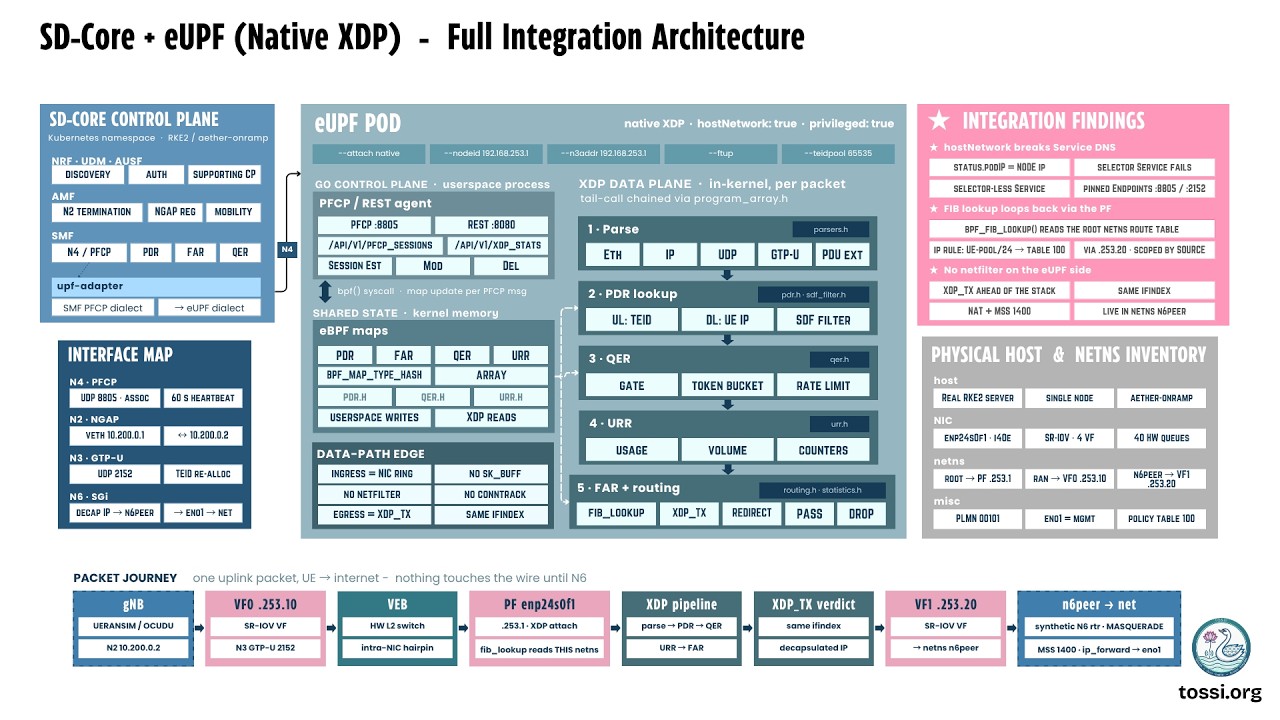 5G Core5:17Aug 5, 2026SD-Core × eUPF: XDP Datapath with In-Kernel Usage MeteringThis release details the integration of SD-Core with eUPF, transitioning from a userspace packet processing path to a high-performance kernel datapath utilizing eBPF/XDP. End-to-end usage reporting, quota enforcement, and PFCP Session and Association management are now implemented at kernel speed for accurate per-subscriber accounting and policy control. The standard SD-Core control plane remains unchanged while the user plane is extended with in-kernel processing and configurable subscriber limits. This implementation showcases improvements to 5G core component efficiency and scalability without sacrificing standards compliance, leveraging open-source projects OMEC SD-Core and eUPF.
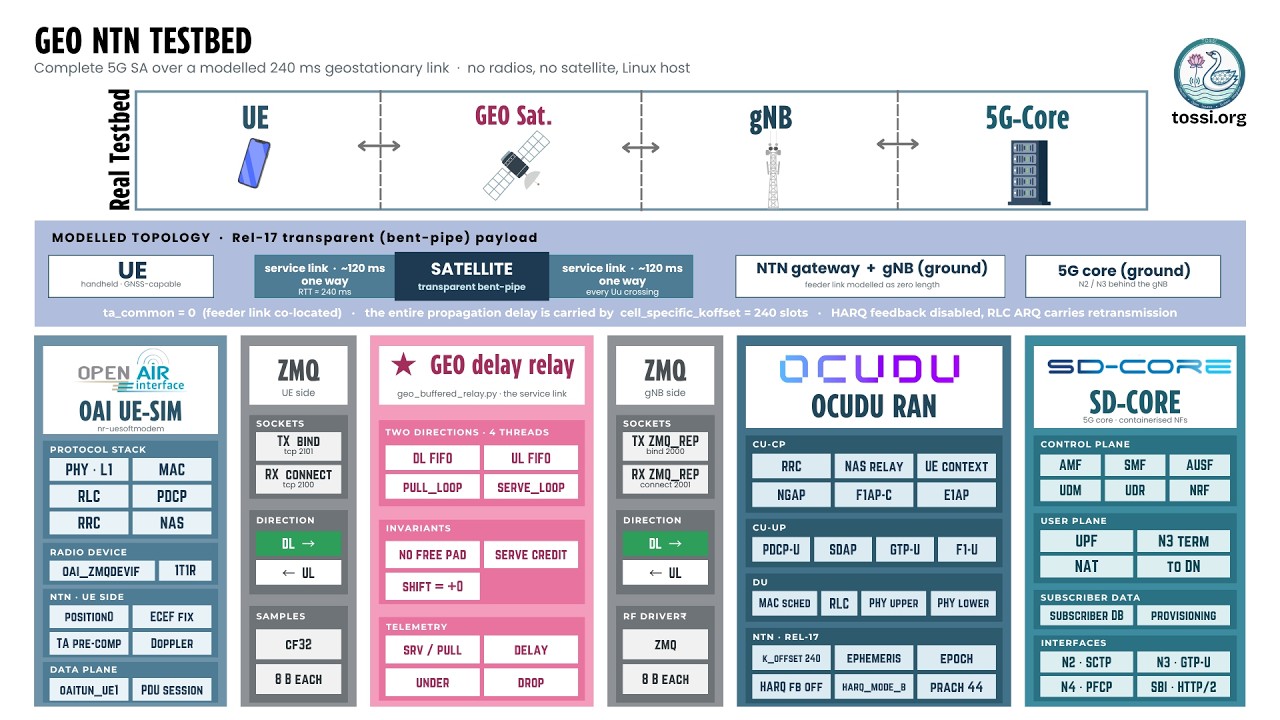 NTN4:26Jul 31, 2026NTN E2E Testbed :Release A - GEO NTN with OCUDU RAN and OAI UE SimulatorNTN Testbed Release A is the initial open-source software implementation of a 5G Non-Terrestrial Network testbed. This demonstration presents a fully functional 5G Standalone network utilizing a simulated 240 millisecond geostationary satellite link, employing OCUDU RAN, an OAI UE Simulator via ZMQ, and a 5G Core all hosted on a single machine without radio frequency hardware. Successful operation was verified through cell search, SIB19 acquisition, random access, RRC connection setup, NAS authentication, PDU session establishment, and end-to-end user plane IP traffic. The current configuration achieves approximately 510 millisecond round-trip latency and validates scheduler improvements for 3GPP Release 17 NTN compatibility; future releases will incorporate low Earth orbit satellite support with variable propagation delays and Doppler shifts.
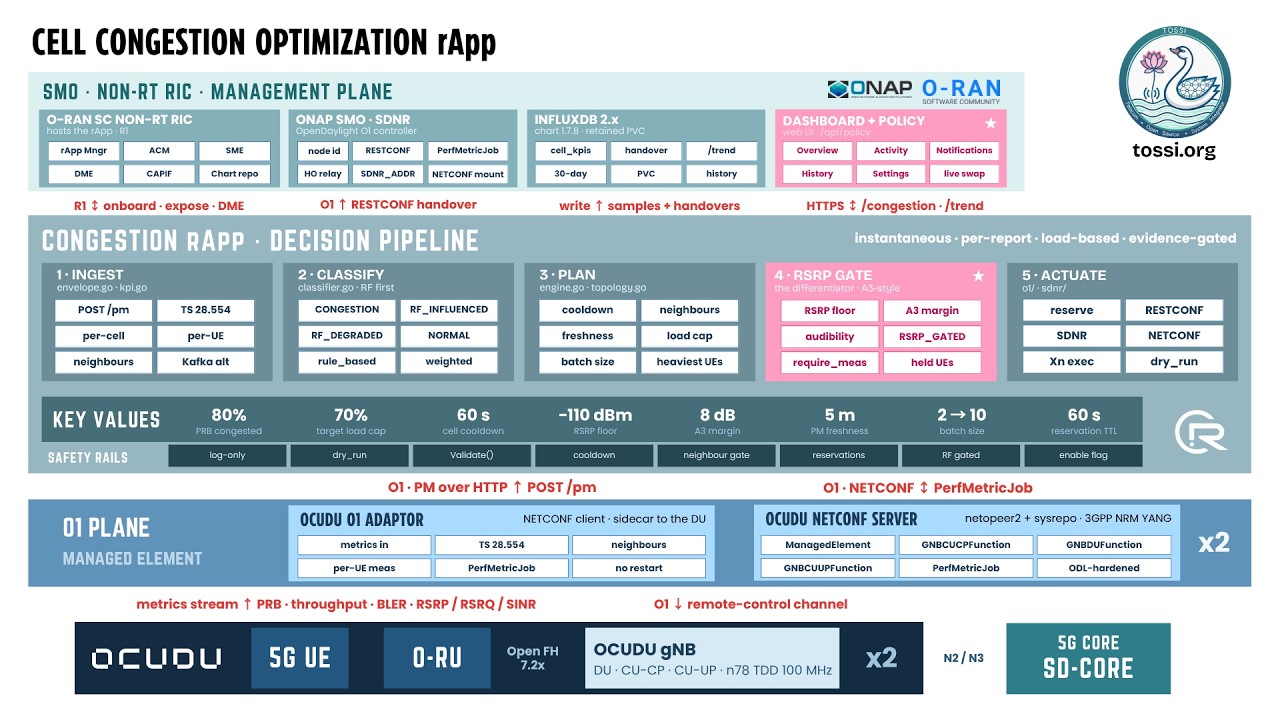 Integration7:55Jul 28, 2026Closed-loop Cell Congestion Optimization rApp with OCUDU RAN StackThis demonstration presents an end-to-end Cell Congestion Optimization workflow implemented with Open RAN standards and open-source software, including the OCUDU RAN Stack, Aether SD-Core, and ONAP-based SMO. The system monitors O1 performance data to detect congestion, selects a neighboring cell based on configurable policies, and initiates a handover request via the management plane using standardized interfaces like O1, NETCONF/YANG, and RESTCONF. The workflow validates interoperability between independently developed components through a closed-loop control process involving live telemetry collection, handover generation, and execution. This implementation provides a foundation for autonomous network operations and intelligent rApps in evolving Open RAN environments. The complete source code and technical documentation are publicly available.
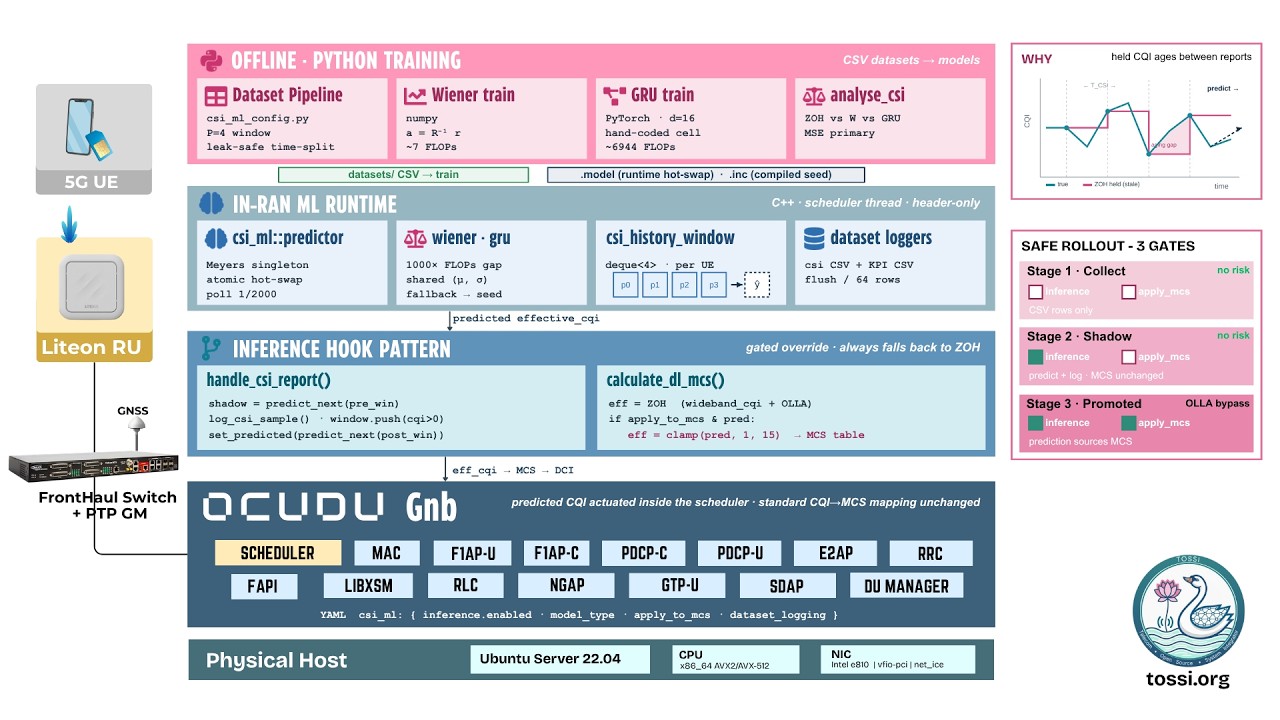 AI-RAN5:46Jul 26, 2026OCUDU AI-RAN Release 3 : ML-Based CSI Prediction for Intelligent 5G SchedulingOCUDU AI-RAN Release 3 improves downlink link adaptation by predicting channel quality reports instead of relying on periodically received, potentially stale data. The system utilizes two prediction engines, a linear filter and a neural network, to forecast per-user channel trends and inform scheduling decisions. This pipeline compiles a complete stack, collects over-the-air channel data for training, and runs live base stations with the predictive scheduler. Benchmarking demonstrates performance gains compared to conventional methods while maintaining standards compliance through arithmetic operations within the DU without new signaling or external dependencies. The framework offers automatic fallback mechanisms ensuring operational safety.
 Digital Twins9:14Jul 21, 2026NVIDIA Sionna RT Meets OCUDU: Building Deterministic Digital Twins for 6G and AI-RANNVIDIA Sionna, an open-source GPU-accelerated platform for AI-native wireless research, has been integrated with the OCUDU RAN ecosystem via its differentiable ray tracer, Sionna RT. This integration enables a live connection between 3D physical geometry and a functional protocol stack through asynchronous channel streaming using ZeroMQ PUB/SUB. The system employs a GPU-based physics engine for radio wave propagation simulation, transferring data to the CPU for deterministic channel filtering with AVX-512 operations, and supports hot-swapping of channel tap sets without connection interruption. This architecture facilitates site-specific physical realism for applications including AI-driven beamforming and localized LLM fine-tuning in telecom environments.
 Integration13:20Jul 17, 2026NVIDIA Aerial, xFAPI & OCUDU: Building the Future of Open AI-RANThis demonstration presents xFAPI Release 2.3 facilitating interoperability between NVIDIA Aerial Layer 1 and OCUDU Layer 2 in an end-to-end Open RAN configuration. The setup also includes AERIAL_OAI mode, which integrates NVIDIA Aerial with Duranta (OAI) to demonstrate flexibility across different ecosystems. Key components used in the deployment are NVIDIA Aerial L1, xFAPI Release 2.3, OCUDU L2, LiteON O-RU, Aether SD-Core, a commercial UE, and Netweb Tyrone Spark AI Supercomputer. This integration showcases GPU-accelerated Layer 1 platforms working with open-source Layer 2 ecosystems for practical AI-RAN deployments.
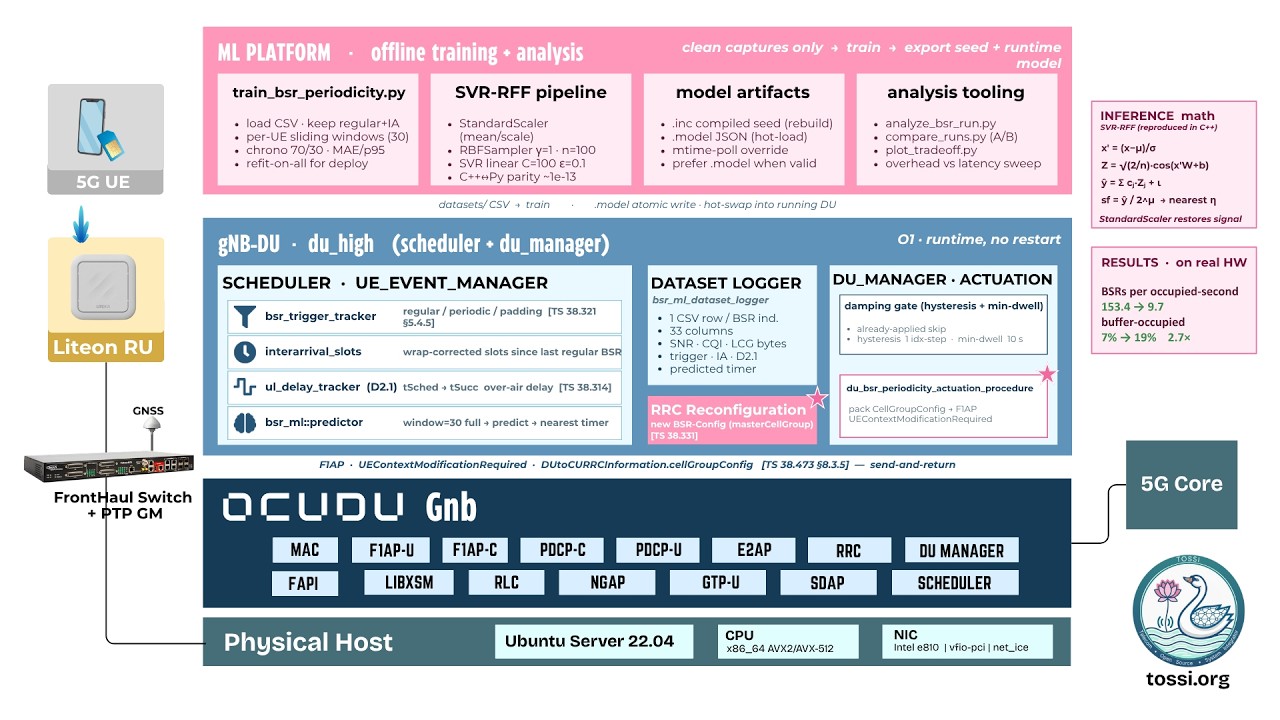 AI-RAN4:32Jul 10, 2026OCUDU AI-RAN: Building an Open Framework for Per-UE IntelligenceAI-RAN Series Release 2 introduces an open framework for machine-learning-based adaptive Buffer Status Report (BSR) configuration in OCUDU RAN. The release lets the RAN learn each individual UE's traffic behaviour, predict its uplink packet arrival pattern, and dynamically adapt the periodicBSR-Timer per UE at runtime. A small learned model (SVR over Random Fourier Features) predicts the next uplink interarrival, snaps it to the nearest legal TS 38.331 timer, and reconfigures the UE over F1AP, trading signalling cost against how quickly the gNB learns of new uplink data. Disabled by default, it falls back cleanly to the static timer.
 Integration7:44Jul 7, 2026OCUDU RAN: Standards-Based Inter-gNB Handover with O-RAN O1 ManagementSeamless inter-gNB handover in a real-world Open RAN deployment with OCUDU RAN, SD-Core, LiteON radio units, and commercial 5G UEs. Demonstrates both operator-initiated (gNB-triggered) and UE-initiated (3GPP A3 measurement-based) handovers with uninterrupted mobility across cells, and introduces O-RAN O1 support for handover monitoring and control, standardized mobility KPIs, and a foundation for AI-powered mobility xApps and rApps.
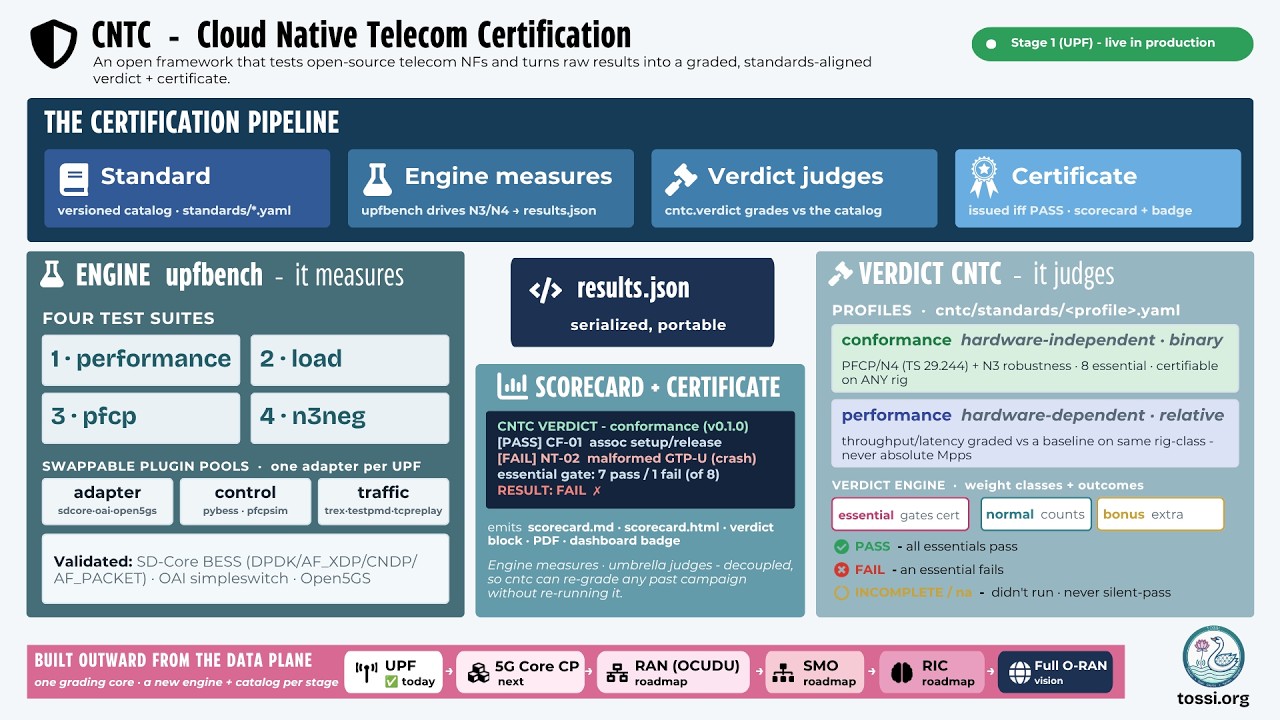 5G Core5:06Jul 4, 2026Introducing Cloud Native Telecom Certification (CNTC): Trusted Certification for 5G UPFsIntroducing Cloud Native Telecom Certification (CNTC), an open, trusted certification process for 5G User Plane Functions. Covers how CNTC validates UPF conformance, performance, and cloud-native readiness so operators can deploy open-source and third-party UPFs with confidence.
 AI-RAN3:33Jul 1, 2026OCUDU AI-RAN Release 1: Building an Open Framework for Intelligent Link AdaptationOCUDU AI-RAN Release 1, an open, end-to-end framework for building, deploying, and continuously improving intelligent RAN applications. The first application is ML-based uplink link adaptation, where a gradient-boosted model picks the MCS alongside OLLA, built on 900k+ real over-the-air transmissions.
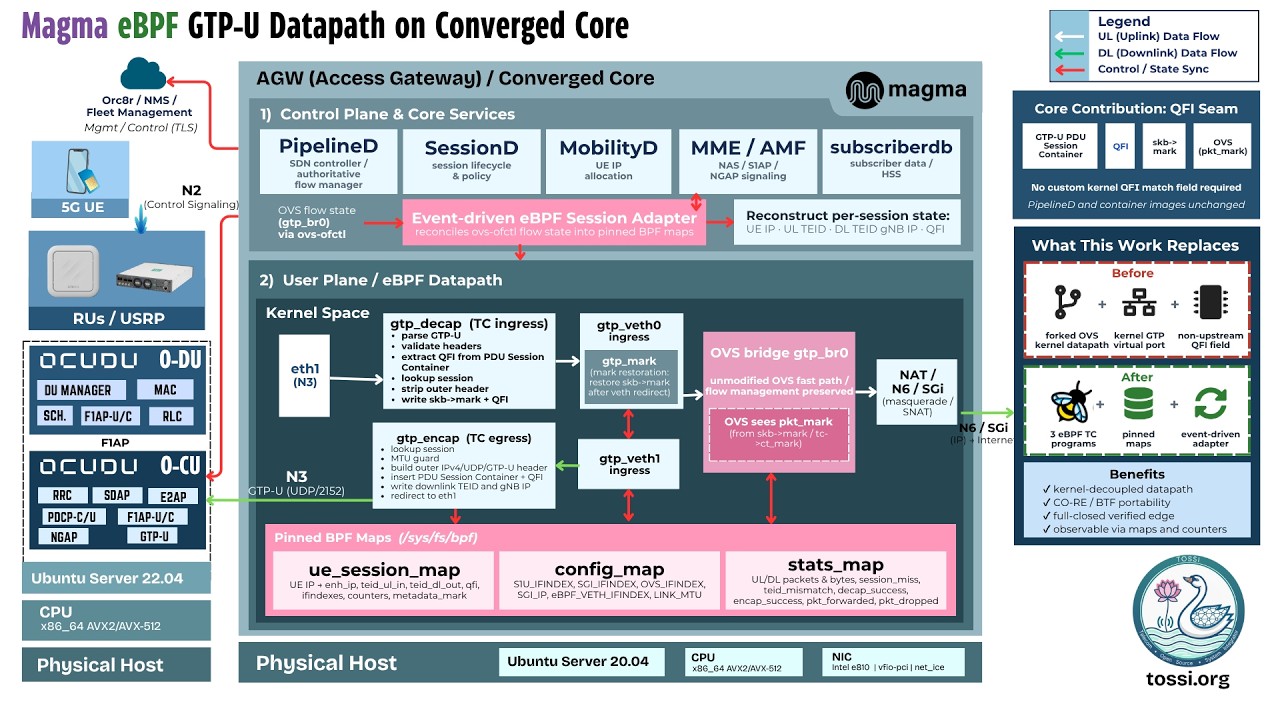 5G Core4:49Jun 27, 2026From Kernel-Locked to Cloud-Native: Rebuilding Magma’s 5G User Plane with eBPFRebuilding Magma’s 5G user plane from a kernel-locked data path to a cloud-native one with eBPF. Moves packet processing into eBPF/XDP programs for a portable, programmable, high-throughput user plane that runs on commodity Linux without custom kernel modules.
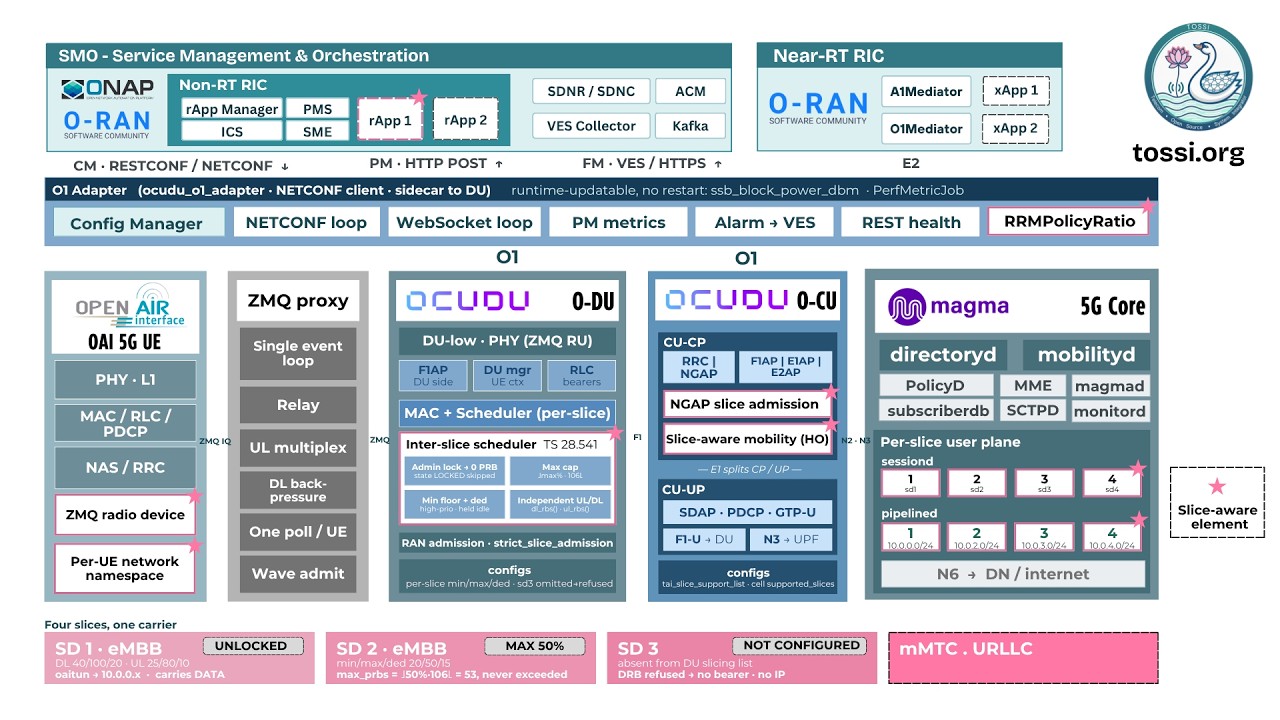 Integration4:21Jun 26, 2026Building an End-to-End Open Network Slicing Ecosystem with OCUDUA complete open-source network slicing ecosystem built around OCUDU. Multi-UE OAI orchestration with independent S-NSSAIs, slice-aware DU scheduling via 3GPP RRM Policy Ratios, Magma Core integration, and O1-based live slice configuration through the SMO, with per-slice performance monitoring for rApp-driven closed-loop automation.
 GPU Offload4:32Jun 23, 2026Building the AI-RAN Data Path in OCUDU: Inline GPU Processing for PRACH and SRSInline GPU acceleration in OCUDU Open RAN using NVIDIA GPUDirect RDMA. Fronthaul packets are delivered directly from the NIC into GPU memory where PRACH detection and SRS channel estimation execute inline, with no CPU copy. Shows 3.3× speedup for PRACH (106 µs vs 352 µs) and sub-linear SRS scaling up to 256 UEs.
 Integration4:06Jun 21, 2026OAI L1 + xFAPI + OCUDU DU-High | End-to-End Open RAN InteroperabilityEnd-to-end Open RAN interoperability across the FAPI split. OAI L1 (nFAPI PNF) talks to OCUDU DU-High through the xFAPI bridge in OAI_OCUDU mode — nFAPI over P5 SCTP and P7 UDP between hosts, then xSM shared-memory transport into the OCUDU MAC scheduler. Demonstrates a two-host deployment with F1AP up to the CU.
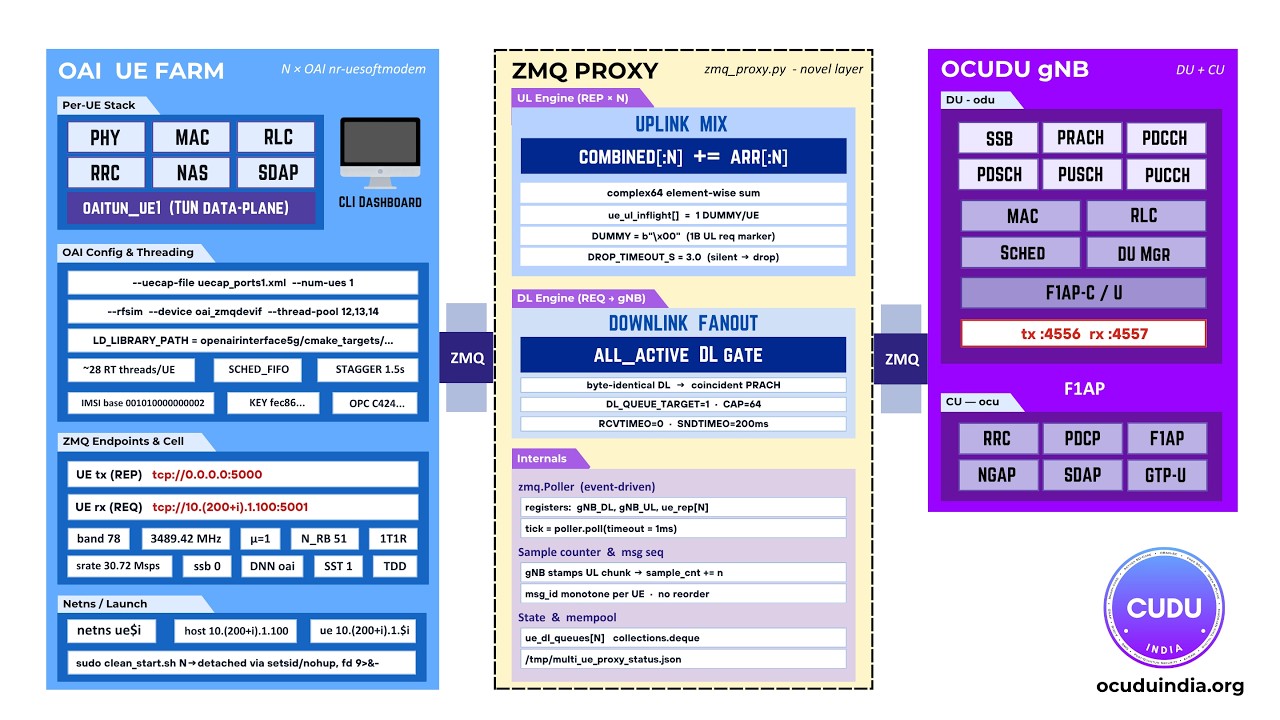 Testing3:07May 25, 2026Scaling RAN Testing: From Single UE to Multi-UE SimulationScaling open RAN testing from a single UE to a multi-UE simulation. Walks through the OAI ZMQ-capable nr-uesoftmodem, a Python IQ-superposition proxy that fans the downlink and sums uplinks for N UEs, per-UE Linux network namespaces, wave admission into the 5G core, and a live dashboard driving the demo.
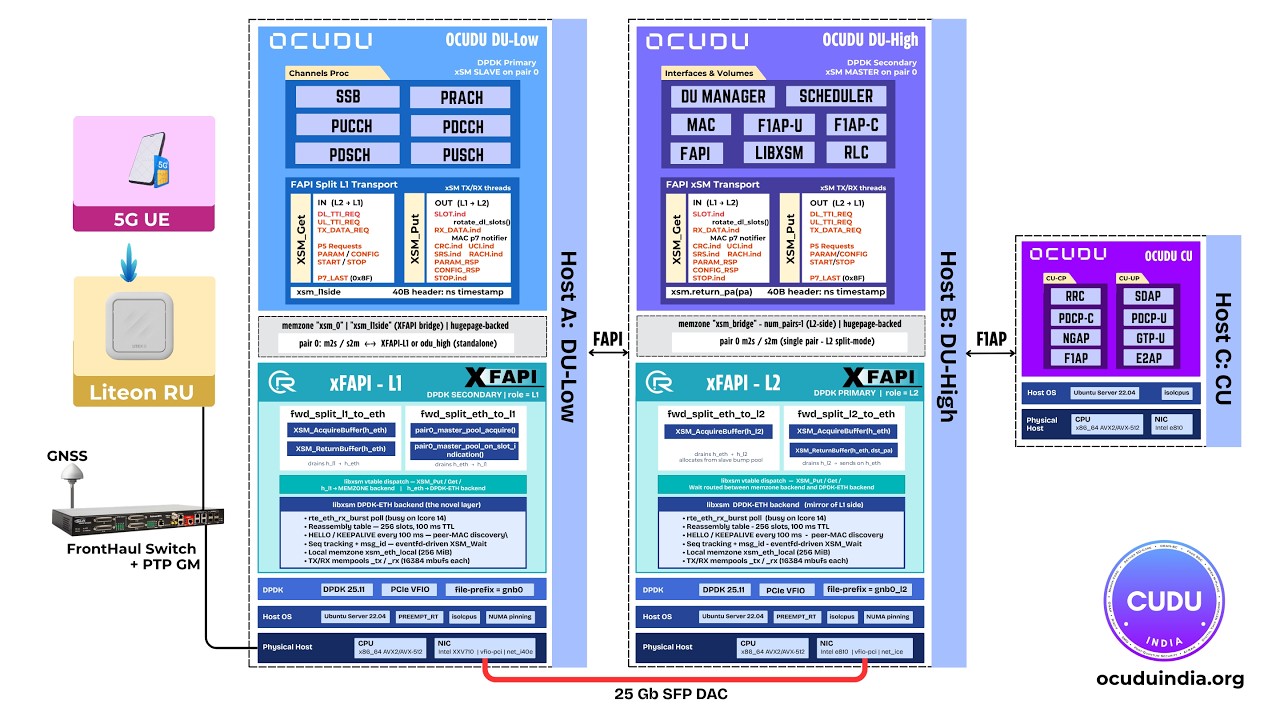 Integration2:52May 19, 2026xFAPI Demo: Disaggregated FAPI Interface in Open RANA disaggregated FAPI interface in open RAN. Walks through the latest xFAPI release: interoperable deployment of L1 and L2 through a modular FAPI-based architecture and an xSM shared-memory transport.
 GPU Offload4:31May 3, 2026GPU Offloading of PRACH Detection Using CUDA GraphsGPU offloading of PRACH detection using CUDA graphs. Walks through NVIDIA GPU acceleration for PRACH preamble detection in the upper-PHY via cuFFTDx and CUDA-graph capture, with A/B performance results measured on live 5G cells against both Split 8 and Split 7.2 radios.
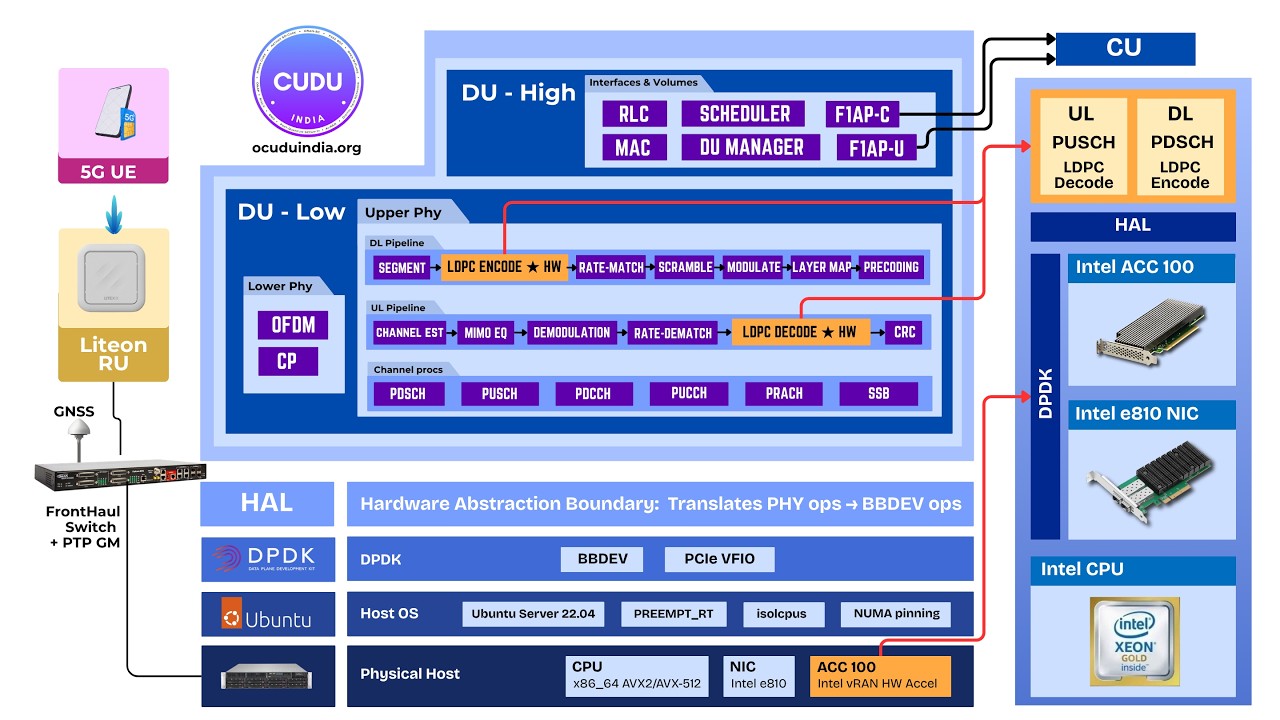 GPU Offload2:49Apr 26, 2026Offloading LDPC in PDSCH and PUSCH to AcceleratorsOffloading LDPC in PDSCH and PUSCH to hardware accelerators. Walks through the integration of accelerator cards (demonstrated on Intel ACC100) for LDPC offload into the upper-PHY via DPDK BBDEV, with A/B performance results on a live 100 MHz TDD cell against a real UE.