Non-Terrestrial Networks (NTN): An Introduction
A plain-language guide to what NTN is, why it exists, and what changes inside a 5G network when the base station is in space. A normal mobile network puts base stations on towers, so your phone is usually within a few kilometres of one and its signal reaches the tower in well under a millisecond. That assumption is baked deep into how 5G works. Non-Terrestrial Networks replace the tower with something flying, a satellite or an aircraft or balloon in the stratosphere, and the other end of the radio link is suddenly somewhere between 20 and 36,000 kilometres away. NTN is essentially the set of adjustments 3GPP made so that ordinary 5G keeps working when the distance gets very large.
The idea in plain terms
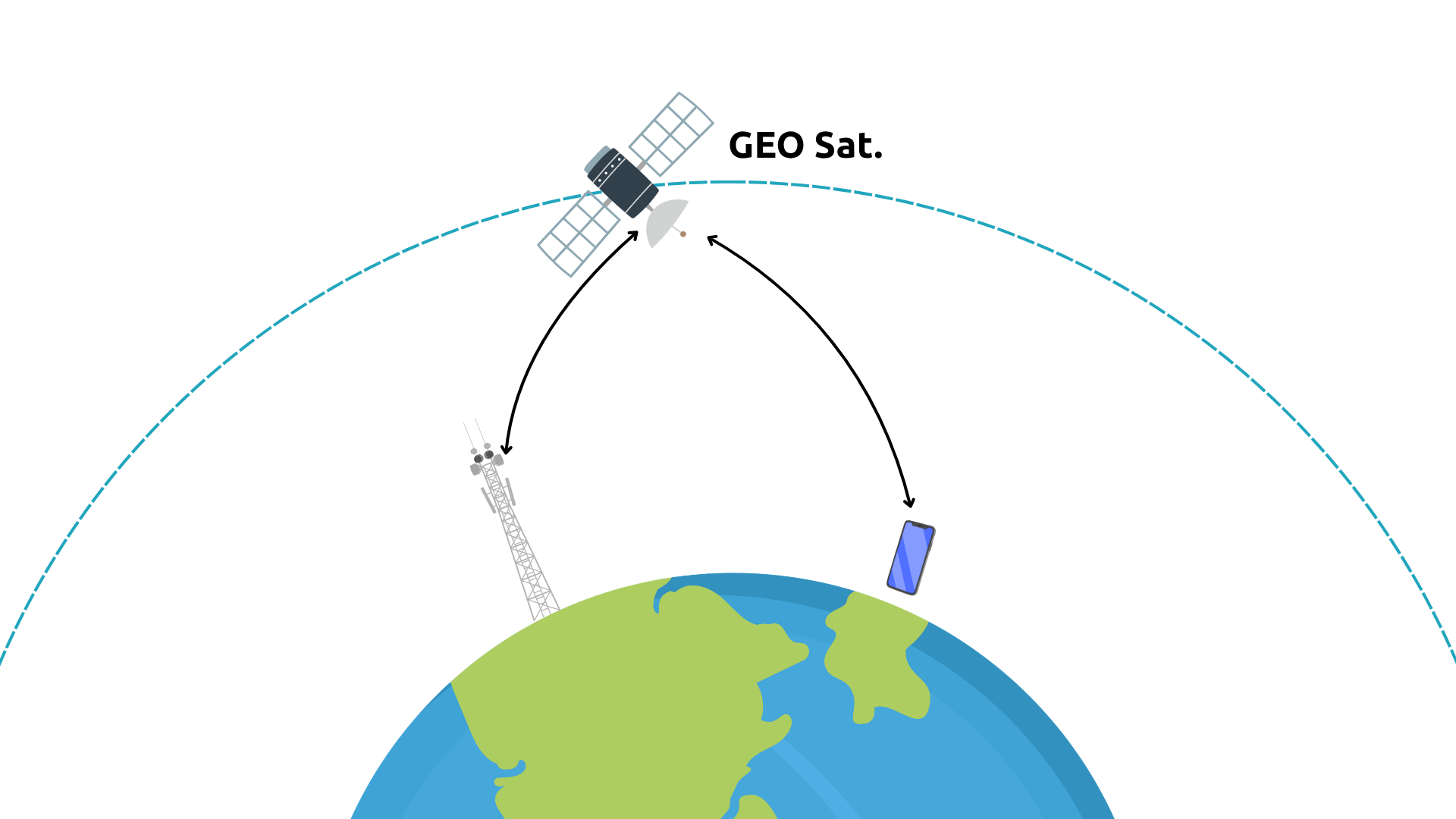
Non-Terrestrial Networks replace the tower with something flying: a satellite, or an aircraft or balloon operating in the stratosphere. The phone still speaks 5G. The difference is that the other end of the radio link is now somewhere between 20 kilometres and 36,000 kilometres away. That single change breaks a surprising number of assumptions, and NTN is the set of adjustments 3GPP made so that ordinary 5G keeps working when the distance gets very large.
The motivation is coverage. Terrestrial networks cover where people live, which leaves out oceans, deserts, mountains, polar regions, aircraft in flight, and large parts of many countries. Satellites see all of it. NTN lets an operator extend the same network, the same SIM, and increasingly the same handset, into places where building towers is impossible or uneconomic. It also provides resilience: when a terrestrial network fails during a disaster, a satellite link does not depend on local infrastructure.
Where the base station sits
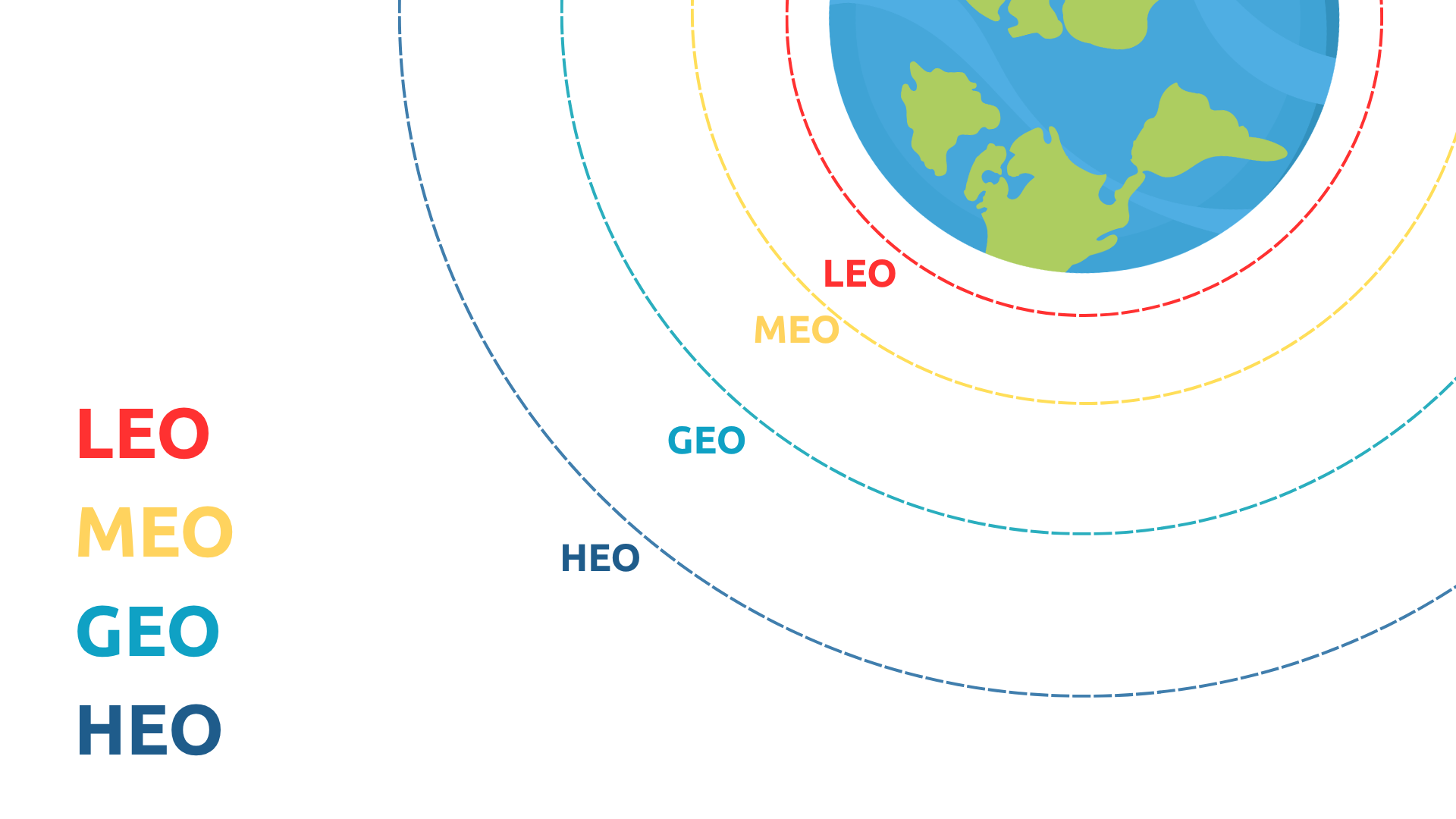
Satellites are grouped by how high they orbit, because altitude decides almost everything else.
| Orbit | Altitude | One-way delay | Behaviour |
|---|---|---|---|
| LEO (Low Earth Orbit) | roughly 500 to 2,000 km | a few milliseconds | Moves fast across the sky. Many satellites needed for continuous coverage. |
| MEO (Medium Earth Orbit) | roughly 8,000 to 20,000 km | tens of milliseconds | Middle ground. |
| GEO (Geostationary Earth Orbit) | 35,786 km above the equator | around 120 ms | Appears fixed in the sky. One satellite covers a third of the planet. |
| HEO (Highly Elliptical Orbit) | varies | varies | Elliptical path, useful for high-latitude coverage. |
| HAPS | 8 to 50 km | negligible | Aircraft or balloons in the stratosphere. |
There is a genuine trade-off here. GEO gives you enormous coverage from a single satellite that never appears to move, which makes pointing and handover simple, but you pay around 240 ms for every round trip. LEO gives you low delay, but the satellite crosses the sky in minutes, so the network is constantly handing users between satellites and dealing with large Doppler shifts. Note that a GEO satellite is not perfectly stationary: gravitational effects mean it drifts within a few kilometres of its nominal position, so its exact location still has to be tracked.
Two ways to build the satellite
This is one of the most important architectural choices in NTN.
Transparent payload (bent-pipe)
The satellite is a mirror. It receives the radio signal, shifts the frequency, amplifies it, and sends it back down. It does not understand 5G at all. The actual base station (the gNB) sits on the ground at a facility called the NTN Gateway. The path looks like this:
UE <-- service link --> SATELLITE <-- feeder link --> GATEWAY + gNB --> Core network
The hop from the user to the satellite is called the service link. The hop from the satellite down to the gateway is called the feeder link, sometimes also called the Satellite Radio Interface. The important consequence is that the round trip your phone experiences includes both hops, up and down, twice. That is why a transparent GEO link costs roughly 480 ms end to end even though the satellite is "only" 120 ms away.
Regenerative payload
The satellite carries an actual base station. It demodulates, decodes, and processes the signal on board. Because it understands the data, it can also route traffic directly to other satellites over inter-satellite links, without going down to the ground first. This is more capable and reduces latency, but it is much harder to build and maintain, and software on a satellite is difficult to upgrade.
3GPP tackled these in order. Release 17, the first release with normative NTN support, covers transparent payload only. Regenerative payload is being addressed in Release 19.
What actually breaks, and how 3GPP fixed it
This is the heart of NTN. Five things go wrong when you move the base station into space.
The signal takes far too long to arrive
In a terrestrial network, a phone's transmission reaches the tower in microseconds. 5G uses a mechanism called timing advance to make every phone's uplink arrive at the base station at the same moment: phones further away transmit slightly earlier. The range of that adjustment was designed for cells a few tens of kilometres across. Over a satellite link, the delay is hundreds of times larger than anything the original design anticipated. 3GPP's answer has two parts.
The phone corrects for the delay itself. NTN phones are assumed to have GNSS (GPS or equivalent). The network broadcasts the satellite's position and velocity (its ephemeris), and the phone knows its own position, so it can calculate exactly how far away the satellite is and transmit early by exactly the right amount. If a phone loses either its GNSS fix or valid satellite data, it must stop transmitting until it recovers them.
The scheduling timeline is stretched. Even with timing advance handled, various 5G procedures assume a reply arrives within a few milliseconds. 3GPP introduced offsets that push those deadlines out:
- Common TA covers the round trip between the ground reference point and the satellite (the feeder link).
- K_offset is roughly the service link round trip plus the Common TA. It is applied to the timing between a scheduling command and the transmission it schedules.
- k_mac covers the round trip between the reference point and the base station.
Retransmissions stall
5G uses HARQ, a fast retransmission scheme where the receiver acknowledges each block and the sender retries anything that failed. The sender keeps a limited number of these transmissions in flight while waiting for acknowledgements. Over a satellite link, an acknowledgement can take half a second to come back. If the sender can only have a few blocks outstanding, it spends nearly all its time waiting, and throughput collapses. This is called HARQ stalling. 3GPP offers two remedies:
- Disable HARQ feedback entirely and rely on the slower RLC layer to catch errors instead. This is the recommended approach for geostationary satellites.
- Increase the number of parallel HARQ processes to 32, so more can be in flight at once. This suits non-geostationary orbits where the delay is smaller.
The satellite moves, so the frequency shifts
Anything moving fast relative to you shifts the frequency of its signal. This is the Doppler effect, the same reason a passing siren changes pitch. A LEO satellite travels at roughly 7.5 km/s, which produces a large and rapidly changing frequency offset. The phone pre-compensates for the Doppler shift on the service link using the same ephemeris and position data it uses for timing. Doppler on the feeder link is left to the network operator to handle.
Cells move across the ground, and across borders
A LEO satellite's coverage sweeps across the Earth's surface. If the network tracked users by which cell they were in, phones would appear to be constantly moving even while sitting still, generating enormous signalling load. 3GPP's solution is earth-fixed tracking areas: the tracking area is tied to a fixed geographical region on the ground rather than to the moving beam. The network can also broadcast several tracking area codes in one cell to smooth out the edges.
There is a regulatory dimension too. A satellite beam does not respect national borders, but telecommunications law does. Networks need to know which country a user is in, for lawful interception, emergency calls, and public warning systems. Release 18 added network-verified UE location so the network can confirm a phone's reported position rather than simply trusting it.
The link budget is tight
The satellite is far away and a handset has a small antenna and limited battery power. The uplink in particular is difficult. Release 18 added coverage enhancements aimed at this, including repetition of certain uplink control messages and techniques that let the phone transmit more coherently over longer periods.
Spectrum
NTN operates in bands allocated to Mobile Satellite Service. The main ones:
| Band | Uplink | Downlink | Notes |
|---|---|---|---|
| n255 | 1626.5 to 1660.5 MHz | 1525 to 1559 MHz | L-band, Release 17 |
| n256 | 1980 to 2010 MHz | 2170 to 2200 MHz | S-band, Release 17 |
| n254 | 1610 to 1626.5 MHz | 2483.5 to 2500 MHz | L-band up, S-band down, Release 18 |
| n510, n511, n512 | 27.5 to 30 GHz | 17.7 to 20.2 GHz | Ka-band, for fixed terminals |
The FR1 bands (n254, n255, n256) are the ones used for direct-to-handset service, because lower frequencies penetrate better and tolerate small antennas. The Ka-band options target VSAT terminals, which are larger dishes on ships, aircraft, or buildings. Supported channel bandwidths for n255 and n256 are 5, 10, 15 and 20 MHz, with 30 MHz added in Release 18.
There is also a separate track for the Internet of Things. Alongside NR-NTN, 3GPP adapted NB-IoT and eMTC for satellite use, aimed at low-power sensors reporting occasionally from remote locations. Both were submitted to the ITU as part of the satellite component of IMT-2020.
How the standard developed
| Release | What happened |
|---|---|
| Rel-14 | Early studies identified satellite access as a way to extend 5G coverage. |
| Rel-15 | Study item producing TR 38.811: channel models and deployment scenarios. No normative work. |
| Rel-16 | Study item producing TR 38.821: detailed analysis of what needs to change in the radio protocols. Still a study. |
| Rel-17 | First release with normative NTN support. Transparent payload, FR1 bands n255 and n256, GNSS-capable handsets, earth-fixed tracking areas. ASN.1 frozen June 2022. |
| Rel-18 | Enhancements: coverage improvements, network-verified UE location, better NTN to terrestrial mobility, Ka-band, 30 MHz channels, band n254. |
| Rel-19 | Regenerative payload, store-and-forward operation, UE-to-satellite-to-UE communication, operation without GNSS, RedCap devices. |
Two Release 19 items are worth understanding because they change the shape of the system.
Store and forward. Today a satellite needs a simultaneous connection to both the user and the ground. Store and forward lets a satellite collect data from devices, carry it in orbit, and deliver it later when a gateway comes into view. This makes sparse constellations viable for delay-tolerant IoT.
GNSS-independent operation. Releases 17 and 18 assume every NTN device has a working satellite positioning receiver. Release 19 studies how to serve devices that do not.
Why this matters in practice
The commercial driver behind NTN is direct-to-device: making an ordinary, unmodified smartphone able to connect to a satellite. Because 3GPP standardised NTN inside the 5G specifications rather than as a separate system, a handset that supports the NTN bands can use satellite coverage with the same modem, the same SIM, and the same core network as terrestrial service.
Realistic expectations matter. Direct-to-handset satellite service delivers modest data rates and works best for messaging, emergency communication, and low-rate IoT. Larger terminals in Ka-band can achieve hundreds of megabits per second. The value is coverage where nothing else exists, not competing with fibre or a nearby cell tower.
Glossary
| Term | Meaning |
|---|---|
| Service link | Radio hop between the user device and the satellite. |
| Feeder link | Radio hop between the satellite and the ground gateway. Also called the Satellite Radio Interface. |
| NTN Gateway | Ground station where the feeder link terminates. |
| Ephemeris | Data describing a satellite's position and velocity, so its location can be predicted. |
| Epoch time | The reference instant the ephemeris data applies to. |
| Timing advance | How early a device transmits so its signal arrives aligned at the receiver. |
| Common TA | The part of the timing advance covering the feeder link. |
| K_offset | Scheduling offset stretching 5G timing relationships to absorb satellite delay. |
| HARQ | Fast retransmission scheme at the MAC layer. |
| HARQ stalling | Throughput loss when a sender waits for acknowledgements over a long link. |
| SIB19 | The broadcast system information block carrying NTN parameters such as ephemeris and K_offset. |
| Transparent payload | Satellite acting as a relay only. Base station on the ground. |
| Regenerative payload | Satellite carrying base station functions on board. |
| ISL | Inter-satellite link. Requires a regenerative payload. |
| Earth-fixed cell | Beam steered to hold a fixed spot on the ground while the satellite passes over. |
| Earth-moving cell | Beam that sweeps across the ground with the satellite. |
| GNSS | Global Navigation Satellite System (GPS, Galileo, GLONASS, BeiDou, NavIC). |
| VSAT | Very Small Aperture Terminal. A fixed or vehicle-mounted satellite dish. |
| HAPS | High Altitude Platform Station. Aircraft or balloon carrying network equipment. |
| MSS | Mobile Satellite Service. The spectrum allocation category NTN bands fall under. |
References
3GPP overview and specifications
- 3GPP, "Non-Terrestrial Networks (NTN)", Technologies Deep Dive, by Joern Krause, 3GPP MCC. Last updated 4 July 2025. 3gpp.org/technologies/ntn-overview
- 3GPP TR 38.811, "Study on New Radio (NR) to support non-terrestrial networks". Release 15 study item, channel models and deployment scenarios.
- 3GPP TR 38.821, "Solutions for NR to support non-terrestrial networks (NTN)". Release 16 study item, protocol and architecture solutions.
- 3GPP TS 38.300, "NR; Overall description; Stage 2". Clause 16.14 covers NTN.
- 3GPP TS 38.101-5, "NR; User Equipment (UE) radio transmission and reception; Part 5: Satellite access Radio Frequency (RF) and performance requirements".
- 3GPP TS 38.108, "NR; Satellite Access Node radio transmission and reception".
- 3GPP TS 38.331, "NR; Radio Resource Control (RRC) protocol specification". Defines SIB19 and the NTN configuration information elements.
- 3GPP TS 38.213, "NR; Physical layer procedures for control". Defines the K_offset timing relationships.
- 3GPP TS 38.321, "NR; Medium Access Control (MAC) protocol specification". Defines scheduling request behaviour and HARQ handling.
- 3GPP TR 22.822, "Study on using satellite access in 5G". Release 16 use cases and requirements.
- 3GPP TS 22.261, "Service requirements for the 5G system". Contains the satellite access stage 1 requirements.
- 3GPP TR 23.737, "Study on architecture aspects for using satellite access in 5G".
- 3GPP TR 38.863, "Non-terrestrial networks (NTN) related RF and co-existence aspects".
- 3GPP TR 38.882, "Study on requirements and use cases for network verified UE location for NTN in NR".
- 3GPP TR 37.911, "Study on self evaluation towards the IMT-2020 submission of the 3GPP satellite radio interface technology".
- 3GPP TR 22.865, "Study on satellite access, Phase 3". Release 19 store and forward and GNSS-independent operation.
Academic and industry
- X. Lin, S. Rommer, S. Euler, E. A. Yavuz, R. S. Karlsson, "5G from Space: An Overview of 3GPP Non-Terrestrial Networks", arXiv:2103.09156, 2021. arxiv.org/abs/2103.09156
- ATIS republication of 3GPP TR 38.821 v16.0.0.
- R. Djapic, TNO, "5G Non-Terrestrial Networks", Dutch Guild SATCOM Workshop, 24 April 2024.
- Cisco, "Non-Terrestrial Networks: Preparing for the Emerging Direct-to-Device Satellite Market Transformation", white paper.
- Enea, "Satellite NTN Architectures and Spectrum".
- RF Wireless World, "NTN Frequency Bands: n254, n255, n256, n510, n511, n512".
ITU
- ITU-R Report M.2514, "Vision, requirements and evaluation guidelines for satellite radio interface(s) of IMT-2020".
Specification numbers and clause references are given so they can be looked up directly at 3gpp.org/specifications. Frequency allocations and release contents reflect the state of the standard as of the sources cited above and continue to evolve.