Control-Plane Certification
Cloud-Native Telecom Certification (CNTC) is an open, reproducible framework that turns 3GPP specifications into an automated pass / fail certificate for a 5G core. This release adds the control-plane engine, cpbench, which certifies the core's network functions: AMF, SMF, NRF, AUSF and UDM.
The model in one line: a published standard, then automated tests, then a pass/fail gate, then a per-NF certificate. Every run is executed against your live core, and every result is a real observation on the wire or over the Service-Based Interface.
Architecture
Section titled “Architecture”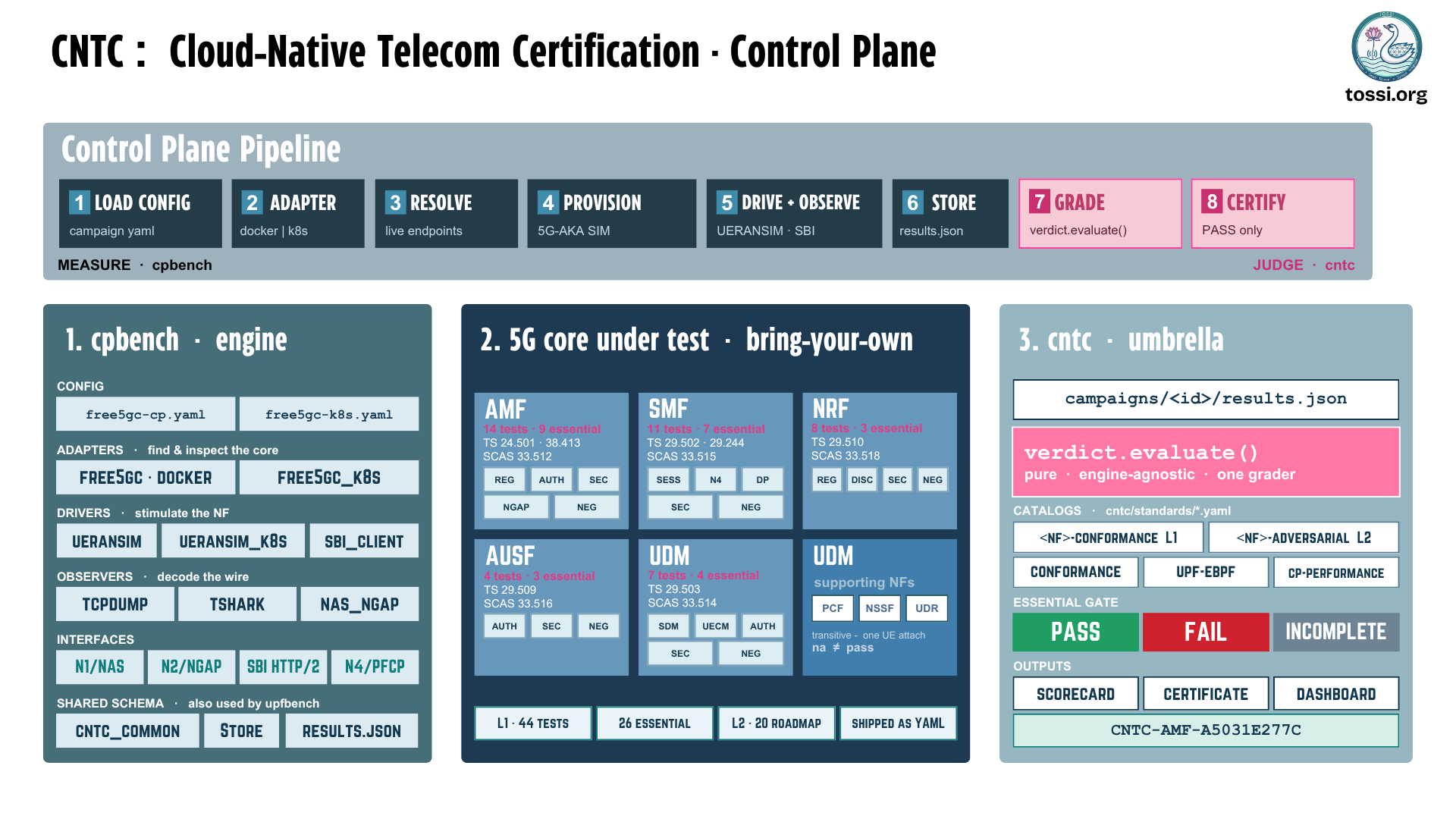
The cpbench engine measures, and the cntc umbrella judges. Keeping those two layers decoupled is what lets one grading core certify both the user plane and the control plane.
What it is
Section titled “What it is”Most of the industry can certify a device or a base station, but there is no open, reproducible way to certify a 5G core network function against its own 3GPP spec. Commercial tools that do this (Spirent, Keysight, Valid8, Emblasoft) are closed and expensive.
CNTC fills that gap with two decoupled layers:
| Layer | Role | Ships in this release |
|---|---|---|
cpbench engine | Measures. Drives each NF over its real interfaces and records results | control plane (AMF / SMF / NRF / AUSF / UDM) |
cntc umbrella | Judges. Grades results against a per-NF requirement catalog and issues a certificate | reused, unchanged |
The umbrella is pure and data-driven: it grades whatever test IDs appear in a results.json against a YAML catalog. The same umbrella already certifies the user plane (the UPF, via the sibling upfbench engine), so one grading core certifies the whole core.
How it tests, per NF and standard-anchored
Section titled “How it tests, per NF and standard-anchored”Every test maps to a clause of that NF's own 3GPP specification, covering both its stage-3 protocol spec and its SCAS security-assurance spec:
| NF | Protocol | SCAS | Driven via |
|---|---|---|---|
| AMF | TS 24.501 (NAS) · TS 38.413 (NGAP) · TS 33.501 (5G-AKA) | TS 33.512 | UERANSIM over N1/N2 plus on-the-wire capture |
| SMF | TS 29.502 (Nsmf) · TS 29.244 (N4/PFCP) | TS 33.515 | PDU sessions via UERANSIM plus N4 capture |
| NRF | TS 29.510 (Nnrf) | TS 33.518 | SBI client (HTTP/2 + TLS + OAuth2) |
| AUSF | TS 29.509 (Nausf) | TS 33.516 | SBI client plus transitive via registration |
| UDM | TS 29.503 (Nudm) | TS 33.514 | SBI client plus transitive via registration |
It drives each NF with a spec-compliant UE and SBI client, then observes the result. That includes capturing NAS on N2 and PFCP on N4 and decoding them, so security properties (NAS ciphering, control to dataplane binding, no auth bypass) are proven on the wire rather than assumed.
Two certification levels
Section titled “Two certification levels”| Level | Proves | Tests | Status |
|---|---|---|---|
| Level 1: Conformance & Observable Security | everything provable with a spec-compliant peer plus observation | 44 (26 essential) | shipped, v1.0 |
| Level 2: Adversarial Robustness & Privileged Interop | everything needing a non-compliant or privileged peer (forged, replayed or malformed state; registered-NF PKI) | 20 | roadmap |
The Level-1 guarantee: every L1 test is implemented, so a verdict is never INCOMPLETE because the tester did not build something. When a case genuinely cannot be judged on a deployment (the core enforces no OAuth2, or there is no UE to drive registration) the result is a transparent INCOMPLETE about that deployment: a reported gap, never a silent pass. An NF earns its certificate only when all its essential tests pass.
What a real run shows
Section titled “What a real run shows”Verified against a live free5GC on both deployment styles. Same tests, same NFs, different result, because the difference is the deployment's hardening (and what the rig can exercise), not the tests:
| NF | Docker free5GC | Kubernetes free5GC (Helm + in-cluster UE) |
|---|---|---|
| AMF | PASS (9/9) | PASS (9/9) |
| AUSF | PASS | INCOMPLETE1 |
| UDM | PASS | INCOMPLETE1 |
| SMF | FAIL, no TLS on SBI | FAIL2 |
| NRF | FAIL, no TLS on SBI | FAIL, serves discovery to an unauthenticated client (HTTP 200) and no TLS |
Docker: 3 of 5 certifiable. Kubernetes: AMF certifies, covering the full attach cycle (registration, 5G-AKA, NAS ciphering and integrity, and a wrong-key negative attach) driven by an in-cluster UE. Same harness, and it still surfaces every gap: the Kubernetes NRF serves the network topology to an unauthenticated client, a real authorization finding that the OAuth2-enforcing docker core does not have. The framework reports the gap. It does not rubber-stamp, and never fakes a pass.
1 AUSF and UDM core auth and subscription pass transitively, via registration; their SBI-authorization case is na because the default Helm free5GC does not enforce OAuth2, so a token-less call returns 400 rather than 401 or 403 and there is no authorization decision to grade.
2 the in-cluster single-node UPF has no N6 route, so the PDU-session data-path case cannot complete.
Quick start
Section titled “Quick start”Five steps, from a clean machine to a signed certificate. Each step below is self-contained: run them in order.
Step 1: Clone and install the tester
Section titled “Step 1: Clone and install the tester”Clone the repository from the main branch. The bootstrap script installs the system and Python dependencies and builds UERANSIM from source.
# clone the repository (main branch)
git clone -b main https://github.com/TOSSI-Foundation/CNTC.git
cd CNTC

# installs system deps, Python deps, and builds UERANSIM from source
./scripts/bootstrap_cpbench.sh
Step 2: Deploy the 5G core you want to certify
Section titled “Step 2: Deploy the 5G core you want to certify”CNTC is bring-your-own-core. Deploy the core under test however you normally would, on docker or on Kubernetes. It is tested against free5GC, Open5GS and OAI. Nothing needs to be installed into the core itself: CNTC drives it over its real interfaces, exactly as a peer network function would.
Step 3: Build a config and preflight
Section titled “Step 3: Build a config and preflight”The wizard auto-detects whether the core runs on docker or Kubernetes and writes a config for it. Then run the doctor: it must print READY before you continue.
# build a config (auto-detects docker vs Kubernetes)
make cp-configure

# preflight the rig; must print READY
make cp-doctor CONFIG=configs/<your>.yaml
Addresses are resolved live on every run (docker inspect or kubectl get svc), so redeploying the core needs zero config edits. The config holds only what cannot be derived (the N2 endpoint, the capture interface, subscriber credentials), and the wizard auto-detects even those.
Step 4: Run, grade, and issue certificates
Section titled “Step 4: Run, grade, and issue certificates”cp-run drives every network function and writes a results.json. cntc verdict grades those results against the profile's requirement catalog, and cntc certify issues a certificate when every essential test passes.
# drive all NFs and record results
make cp-run    CONFIG=configs/<your>.yaml NF=all

# grade the results, then issue the certificate
cntc verdict   campaigns/<id>/results.json --profile amf-conformance
cntc certify   campaigns/<id>/results.json --profile amf-conformance
Swap --profile for the NF you are certifying, and use NF=amf (or smf, nrf, ausf, udm) to run a single one instead of all.
Step 5: See it all in the dashboard
Section titled “Step 5: See it all in the dashboard”The dashboard is a live web view over every campaign you have run, with per-NF scorecards and the issued certificates.
make dashboardWhat is in the box
Section titled “What is in the box”The repository holds both certification engines plus the shared grading core:
| Directory | What it holds |
|---|---|
cpbench/ | the control-plane engine (adapters, drivers, observers, suites) |
cntc/ | the grading umbrella (verdict engine, certificate issuer, standards catalogs) |
cntc_common/ | the shared results schema |
upfbench/ | the sibling user-plane (UPF) engine |
dashboard/ | the live web dashboard over all campaigns |
scripts/ | bootstrap, config wizard, run helpers |
docs/ | architecture, the levels guide, the implementation report, diagrams |
The tool stack
Section titled “The tool stack”- UERANSIM, the gNB and UE simulator (N1/N2). AGPL-3.0; fetched and built by the bootstrap rather than bundled, so CNTC invokes it as a separate process and the two licenses never mix.
- SBI client, our own HTTP/2 + TLS + OAuth2 client for Nnrf, Nausf, Nudm, Namf and Nsmf.
- tcpdump and tshark, to capture and decode N2 (NAS) and N4 (PFCP) on the wire.
- pfcpsim, for N4/PFCP driving and observation.
License
Section titled “License”Apache-2.0. External drivers keep their own licenses and are fetched separately (UERANSIM is AGPL-3.0). See NOTICE or the bootstrap script for details.