
Artificial intelligence will not transform Open RAN by optimizing only one network parameter. The larger transformation will happen when the network begins to understand that every deployment environment is physically different.
A factory floor, urban street, warehouse, campus, railway corridor, or industrial site creates its own radio-propagation behaviour. Walls, pillars, vehicles, buildings, and other objects influence reflection, diffraction, scattering, blockage, and multipath propagation.
Traditional radio networks can measure the outcome of these effects through KPIs such as SINR, throughput, and latency. However, they do not directly understand the physical geometry that created those outcomes.
The integration of NVIDIA Sionna RT with the OCUDU RAN ecosystem addresses this gap by connecting a 3D digital representation of the physical world to a live cellular protocol stack. The result is a direct, asynchronous pipeline between the environment, the radio channel, and the operational RAN.
![End-to-end digital twin data flow in three stages. The World: Sionna RT uses GPU ray tracing over 3D geometry (a Munich OSM scene) to compute propagation paths. The Channel: the paths become CIR taps h[k] capturing true path loss and multipath, applied by the sionna radio driver through FIR convolution. The Network: the OAI nrUE and OCUDU-RAN run as a real stack and scheduler (MAC, SCHED, RLC, PDCP, RRC, PHY, F1AP, GTP-U), exchanging samples over ZMQ cf32 between the UE and gNB.](dataflow.png)
Sionna RT and OCUDU Digital Twin Architecture
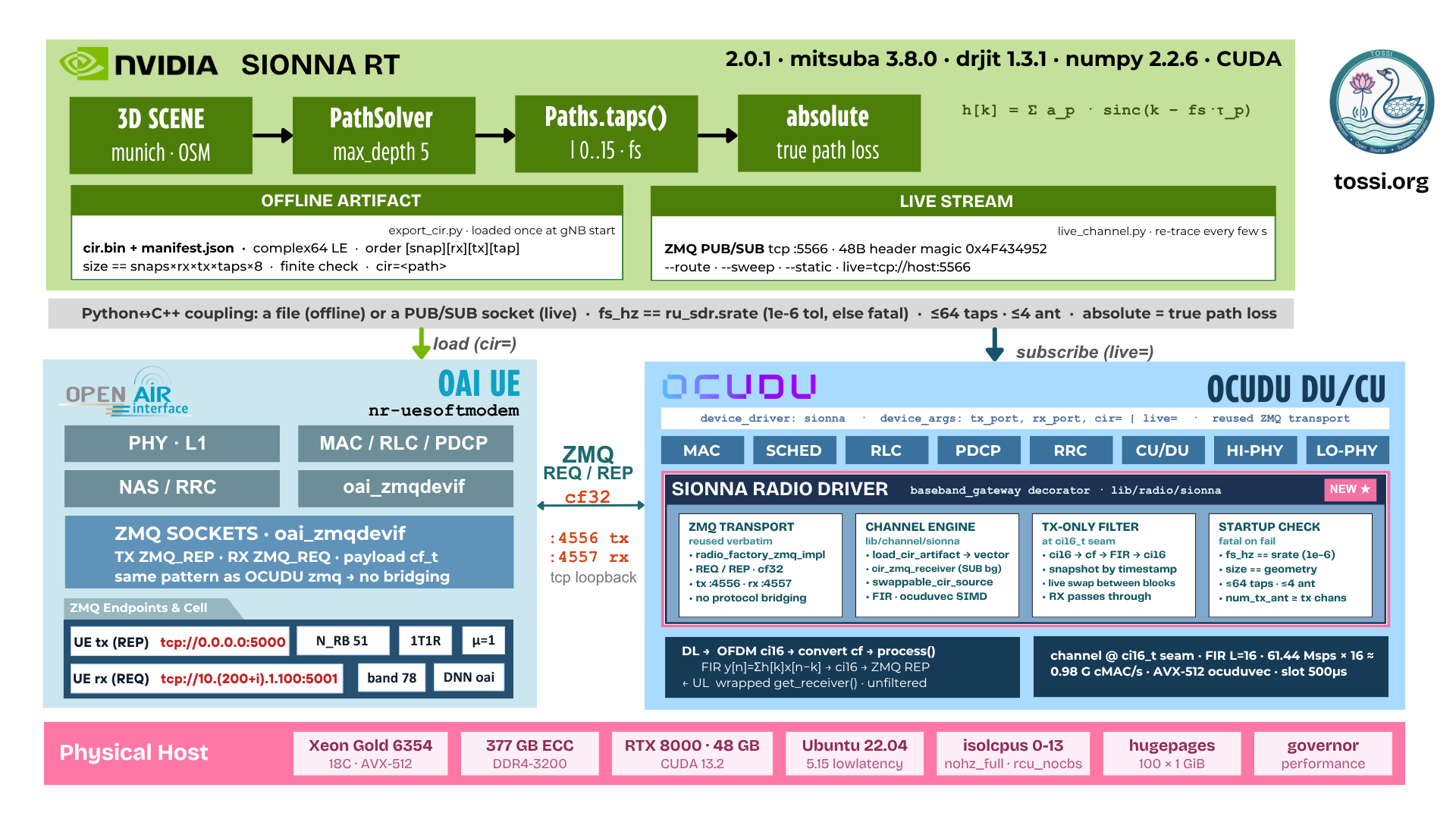
The integrated NVIDIA Sionna RT and OCUDU architecture connects a 3D representation of the physical environment directly to the live RAN processing path. NVIDIA Sionna RT uses GPU-accelerated ray tracing to calculate deterministic multipath propagation and generate Channel Impulse Response, or CIR, taps. These taps can either be loaded into the OCUDU RAN as an offline artifact or streamed in real time through a ZeroMQ PUB/SUB socket to the OCUDU DU. The DU then applies the updated channel to the downlink baseband signal using CPU-accelerated SIMD convolution before forwarding the processed samples to the OAI NR UE.
Why Statistical Channel Models Are Not Enough
For decades, wireless systems have been developed and tested using statistical channel models. Standard 3GPP channel profiles such as Tapped Delay Line, or TDL, and Clustered Delay Line, or CDL, introduce fading, delay, and multipath effects derived from generalized field measurements. These models remain highly useful for:
- Baseline performance testing
- Standards compliance
- Repeatable experimentation
- Generalized urban, indoor, and mobility scenarios
However, they represent an average radio environment. They do not know the exact structure of a specific deployment site. A statistical channel model cannot identify the precise location of a concrete wall, calculate the signal blockage caused by a passing vehicle, or reproduce the unique multipath signature of a particular factory floor.
This limitation becomes important for AI-RAN. When an AI model is trained using generalized channel data, it may learn the statistical behaviour of the channel generator rather than the physical characteristics of the actual deployment site. When the model is introduced into a live network, it may encounter propagation conditions that were not represented accurately during training. A true site-specific digital twin therefore requires a shift from statistical approximation toward deterministic physical modelling.
From 3D Geometry to a Running RAN Stack
The integrated architecture creates an end-to-end data path across three layers: the physical environment, the radio channel, the network.
First, a 3D representation of the environment is loaded into NVIDIA Sionna RT. The GPU-accelerated ray tracer calculates deterministic multipath propagation by tracing radio paths as they interact with the 3D scene. The resulting propagation information is represented as a Channel Impulse Response, or CIR. The CIR contains the channel taps required to model the delay and gain of the different radio paths.
These CIR taps can then be:
- Generated as an offline artifact
- Loaded into the RAN environment
- Streamed dynamically to the DU
- Applied to the baseband signal through channel convolution
In the demonstrated implementation, the CIR is either loaded offline or streamed through a ZeroMQ PUB/SUB socket directly to the DU. The actual channel convolution is then performed using CPU-based SIMD processing. This design connects site-specific physical geometry to a running cellular stack without requiring the RAN itself to perform the computationally expensive ray tracing.
Decoupling Ray Tracing from Real-Time RAN Processing
One of the most important elements of the architecture is the separation between the ray-tracing engine and the real-time radio-processing path. Complex GPU-based ray tracing may not always complete within the strict timing requirements of a RAN. The protocol stack cannot pause while waiting for a new channel calculation.
The implementation therefore uses an asynchronous live-streaming architecture. A background publisher continuously updates the receiver position inside the 3D scene and recalculates the ray-traced propagation path. The resulting CIR taps are streamed as discrete updates through a ZeroMQ PUB/SUB socket. The DU subscribes to these updates and replaces the active tap set at the next suitable processing boundary. The RAN does not need to restart; the protocol stack remains active while the environment changes around it.
During the documented end-to-end mobility test, the receiver moved along a 220-metre route. The SINR reported by the RAN dynamically followed the ray-traced path gain and building-shadow effects without requiring driver restarts. This demonstrates an important digital-twin capability: changes in physical geometry can influence live network KPIs while the RAN continues operating.
How the Downlink Data Path Works
In the current implementation, the ray-traced channel is applied to the downlink transmit path. The processing flow is:
- The lower PHY generates a
ci16_tbaseband buffer. - The baseband samples are converted into
cf_t, or complex float32, format. - The channel engine convolves the signal with the active CIR taps.
- The convolution is accelerated using
lib/ocuduvecand AVX-512 SIMD operations. - The processed signal is converted back to
ci16_t. - The resulting signal is forwarded through the ZMQ transport to the OAI NR UE.
The design also protects the real-time processing path. When a transmit block exceeds the preallocated processing capacity, the system passes the block through without filtering and records a warning. This prevents the radio link from stalling because of channel-processing delays. In the current release, the ray-traced channel is applied only to the downlink. The uplink remains unfiltered, allowing the implementation to isolate the environmental effects applied to downlink performance.
Why This Matters for AI-RAN
AI-RAN requires more than collecting network KPIs and training generic machine-learning models. For site-specific intelligence, the AI system must understand how the physical environment affects the radio channel. A deterministic digital twin can provide a controlled relationship between:
- 3D environmental geometry
- Radio propagation
- Channel impulse response
- Baseband signal processing
- RAN behaviour
- Network KPIs
This creates a stronger foundation for training and evaluating AI models against realistic deployment conditions. Instead of training only on generalized random fading, researchers can expose AI models to the multipath characteristics of a specific environment. For example, a model can observe how building shadows affect SINR along a defined route, how receiver movement changes the active propagation paths, or how physical obstructions influence downlink performance. The objective is not simply to simulate a radio channel. It is to connect the physical environment directly to the operational behaviour of the RAN.
A Deterministic Foundation for Digital-Twin Research
The architecture establishes an observable and repeatable pipeline for physical-layer experimentation. Because the environment, receiver path, and channel updates can be controlled, researchers can compare different RAN or AI implementations under the same physical conditions. This is especially relevant for:
- Site-specific AI-RAN training
- Mobility analysis
- Physical-layer validation
- Environmental path-loss measurement
- Shadowing analysis
- Controlled RAN experimentation
- Digital-twin-based performance testing
The current implementation intentionally begins with a stable baseline focused on environmental path loss and shadowing before introducing more complex spatial-processing scenarios.
The Hardware Reality
High-fidelity physical modelling requires significant compute and memory resources. Large 3D environments can consume substantial GPU memory because the ray tracer must process the scene geometry and calculate large numbers of radio paths. The reference implementation was validated using an NVIDIA Quadro RTX 8000 with 48 GB of VRAM, and GPU memory becomes a major constraint when ray tracing complex scenes such as the built-in Munich city model.
The architecture therefore separates the workload:
- The GPU performs the computationally intensive ray tracing.
- The host CPU performs the channel convolution.
- The gNB continues executing its real-time functions.
This division allows the digital twin to scale its physical modelling without placing the entire workload inside the deterministic gNB execution path.
The Path Toward 6G
The current integration establishes a real-time, one-way deterministic channel pipeline from a 3D environment into a running Open RAN stack. It demonstrates that the physical world can be represented digitally and continuously streamed into the RAN without restarting the network. The roadmap includes:
- Advanced MIMO link mapping
- Reciprocal channel applications
- Uplink channel integration
- Differentiable radio-system research
- 6G autoencoder experimentation
- Joint training of neural networks against site-specific radio physics
Because NVIDIA Sionna is built on differentiable programming frameworks, the architecture may eventually support systems in which communication algorithms and neural-network models are optimized directly against realistic environmental propagation. This represents an important shift. The digital twin is no longer only an offline visualization or planning tool. It can become an active component of the RAN research, training, and validation environment.
Final Perspective
The integration of NVIDIA Sionna RT with OCUDU demonstrates how 3D physical geometry, GPU ray tracing, live CIR streaming, and operational RAN processing can be combined into one deterministic digital-twin pipeline. Traditional channel models remain essential for standardized and generalized testing. However, site-specific AI-RAN requires an additional layer: a model of the actual physical environment in which the network will operate.
By streaming deterministic propagation conditions into a live RAN stack, researchers can evaluate how physical reality influences network behaviour without stopping the network or relying entirely on generalized statistical assumptions.
The AI model may continue to change. The physics remains real. The platform connects both.
- Documentation: SIONNA RT with OCUDU RAN
- OCUDU-RAN: github.com/TOSSI-Foundation/OCUDU-RAN