
India's 5G journey did not begin with commercial 5G rollout. It began with a much bigger ambition: can India build its own telecom technology stack instead of remaining only a large consumer market for global telecom vendors?
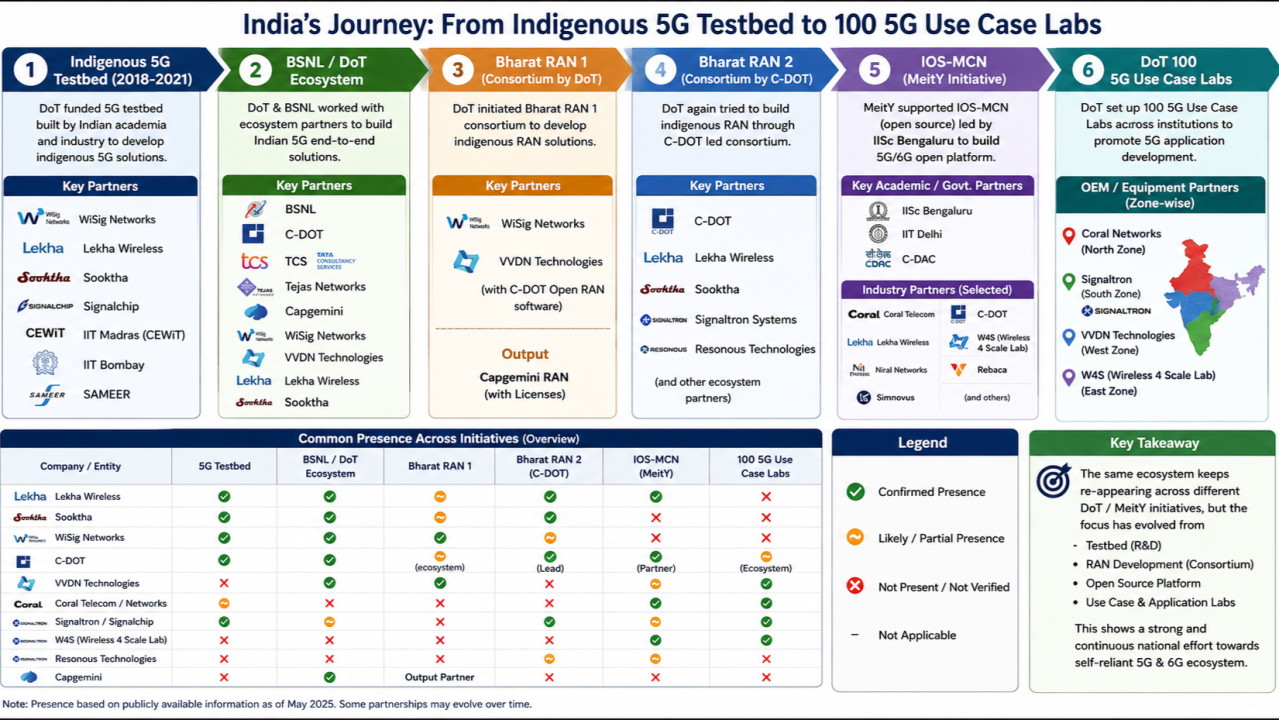
From 2018 to 2026, India's 5G ecosystem moved through several important phases: Indigenous 5G Testbed, then the BSNL/DoT ecosystem push, then Bharat RAN 1, then Bharat RAN 2, then IOS-MCN, then 100 5G Use Case Labs.
Alongside this journey, there is one important case study India must remember before 6G: 5Gi. 5Gi showed that India can contribute to global standards. But it also showed that a standard feature alone does not create market impact unless operators, OEMs, chipset vendors, network vendors, deployment economics, and product roadmaps are aligned.
1. 2018 to 2021: The Indigenous 5G Testbed
India's foundational 5G journey began with the Indigenous 5G Testbed Project. Based on the available testbed material, the project was first proposed by Prof Arogyaswami Paulraj, funded by the Department of Telecommunications (DoT), planned as a three-year national project, and developed around the 2018 to 2021 timeframe.
The project brought together major institutions such as IIT Madras, IIT Bombay, IIT Hyderabad, IIT Delhi, IISc Bengaluru, IIT Kanpur, CEWiT, and SAMEER, along with Indian industry partners such as Lekha Wireless, WiSig Networks, Sooktha, and SignalChip.
The simplified 5G stack can be understood as: Radio to L1 to L2/L3 to Core to IMS. In this flow, the L2/L3 RAN stack was linked with IIT Madras and CEWiT, with industry partners such as Lekha Wireless and Sooktha. The Core network was linked with IIT Bombay. IMS was linked with Coral Telecom. IIT Hyderabad contributed on the standards side through TSDSI, 3GPP, and ITU-related work, including the 5Gi / LMLC story.
This was not just a lab demo. It was an attempt to build a full-stack Indian 5G technology base.
2. Post-Testbed: The BSNL and DoT Ecosystem Push
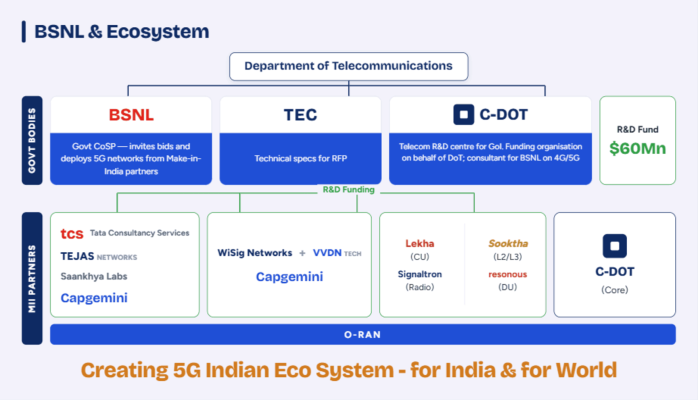
After the Indigenous 5G Testbed, DoT's focus expanded toward creating a broader Indian 5G ecosystem. The BSNL/DoT ecosystem flow showed the involvement of public-sector bodies, Indian companies, and technology partners, under the larger message: "Creating a 5G Indian Ecosystem, for India and for the World."
The ecosystem included names such as C-DOT, BSNL, TCS/Tejas, Capgemini, WiSig Networks, VVDN, Lekha Wireless, and Sooktha. This was the phase where India started moving from testbed capability toward practical telecom ecosystem development. The focus was no longer only on proving that India could build 5G components; it started moving toward building an Indian 5G ecosystem that could support real deployment and productization.
3. Bharat RAN 1: First RAN Consortium Push
The next step was Bharat RAN 1. Based on the discussed flow, Bharat RAN 1 was the first major RAN consortium effort after the Indigenous 5G Testbed. WiSig Networks appears as a key partner in this phase, and the output was described as Capgemini RAN with licences. In simple terms, Bharat RAN 1 represented an attempt to move from research capability toward RAN productization.
4. Bharat RAN 2: C-DOT's Another RAN Attempt
After Bharat RAN 1, DoT again tried to build indigenous RAN capability, this time through C-DOT. The partners discussed in this context include Lekha Wireless, Sooktha, Signaltron, and other ecosystem partners. The key meaning of Bharat RAN 2 is that DoT again tried to build RAN, this time through a C-DOT-led model.
This shows a recurring pattern in India's telecom policy: when one model does not fully convert into a market-ready outcome, the same ecosystem is reorganized through another structure with a bigger vision and a renewed objective. This is not necessarily wrong. Reattempts are part of technology development. But the important question is: did the reorganization create a better product outcome, or did it only create another initiative?
5. MeitY Enters: IOS-MCN and the Open-Source Model
The next stage brought MeitY into the picture through IOS-MCN, the Indian Open Source for Mobile Communication Networks. This time IISc Bengaluru, one of the academic institutions from the earlier 5G Testbed ecosystem, became central to the open-source direction. Earlier the model was testbed to RAN consortium to C-DOT-led RAN; now the model became an open-source mobile communication platform. Its partner ecosystem includes names such as Coral, Lekha, Niral Networks, Rebaca, and W4S, among others.
The code-level assessment indicates that a substantial majority of the released software appears to correspond to upstream open-source code reused through configuration, integration, automation, interface development, containerisation, refactoring, and deployment engineering. The genuinely original India-developed work appears to be a smaller part of the complete platform, broadly estimated at around 4 to 6 percent, based on the assessment discussed.
The core network baseline appears to be based on older OMEC / SD-Core lineage, while parts of the unified Radio Access Network also appear to track older OpenAirInterface releases. The OpenAirInterface RAN and associated components are governed by the OpenAirInterface Public License v1.1, which is based on Apache License 2.0 but includes an additional patent-related provision involving fair, reasonable, and non-discriminatory terms for certain commercial uses.
This does not mean IOS-MCN has no value. Integration itself is important. Packaging, testing, deployment automation, documentation, and making open-source telecom usable for Indian institutions is meaningful work. But we should be honest about what it is. IOS-MCN appears to be primarily an integration and distribution effort around established international open-source telecom projects, rather than a fully India-originated RAN and Core stack.
That distinction matters for 6G. If India wants to lead 6G, it cannot only integrate global open-source code. It must also create core intellectual property, original algorithms, production-grade implementations, security architecture, field-tested RAN/Core modules, and deployable products.
6. DoT 100 5G Use Case Labs: From Stack Building to Application Enablement
Then DoT moved toward 100 5G Use Case Labs. This was a different kind of initiative. The earlier initiatives focused on building the 5G platform and stack; the 100 5G Use Case Labs focused on enabling institutions, startups, and students to experiment with 5G applications. The partners were Coral Networks/Coral Telecom, Signaltron, VVDN, W4S, and others.
This stage represents a shift from "Can India build 5G?" to "Can Indian institutions and startups build applications on top of 5G?" However, the main issue is not only applications on top of 5G. A more important national objective should be to provide institutions with practical access to Radio, RAN, Core, L1, L2, L3, and full telecom system environments so that India can build deeper research and development capacity.
These labs can become very important for 6G, but only if they are not treated as closed demonstration environments. They should allow students, researchers, and startups to understand and experiment with:
- RAN internals
- Core network behaviour
- protocol stack design
- open interfaces
- security
- AI-RAN
- private network use cases
- spectrum and RF behaviour
- interoperability
- and real telecom deployment constraints
If these labs become only application demo centres, India will miss the deeper opportunity. The real value of the 100 5G Use Case Labs should be to create a future 6G research base, not just a 5G application showcase.
7. The 5Gi Lesson for India's 6G Ambition
The Indian 5Gi Standard Essential Patent story should be treated carefully. The work around pi/2-BPSK with spectrum shaping was important. The IIT Hyderabad / CEWiT / WiSig ecosystem contributed to this technical area, and WiSig declared certain 5G NR patents to TSDSI. Public claims also mention 15 declared 3GPP 5G SEPs. However, this should be treated as declared or potential SEP ownership, not as legally proven exclusive ownership of the entire pi/2-BPSK feature.
pi/2-BPSK was not an isolated invention owned by one party. Around the same technical area, global telecom companies such as Qualcomm, Ericsson, Samsung, Huawei/HiSilicon, ZTE, Nokia, LG, and Sierra Wireless also had patents or 3GPP contributions related to pi/2-BPSK, FDSS, low-PAPR waveform design, DMRS, reference-signal generation, and uplink transmission methods. Other companies were active in the same technical cluster: Qualcomm on pi/2-BPSK reference signal and DMRS port generation, Ericsson on DMRS of pi/2-BPSK signals, Samsung on spectrum shaping for pi/2-BPSK DFT-s-OFDM, Huawei/HiSilicon on pi/2-BPSK with FDSS performance evaluation, and ZTE on pi/2-BPSK data/reference sequence modulation.
Therefore, the real question is not simply who filed patents. The real question is claim-level essentiality: which exact patent claims are unavoidable for implementing the standardized Release-17 feature, and is that feature actually deployed in commercial networks and devices? Without deployment, even a declared SEP may have limited commercial value.
India's 6G ambition cannot be only about writing proposals, creating national visions, or announcing testbeds. The 5Gi story shows that standards leadership requires deployment alignment from day one. For 6G, India must do five things differently:
| Lesson from 5Gi | 6G action required |
|---|---|
| Do not build a separate national island first | Start inside 3GPP / ITU from the beginning |
| Technical merit is not enough | Show measurable range, capacity, cost, and device-impact data |
| Optional specs may remain unused | Secure operator and OEM commitment before pushing features |
| Standards without products do not create leadership | Link every standards proposal to a product roadmap and deployment |
| Patents matter only if they ship | Focus on implementable, licensable, deployed IP |
The clean 6G takeaway is: India should not repeat a "standard-first, deployment-later" model. For 6G, the model must be "deployment-backed standards." 5Gi teaches India that SEP strategy cannot be separated from deployment strategy. For 6G, India should not only ask "Can we get this accepted in the standard?" India must also ask "Will this be implemented by vendors, enabled by OEMs, demanded by operators, and used in real networks?"
5Gi proved that India can enter the standards room. But 6G will test whether India can convert standards participation into shipped products, deployed features, and real SEP value.
8. The 2018 to 2026 Pattern
Looking at the full journey, India has not been inactive. In fact, India has done many things: built an Indigenous 5G Testbed, created a BSNL/DoT 5G ecosystem push, attempted Bharat RAN 1 and Bharat RAN 2 through C-DOT, launched IOS-MCN through MeitY and IISc, created 100 5G Use Case Labs, and contributed 5Gi into 3GPP Release 17.
The issue is not lack of effort. The issue is conversion. India repeatedly builds initiatives, consortiums, platforms, and new program structures. But the hard question is: how many of these become carrier-grade products, deployed at scale, supported by operators, enabled by OEMs, accepted by chipset vendors, and exported globally? That is the difference between participation and leadership.
9. Final Takeaway
India's 5G journey from 2018 to 2026 is not a failure story. It is a learning story. It shows serious national intent. The Indigenous 5G Testbed showed that India can build technical capability. Bharat RAN 1 and Bharat RAN 2 showed that India wants indigenous RAN. IOS-MCN showed that India is exploring open-source telecom software. The 100 5G Use Case Labs showed that India wants use-case adoption. 5Gi showed that India can influence global standards.
But 5Gi also gave the most important warning: a standard that does not ship is only a document. A testbed that does not become a product is only a prototype. A consortium that does not get operator pull is only a project.
India's 6G ambition must therefore be built around deployment-backed standards, not standards-only ambition. For 6G, India should focus on practical problems where it can show measurable global value:
- rural coverage
- energy-efficient RAN
- AI-native networks
- NTN integration
- quantum-safe telecom security
- ISAC
- low-cost private networks
- trusted Open RAN
- secure and scalable indigenous Core and RAN
The next question is no longer whether India can participate in telecom standards. India has already shown that it can. The real question is: can India convert standards contributions into products that operators deploy, OEMs enable, users experience, and global markets adopt?
DoT and MeitY are trying to create reference open and deployable Core and RAN platforms. That direction is important. But after years of investment, India still does not appear to have a widely deployed, industry-grade, open, secure, scalable indigenous RAN and Core stack. This is critical for 6G. One possible reason is the repeated circular model of the same academic institutions and industry partners appearing across multiple initiatives without clear accountability for carrier-grade product outcomes.
Every new initiative comes with a bigger vision, new branding, and new promises. But India now needs measurable output: working products, open and usable code, operator-grade deployments, independent audits, security validation, interoperability, chipset and OEM alignment, and export readiness. This is the right time for DoT, MeitY, and other funding agencies to demand stronger accountability from every publicly funded telecom initiative.
India should move away from the culture of repackaging the same work in different wrappers. The focus should shift from announcements to outcomes: from testbeds to deployments, from consortiums to products, from declared patents to shipped features, from open-source integration to original telecom IP, and from 5G learning to 6G leadership. That is the path India must take if it wants to lead, not just participate, in the next generation of telecom.
Disclaimer: This article is based on publicly available information, presentations, official material, media reports, standards-related references, and ecosystem discussions available in the public domain. The intent of this blog is not to target, criticize, or undermine any company, academic institution, government body, or individual. The core purpose is to discuss what India can learn from its 5G journey and how the country can take a more practical, deployment-driven path for 6G.