
A 5G scheduler is only as effective as the channel information available when it makes a decision. For downlink transmission, that information is often already slightly outdated. ML-based CSI prediction replaces the conventional hold-last-CQI assumption with a per-UE forecast of the next report, so the scheduler can act on where the channel is heading, not only where it was last measured.
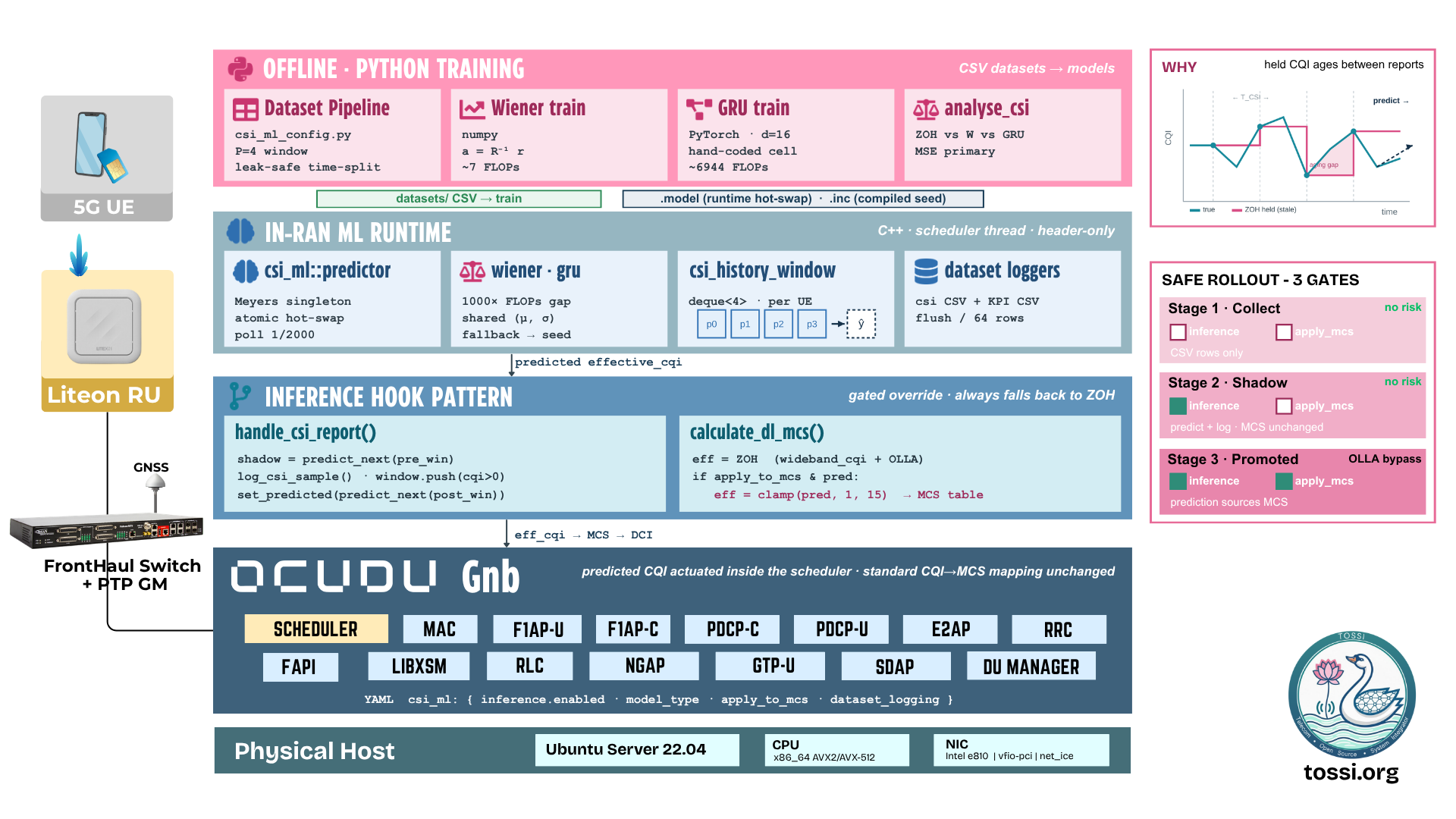
The User Equipment periodically reports its observed radio conditions through Channel State Information, including the Channel Quality Indicator, or CQI. The scheduler uses the reported CQI to select an appropriate modulation and coding scheme for the next downlink transmission. The challenge is that CQI reporting is periodic rather than continuous. Between two reports, the scheduler generally continues using the most recently received value, effectively assuming the radio channel has remained unchanged.
That assumption may hold for a stationary device in a stable radio environment. But commercial mobile networks are highly dynamic. Users walk, drive, enter buildings, turn corners, and move through areas with different interference and propagation conditions. As the device moves, its actual radio channel can quickly diverge from the channel condition represented by the last reported CQI. To address this, we selected the OCUDU Ecosystem as the technical foundation for ML-based CSI prediction and intelligent 5G scheduling: the approach uses recent per-UE channel history to forecast future CQI values, letting the scheduler consider where the channel is heading instead of relying only on where it was last measured.
The Blind Spot Between CQI Reports
Consider the interval between two CQI reports. The UE measures the radio channel at a particular point in time and reports the corresponding CQI to the base station. The scheduler then uses that value for multiple downlink scheduling decisions until the next report becomes available. If the radio channel changes during this interval, the scheduler continues operating with stale information.
This mismatch can produce two outcomes. When the scheduler assumes the channel is better than it actually is, it may select an overly aggressive modulation and coding scheme, resulting in failed transport blocks, HARQ retransmissions, and lower effective throughput. When it assumes the channel is worse than it actually is, it may select a conservative transmission rate; the transmission may succeed, but part of the available radio capacity remains unused.
The problem is therefore not limited to selecting a better modulation and coding scheme. The more fundamental challenge is improving the scheduler's understanding of the channel at the moment the transmission decision is made. This blind spot grows more significant as UE mobility increases, the radio channel changes rapidly, interference varies between reports, the latest CQI becomes older, and the interval between reports widens.
From Channel Reporting to Channel Prediction
Our approach replaces the conventional hold-last-CQI assumption with a predictive mechanism. Instead of repeatedly reusing the latest reported CQI, the scheduler examines a short history of channel-quality reports for each UE. A prediction model processes this sequence and estimates the CQI likely to be available at the next scheduling instant. The predicted CQI is then supplied to the existing downlink rate-selection logic.
The scheduler can therefore make a decision based not only on where the channel was when it was last measured, but also on where it is likely to be when the transmission takes place. In this context, ML-based CSI prediction is implemented by forecasting future CQI values from recent CQI history, changing the scheduler from entirely reactive to predictive.
Per-UE Intelligence Inside the RAN
Radio-channel behaviour is different for every connected device. One UE may be stationary, another walking, another travelling in a vehicle. Devices can also experience different interference levels, propagation conditions, obstacles, and reporting patterns. For this reason, our framework does not generate one common prediction for the entire cell.
Each UE maintains its own short channel history and receives an independent CQI forecast, so the scheduler can adapt its downlink decision to the behaviour of each individual radio link. This creates a practical form of per-UE intelligence inside the RAN. The objective is not to learn one generalized channel behaviour and apply it uniformly to every user, but to let the network respond intelligently to the recent radio conditions experienced by each connected UE.
Two Prediction Engines, One Framework
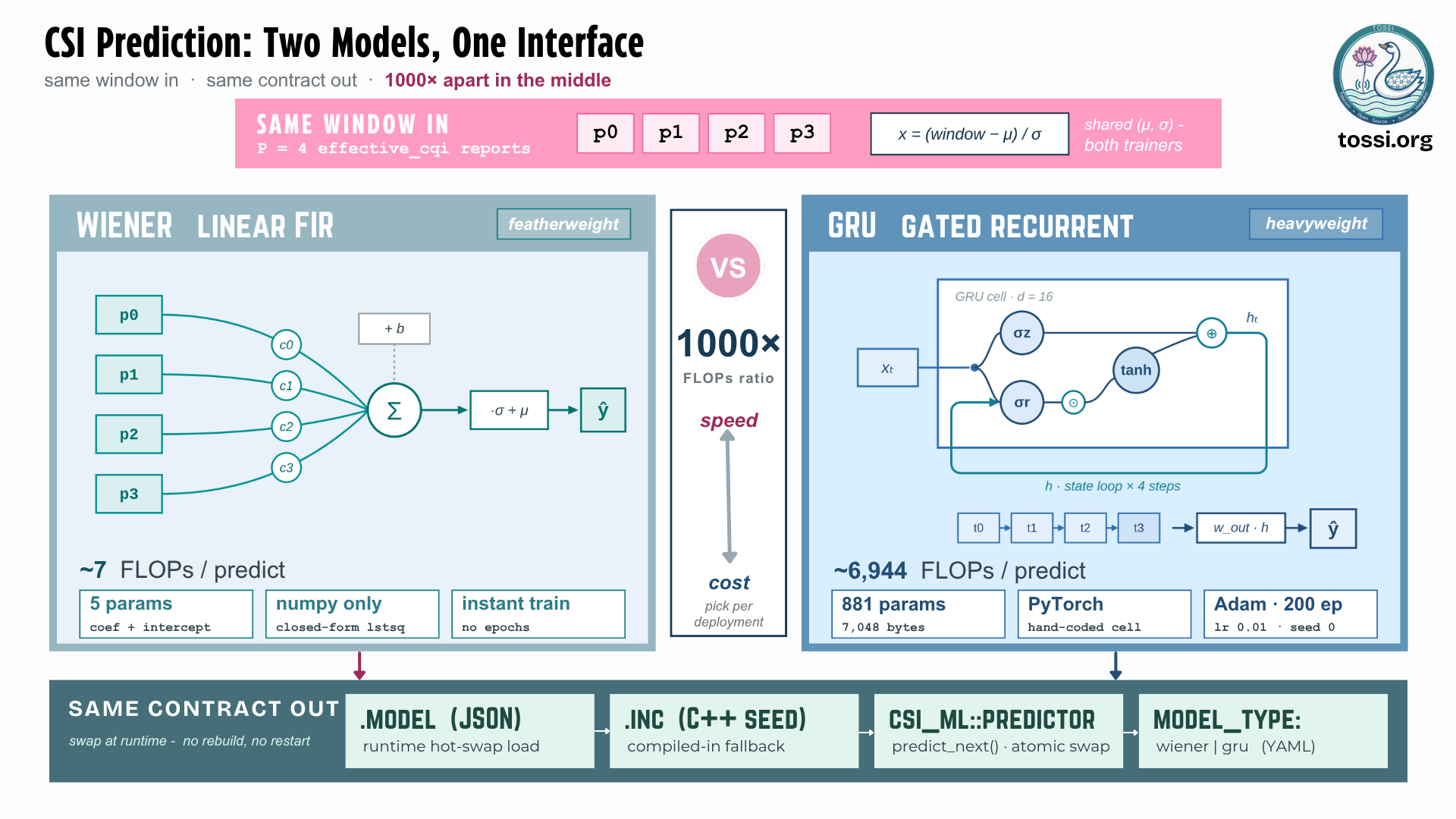
This reference implementation provides two prediction engines behind a common interface.
Lightweight linear predictor
The first option is a lightweight linear predictor. It identifies the short-term direction or trend of the channel and requires very little computational overhead. This model can be effective in relatively stable environments where the channel changes gradually and its recent trend provides a useful indication of what is likely to happen next.
Compact neural predictor
The second option is a compact neural predictor. It is designed to learn more complex channel dynamics that may not be represented adequately by a simple linear trend. This becomes more relevant when UE mobility increases and the radio channel changes in a less predictable manner.
Both models use the same type of per-UE channel-history data, generate the same type of CQI forecast, connect to the same scheduling interface, can be trained using the same data pipeline, and can be selected through configuration. This lets a deployment choose an appropriate balance between prediction capability and computational cost: a lightweight predictor may be sufficient for stable environments, while a compact neural model may provide additional value under higher mobility and more complex channel conditions.
Building on the Foundation Established in Release 1
The CSI-prediction capability is not an isolated machine-learning model added to the scheduler. It builds on the open AI-RAN framework established through OCUDU AI-RAN Release 1, which introduced intelligent link adaptation for the uplink. Release 1 established the broader lifecycle required to introduce AI safely into the RAN:
- Over-the-air data collection
- Offline model training
- Lightweight runtime inference
- Per-UE decision-making
- Shadow-mode validation
- Runtime model updates
- Fallback to conventional scheduling
For this work, we selected the same OCUDU AI-RAN foundation and applied its architectural principles to ML-based CSI prediction for downlink scheduling. While Release 1 focused on improving uplink link-adaptation decisions, CSI prediction addresses a different but closely related problem: improving the quality of channel information available to the downlink scheduler. The same data pipeline, inference architecture, staged rollout process, and operational safeguards can therefore be reused rather than rebuilt for every new AI-RAN application. That is one of the key advantages of building a reusable AI-RAN framework instead of deploying a series of isolated models.
Lightweight Inference Inside the DU
A major architectural question for AI-RAN is where the inference process should run. For real-time scheduling, sending channel data to an external AI platform and waiting for a response may introduce unnecessary latency, transport dependency, and operational complexity. In the selected architecture, prediction is performed directly within the Distributed Unit.
The models execute as lightweight arithmetic close to the scheduling path. The DU does not need to send each prediction request to an external cloud service or separate inference server. The prediction mechanism does not require an external inference server in the scheduling loop, a heavyweight machine-learning runtime linked into the DU binary, a remote AI platform for every scheduling decision, or additional network round trips for real-time inference. Keeping the prediction close to the scheduler matters because downlink scheduling operates under strict timing constraints.
The framework also supports runtime model loading and model replacement. A newly trained model can be introduced into the running system without redesigning the complete base-station architecture or restarting the network function, so models can be retrained for specific deployment conditions and updated as radio environments evolve.
Building Training Data from Normal Network Operation
The AI lifecycle begins with data the network already produces. Every CQI report received from a UE can become part of a labelled training example: the recent CQI sequence is used as the model input, while the value observed immediately afterward becomes the expected output. Over time, normal over-the-air operation produces a dataset representing the actual radio conditions experienced by the network.
This approach does not require a new message from the UE, packet captures as the primary data source, changes to the physical layer, or synthetic channel generation for every training scenario. The models are trained offline and can then be exported in two forms: a runtime-loadable model that can be updated or hot-swapped, and a compiled seed model included within the software binary. Separating offline training from lightweight runtime inference helps make the architecture practical for DU-side deployment.
Shadow Mode Before Scheduler Control
Introducing machine learning into a real-time scheduler requires a controlled validation process. A model should not immediately be allowed to influence live radio decisions simply because it performed well during offline testing. Our framework addresses this through shadow mode.
In shadow mode, the model receives live per-UE channel histories and generates CQI predictions, but those predictions do not affect actual scheduling decisions. The conventional scheduler continues operating while the model's output is recorded. The predicted values can then be compared with the CQI values that were subsequently reported, the conventional hold-last-CQI estimate, the model's offline evaluation results, and observed behaviour under real radio and traffic conditions. Only after the prediction model has been validated in the live environment should its output be promoted to influence the downlink rate-selection process. This staged approach provides a practical transition from model development to operational deployment.
Safe Fallback to Conventional Scheduling
A prediction model may not always have enough information to generate a useful forecast. Immediately after a UE connects, the scheduler may not yet have accumulated sufficient channel history. Prediction may also be unavailable during model initialization or when the required inputs are incomplete. In these situations, the implementation falls back to the conventional scheduling behaviour and uses the most recently reported CQI.
The predictive mechanism therefore supplements the existing scheduler rather than completely replacing it. The operating principle is straightforward: use the predicted channel value when sufficient history and a usable forecast are available; otherwise, continue using the established CQI-based scheduling method. This fallback is essential for introducing AI into an operational RAN function without making normal scheduling dependent on the continuous availability of the prediction model.
Where CSI Prediction Provides the Most Value
The benefit of channel prediction will not be identical in every radio environment. For a stationary UE on a stable channel, the latest CQI report may already provide an accurate representation of the current channel condition, and the predictive scheduler should remain close to the conventional baseline. The value of prediction increases when the channel changes between reports; the approach is therefore expected to provide the greatest benefit when the UE is moving, channel conditions are changing rapidly, CQI information is ageing, the interval between reports is wider, interference conditions are variable, or the last reported CQI no longer represents the current radio link. These are precisely the conditions in which the hold-last-CQI assumption becomes less reliable and a forecast has more useful information to contribute.
This work evaluates the predictive scheduler using mobile UE conditions in a controlled environment and compares it with the conventional baseline under matched radio and traffic conditions. The results show that both the GRU and Wiener predictors reduce prediction error compared with the conventional Zero-Order Hold approach, and the improvement becomes more significant as channel ageing and UE mobility increase. In the controlled downlink test, the predictive scheduling configuration also achieved higher throughput, with the GRU-based approach showing the strongest result among the evaluated configurations.
Standards-Compatible by Design
An important advantage of this architecture is that the prediction remains internal to the base station. The approach does not require a new signaling message between the UE and the gNB, modification of the CQI reporting procedure, a new air-interface protocol, changes to the existing modulation and coding tables, or new capability negotiation with the UE. The only change is the channel-quality value supplied internally to the existing rate-selection logic.
The surrounding air-interface behaviour and existing 3GPP procedures remain unchanged. This means predictive intelligence can be introduced into the scheduler without requiring corresponding changes in commercial user devices or other network functions. The network continues using the channel information it already receives; the improvement comes from using that information more intelligently.
A Reusable AI-RAN Foundation
For this work, OCUDU has been selected not simply as a source of one prediction model, but as a reusable open-source AI-RAN foundation. The framework brings together several capabilities required for operational AI inside the RAN: per-UE data collection, offline model training, lightweight DU-side inference, runtime model loading, shadow-mode validation, staged activation, live model replacement, and fallback to conventional scheduler behaviour.
The same lifecycle can be reused for additional AI-RAN applications instead of building a separate data pipeline, runtime environment, and validation process for every individual use case. OCUDU AI-RAN Release 1 introduced intelligent link adaptation for the uplink; building on that foundation, CSI prediction extends per-UE intelligence to downlink scheduling by forecasting future channel conditions. Both capabilities use the same broader AI-RAN lifecycle, so each new AI-RAN application can build on a common framework rather than reinventing the complete operational architecture.
From Open Interfaces to Open Intelligence
Open RAN has helped open network interfaces and create new opportunities for interoperability and innovation across the RAN ecosystem. The next step is to open the intelligence operating behind those interfaces. ML-based CSI prediction demonstrates how AI can be introduced into 5G scheduling without moving every real-time decision to an external inference platform, modifying the air interface, or removing the safety of conventional scheduler behaviour.
The scheduler no longer needs to rely only on the last known state of the channel; it can begin estimating what the channel may look like when the next transmission takes place. That is the transition from reactive scheduling to predictive and intelligent 5G scheduling. Open RAN opened the interfaces. Open AI-RAN is opening the intelligence behind them.
Availability
- Demo Video: ML-Based CSI Prediction for Intelligent 5G Scheduling
- GitHub: TOSSI-Foundation/OCUDU-RAN
- Documentation: Predictive CSI for 5G Link Adaptation (TOSSI Docs)