
OCUDU RAN is moving Open RAN from basic connectivity validation to real mobility readiness. In cellular networks, mobility is not just a feature, it is the foundation of user experience. A network must keep sessions alive as users move across coverage areas, radio conditions change, and serving cells are updated. Whether the user is streaming, communicating, or transferring data, the transition between cells must remain seamless.
With this release, TOSSI demonstrates standards-based inter-gNB handover and O-RAN O1 integration in a real Open RAN deployment built using OCUDU RAN, SD-Core, LiteON Radio Units, and commercial off-the-shelf UEs.
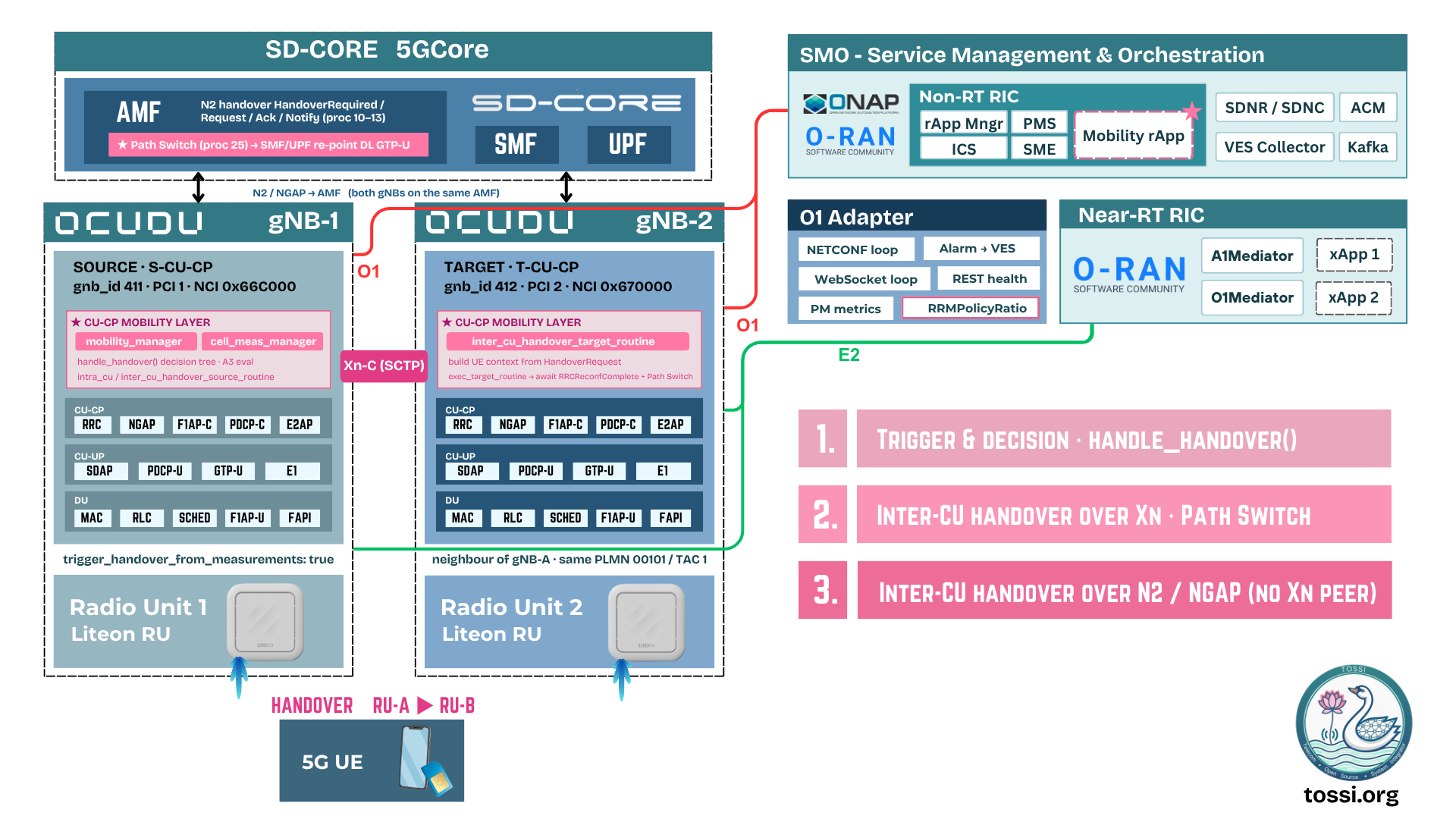
Understanding Inter-gNB Mobility
Inter-gNB handover occurs when a UE moves between cells served by different gNBs. Unlike mobility within a single node, this requires coordination between independent gNBs while preserving UE context, bearer continuity, and user-plane session stability.
This is a critical capability for production-grade 5G networks because mobility must work reliably across multiple cells, multiple nodes, and real deployment conditions.
In 3GPP-based networks, inter-gNB mobility can be supported through standardized procedures such as Xn-based handover and N2-based handover. Mobility decisions may also be driven by UE measurement reports, including Event A3, where the UE reports that a neighboring cell has become better than the serving cell based on configured radio thresholds.
Demonstrating End-to-End Open RAN Mobility
This release demonstrates inter-gNB mobility in a complete Open RAN environment using:
- OCUDU RAN
- SD-Core
- LiteON Radio Units
- Commercial off-the-shelf UEs
- Real over-the-air network validation
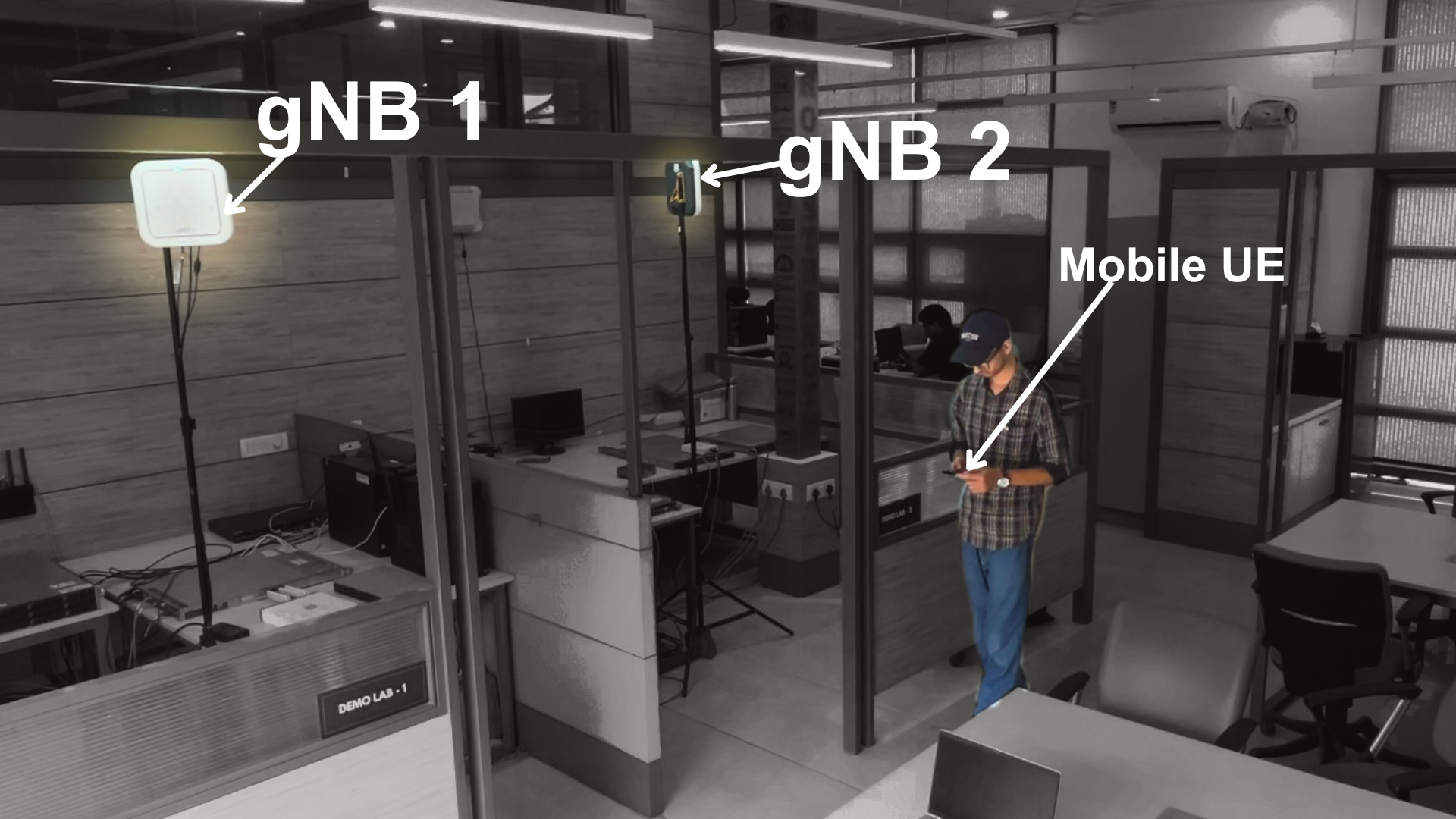
The demonstration validates two important mobility scenarios:
- Network-triggered handover. The gNB explicitly initiates the handover and commands the UE to move to a neighboring cell.
- UE-triggered mobility using 3GPP Event A3. The UE monitors neighboring cells and reports when a neighboring cell becomes better than the serving cell according to configured mobility thresholds.
By validating both operator-controlled and measurement-driven mobility, this release shows that Open RAN can support real mobility behavior beyond basic connectivity.
Bringing Mobility into O-RAN Operations
Mobility should not only work inside the RAN. It should also be visible, manageable, and programmable through standardized interfaces.
With O-RAN O1 integration, the platform exposes mobility-related information such as handover events, UE measurement reports, RSRP, RSRQ, SINR, mobility-related configuration, and operator-driven handover procedures.
This gives operators standardized visibility into one of the most important functions of a mobile network, without depending on proprietary interfaces.
Enabling Intelligent xApps, rApps, and AI-RAN
Standardized mobility telemetry creates a strong foundation for intelligent RAN applications. With O-RAN O1 integration, xApps and rApps can use mobility data to analyze handover performance, detect ping-pong handovers, optimize neighbor relationships, recommend mobility parameter tuning, improve user experience, support closed-loop automation, and enable AI-driven mobility optimization.
As AI becomes more important in next-generation RAN architectures, access to standardized mobility data will be essential. AI-powered applications can combine historical mobility patterns with real-time radio measurements to improve handover decisions, balance traffic, and optimize network performance.
Looking Ahead
Open RAN has already made strong progress in demonstrating interoperability across disaggregated network components. The next step is proving that these open systems can deliver the operational capabilities expected from commercial mobile networks. Mobility is one of those fundamental capabilities.
With this release, TOSSI demonstrates standards-based inter-gNB handover across OCUDU RAN, SD-Core, LiteON Radio Units, and commercial UEs. By adding O-RAN O1 support for mobility monitoring and control, the platform also provides the standardized observability and management layer required for intelligent xApps, rApps, and AI-driven mobility solutions.
This release marks an important step toward Open RAN systems that are not only interoperable, but also observable, programmable, and ready for intelligent mobile network operations.
Availability
- OCUDU RAN: github.com/TOSSI-Foundation/OCUDU-RAN (xnap_handover branch)
- OCUDU O1 Adaptor: github.com/TOSSI-Foundation/OCUDU-O1-Adaptor
- Full demonstration (YouTube): youtu.be/hTzu5zNpdBg