
Artificial Intelligence will not transform Open RAN by optimizing a single network parameter. It will transform Open RAN by enabling the network to understand that every user is different.
With OCUDU AI-RAN, we are building an open framework that brings intelligence natively into the RAN stack, enabling data collection, model training, runtime inference, and standards-based deployment as reusable capabilities rather than isolated machine learning experiments.
This article focuses on adaptive Buffer Status Report (BSR) configuration, demonstrating how the framework continuously learns the uplink traffic behavior of individual UEs and dynamically configures BSR reporting to match their communication patterns.
Adaptive BSR is one example of what this framework enables. Future articles will explore additional AI-driven capabilities such as intelligent scheduling, mobility optimization, beam management, network slicing, and energy-efficient RAN operation, all built on the same open AI-RAN foundation.
This is not simply another machine learning model. It is another step toward making intelligence a native capability of the Open RAN.
Static Configuration Cannot Fit Dynamic Networks
Every uplink transmission begins with a simple question. How does the scheduler know that a UE has data waiting to be transmitted? The answer is the Buffer Status Report (BSR).
The UE periodically reports the amount of data waiting in its uplink buffers, allowing the scheduler to allocate radio resources efficiently. The frequency of these reports is controlled by the standardized periodicBSR-Timer.
For years, this parameter has been configured as a single static value. A shorter timer keeps the scheduler informed with fresh buffer information, reducing latency but increasing signaling overhead. A longer timer reduces signaling overhead but delays the scheduler's visibility into newly arrived uplink traffic. Neither choice is universally correct.
A smartphone uploading video, an industrial sensor transmitting telemetry, a connected vehicle, and a user occasionally sending instant messages all generate fundamentally different traffic patterns. Yet traditional RAN deployments configure every UE with exactly the same BSR reporting interval. One configuration is expected to fit every user. In reality, it rarely does.
From Network-Wide Configuration to Per-UE Intelligence
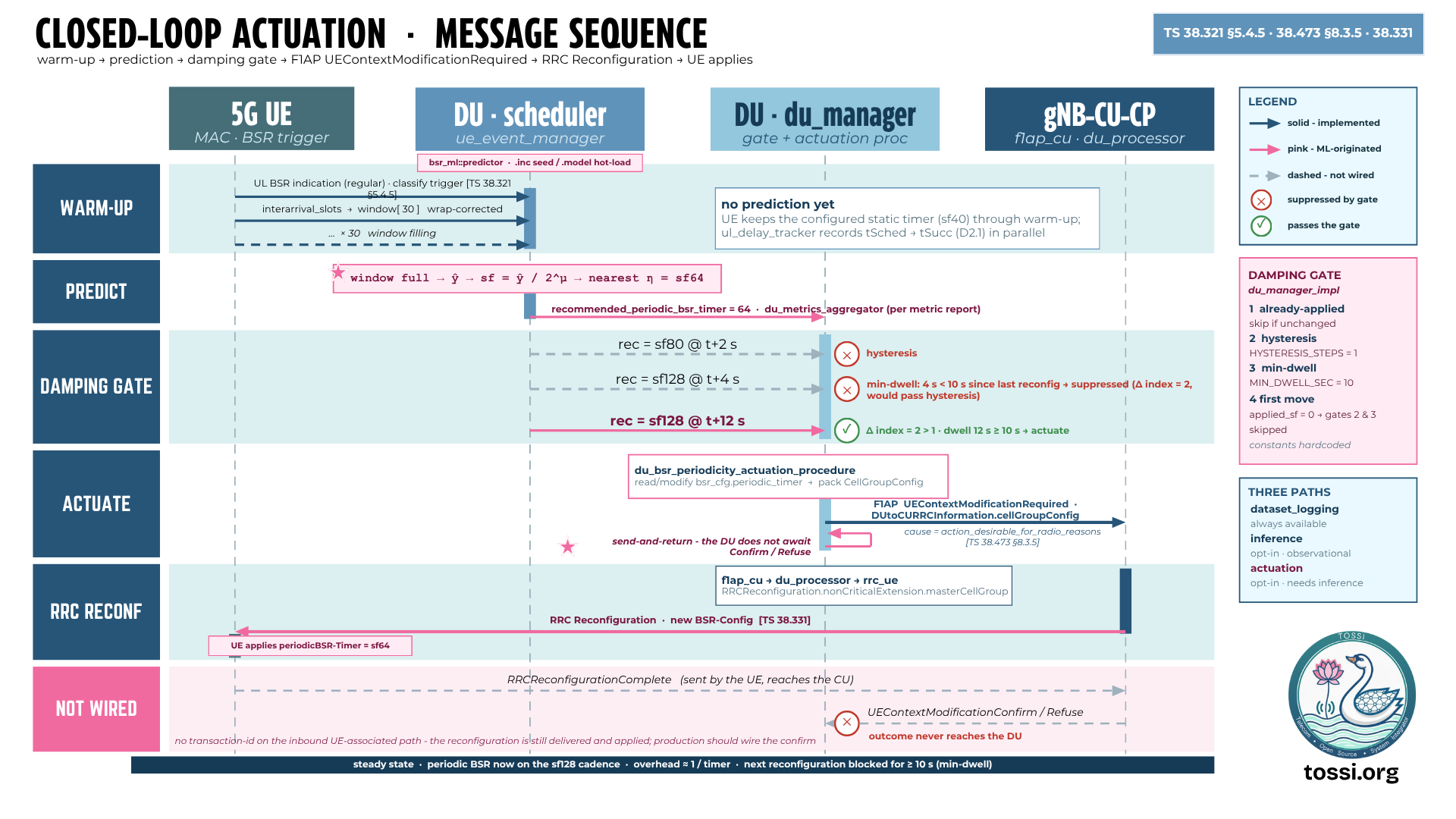
OCUDU AI-RAN replaces the traditional one-size-fits-all approach with adaptive, per-UE optimization. Instead of configuring one reporting interval for the entire network, the OCUDU DU scheduler continuously observes the uplink traffic behavior of each individual UE, predicts when new traffic is likely to arrive, and recommends the most appropriate periodicBSR-Timer for that specific device.
A UE generating continuous uplink traffic can benefit from more frequent reporting. A UE transmitting only occasionally can operate with a longer reporting interval, reducing unnecessary control signaling without sacrificing responsiveness.
Every UE is treated independently. Every prediction is made independently. Every optimization is performed according to that UE's own traffic behavior. One network. Thousands of UEs. Thousands of intelligent decisions.
Intelligence Built Natively into the OCUDU RAN Stack
Many AI-RAN demonstrations stop at showing an isolated machine learning model. Production deployments require something much more comprehensive. OCUDU AI-RAN integrates the complete AI lifecycle directly into the RAN stack.
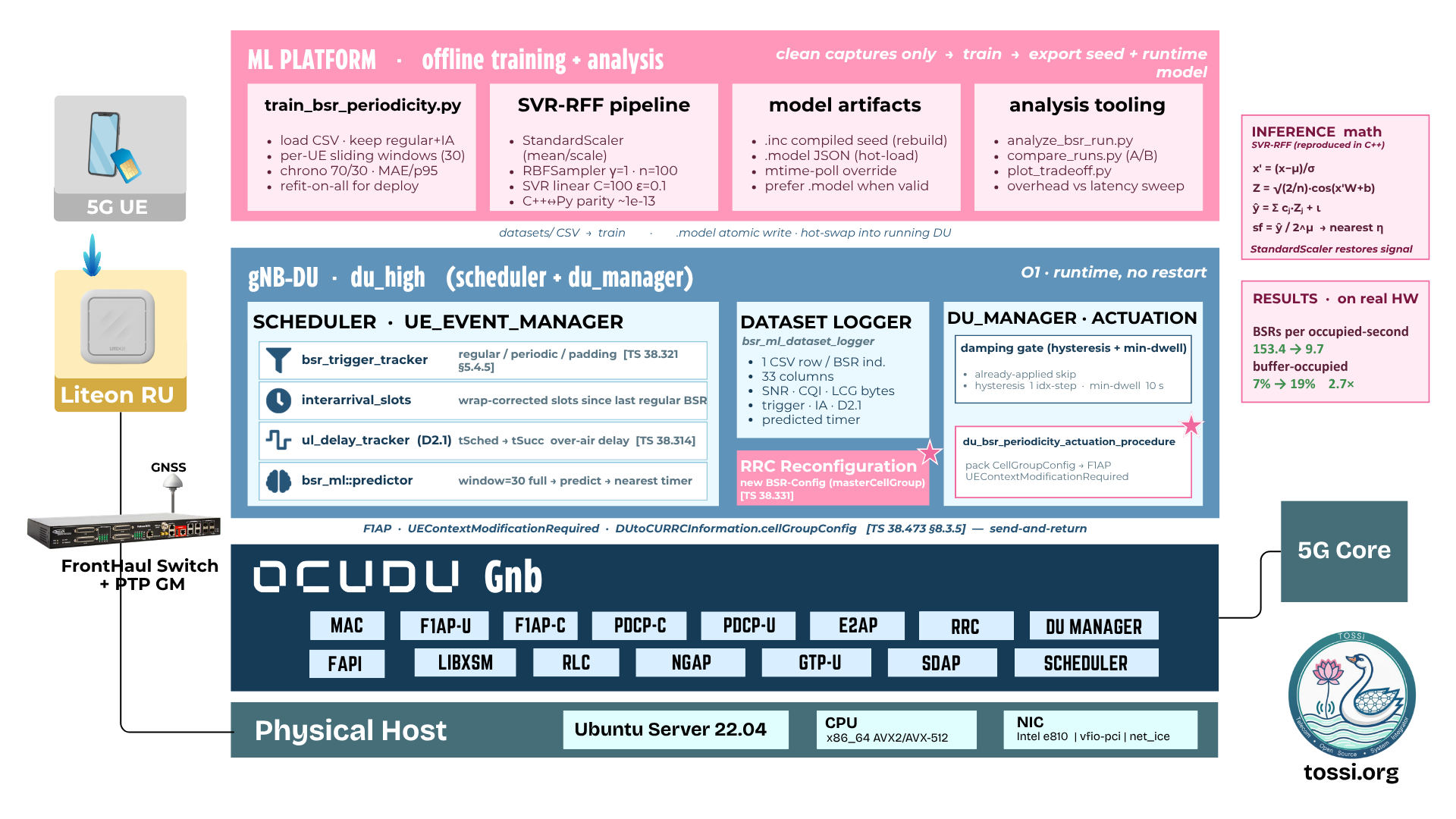
The scheduler automatically collects traffic observations from live network operation. Dataset generation is performed directly inside the DU, eliminating the need for external packet captures or custom instrumentation. The inference engine executes inside the scheduler itself, where predictions are translated into adaptive BSR recommendations for every UE.
When a better configuration is identified, the DU updates the UE using standard 3GPP procedures. A normal F1AP UE Context Modification carries the updated CellGroupConfig to the CU, which delivers a standard RRC Reconfiguration to the UE.
No proprietary signaling. No custom UE modifications. No vendor-specific interfaces. Only standard 3GPP procedures operating entirely within the OCUDU Open RAN architecture.
More Than a Machine Learning Model
One of the biggest challenges in AI-RAN is that no single model can optimize every deployment. Traffic characteristics differ between enterprise private networks, university testbeds, industrial campuses, laboratories, and nationwide mobile operators.
Rather than shipping a fixed AI solution, OCUDU AI-RAN provides the complete infrastructure required to build better ones. The framework automatically generates training datasets directly from live RAN traffic. Developers can train their own prediction models using the integrated training pipeline, validate them on their own datasets, and deploy them into a running OCUDU RAN without changing the underlying implementation.
Models become replaceable components. The infrastructure remains constant.
To help the community get started quickly, OCUDU AI-RAN also includes a pretrained reference model built from real over-the-air traffic. Operators can deploy the provided model, generate their own datasets, retrain using their own production traffic, and seamlessly replace runtime models as network behavior evolves. Every deployment can therefore optimize itself according to its own operational characteristics rather than relying on a generic model trained elsewhere.
Building an Open AI-RAN Ecosystem
Building AI-powered RAN applications should not begin with months of infrastructure development. OCUDU AI-RAN provides the complete lifecycle required for AI-native RAN innovation:
- Integrated dataset generation from live network traffic
- Automatic extraction of network behavior for supervised learning
- Open training pipeline for custom model development
- Runtime inference integrated into the DU scheduler
- Hot-swappable runtime models
- Standards-based F1AP and RRC actuation
- Reference pretrained models
- Analysis tools for evaluating network performance
Researchers can focus on designing better prediction algorithms. Operators can train models using their own production traffic. Developers can evaluate new AI techniques without rebuilding the surrounding infrastructure. The AI changes. The platform does not.
Beyond Adaptive BSR
Adaptive BSR configuration is only one capability enabled by the OCUDU AI-RAN framework. The same architecture is designed to support a growing portfolio of AI-native RAN functions, including:
- Intelligent Scheduling
- Mobility Optimization
- Beam Management
- Network Slicing
- Energy-Efficient RAN Operation
- Radio Resource Management
- Future AI-driven control and optimization functions
Each capability builds on the same open AI infrastructure, allowing intelligence to become a reusable component throughout the RAN rather than a collection of isolated AI solutions.
Building the Future of AI-Native Open RAN
The objective of OCUDU AI-RAN has never been to build isolated AI demonstrations. The objective is to build an open platform where intelligence becomes a reusable capability throughout the RAN.
As more static configuration parameters become adaptive, radio networks evolve from relying on globally optimized settings to making thousands of intelligent decisions continuously for thousands of individual users. That evolution represents the next stage of Open RAN.
This article focused on adaptive Buffer Status Report (BSR) configuration, but it is only the beginning of a broader AI-RAN journey. Future articles will explore how the same open framework enables intelligent scheduling, mobility optimization, beam management, network slicing, energy-aware networking, and many other AI-native capabilities.
The vision is simple. Build the infrastructure once. Enable intelligence everywhere. Because the future of Open RAN will not be defined solely by open interfaces. It will be defined by open intelligence.
Availability
- OCUDU RAN: github.com/TOSSI-Foundation/OCUDU
- Documentation: ML-Based BSR Periodicity Prediction
- Demo video: youtu.be/4peJEy-7JsE