
The promise of Open RAN has always been interoperability: independently developed RAN components, management platforms and intelligent applications working together through standardized interfaces. The real test is whether a live RAN, an SMO platform, a Non-RT RIC and an rApp can complete an end-to-end control loop through standardized O-RAN interfaces. We set out to demonstrate exactly that using the OCUDU RAN ecosystem and a Cell Congestion Optimization rApp developed by coRAN LABS.
The Network Problem
Cell congestion is a familiar challenge in mobile networks. One cell may become heavily loaded, causing users to experience degraded throughput, while a neighboring cell still has sufficient available capacity. A manual response would be to move selected users from the congested cell to the less-utilized neighbor. However, manual intervention does not scale across a live network.
The O-RAN architecture enables this process to become intelligent and automated. A Non-RT RIC and rApp can observe live network conditions, evaluate operational policies and initiate an optimization action through standardized management interfaces. For this demonstration, three elements had to work together:
- A RAN capable of exposing live radio and performance information.
- A management stack capable of carrying that information through standard interfaces.
- An intelligent application capable of observing, deciding and acting.
The Cell Congestion Optimization rApp
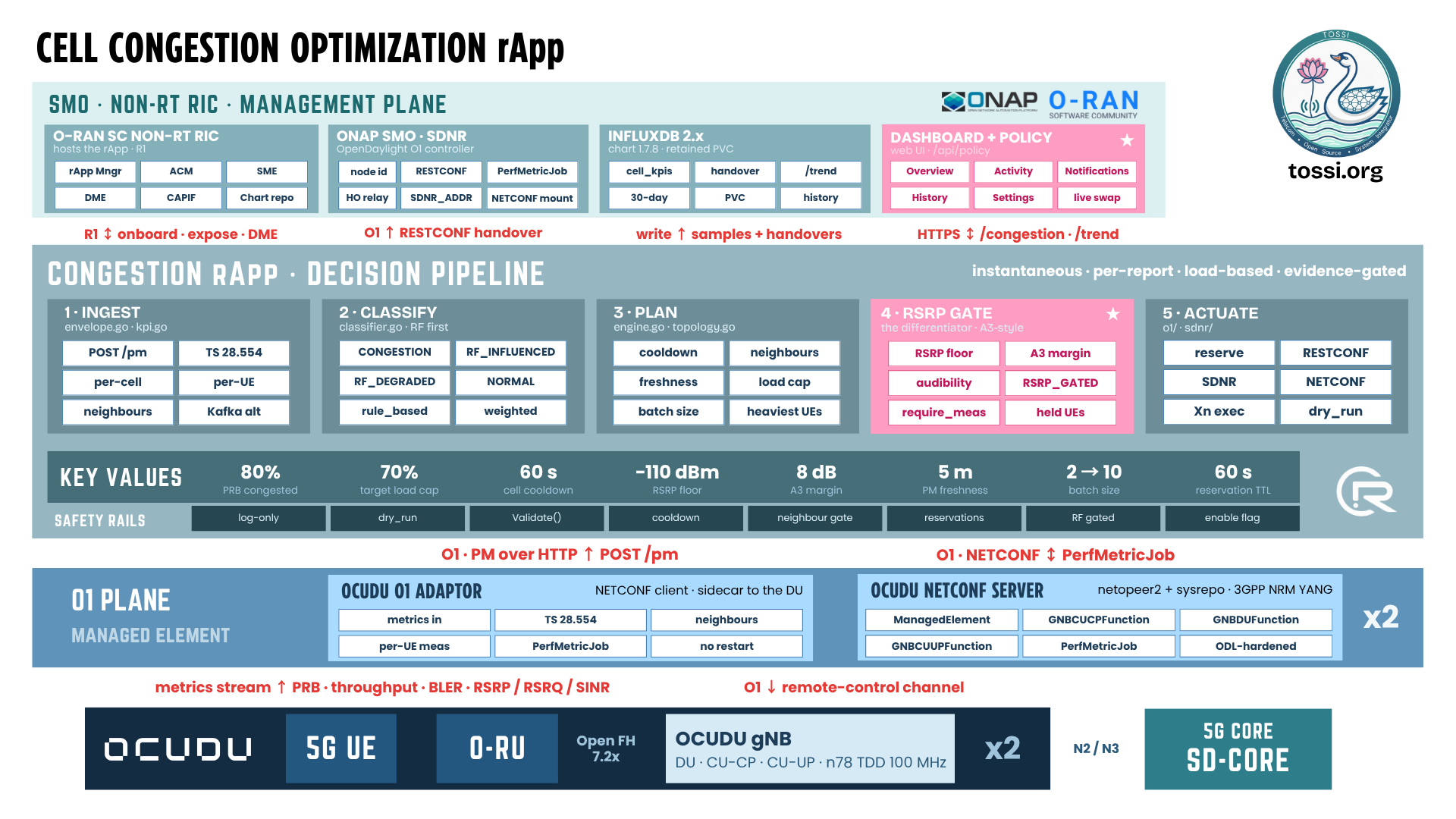
The Cell Congestion Optimization rApp provides the decision-making component of the closed-loop workflow. The rApp receives performance information through the O1 adapter and evaluates each cell against configurable Physical Resource Block utilization thresholds. When congestion is detected, the rApp evaluates available neighboring cells and identifies a suitable target for handover. Before triggering an action, it verifies that:
- the target is a configured neighbor of the congested cell;
- recent performance measurements are available;
- the target cell has sufficient available capacity; and
- the UE's neighbor measurement reports indicate that the target cell is observable by the device.
Operational policies can be updated at runtime without restarting the application. Each decision is also recorded, providing visibility into the source cell, selected target, measured load, trigger condition and resulting action.
Making O1 Work End to End
An intelligent rApp is only as useful as the information it can receive and the actions it can initiate. Closing the loop required the OCUDU RAN to expose the operational data needed for congestion optimization and to accept management-driven handover requests. The OCUDU RAN stack was extended to provide:
- per-cell resource-utilization measurements;
- per-UE radio metrics;
- per-UE throughput information;
- configured neighbor relationships;
- UE neighbor measurement reports; and
- support for executing handover requests received through the management plane.
An O1 Adapter bridges the OCUDU RAN and the Service Management and Orchestration platform. The adapter consumes live RAN metrics, maps them to performance-management definitions aligned with 3GPP TS 28.554, and publishes them over the O1 interface. It also exposes the neighbor-relation and UE-measurement information required by the optimization rApp.
Configuration and management are supported through a NETCONF server implementing the 3GPP network resource model over O1. This enables the SMO to discover the network element, configure performance-measurement jobs and deliver management requests through standardized interfaces.
Meeting at Standard Interfaces
With these components in place, the end-to-end workflow connected independently developed software through published interfaces. The Cell Congestion Optimization rApp was onboarded and deployed on the O-RAN Software Community Non-RT RIC. The deployment used the rApp Manager and associated Automation Composition, Service Exposure and Data Management capabilities to onboard and operate the application in line with the O-RAN R1 framework.
The actuation path extended through an ONAP-based SMO platform. Its SDNR controller carried the handover command toward the network element over RESTCONF. The resulting control path was:
OCUDU RAN telemetry → O1 Adapter → Cell Congestion Optimization rApp → SMO and Non-RT RIC → management action → handover execution in the RAN
The demonstration validated interoperability through standardized interfaces across the complete management workflow. That is the interoperability model Open RAN was designed to enable.
Closing the Loop
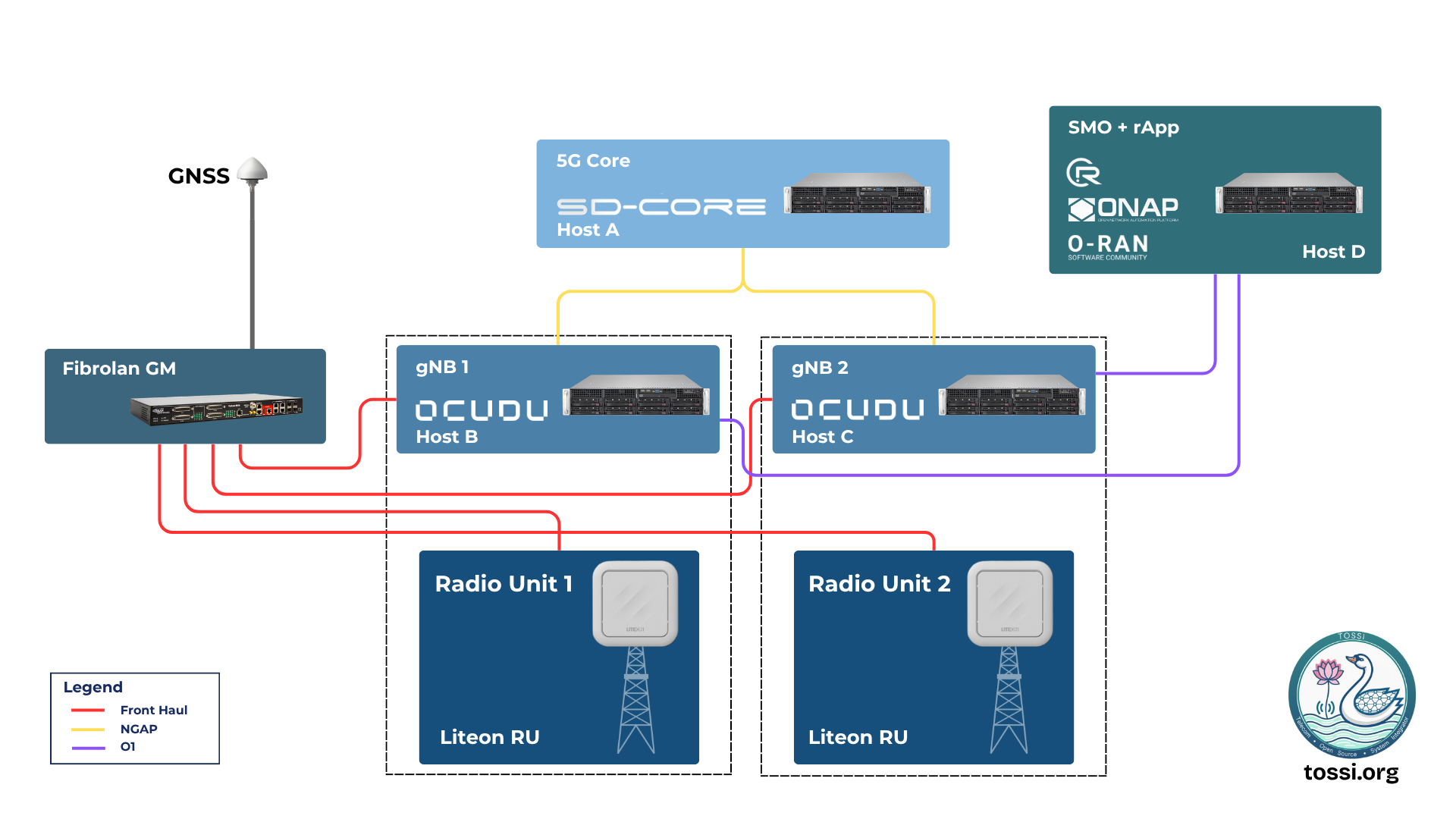
The demonstration used two active cells with a real UE initially connected to the first cell. As the load on the serving cell increased, the following sequence occurred:
- The OCUDU RAN reported rising resource utilization through the O1 management path.
- The rApp received the measurements and classified the serving cell as congested.
- It evaluated the configured neighbor cells.
- It confirmed that the selected target had recent measurements and sufficient available capacity.
- It checked the UE's neighbor measurement information to confirm that the device could observe the target cell.
- The rApp issued a handover request.
- The management plane relayed the action to the network element.
- The OCUDU RAN executed the handover.
- The UE moved to the neighboring cell.
- The source-cell load decreased, and the optimization result was recorded in the rApp's decision history.
The workflow completed a full closed loop:
Observe → Evaluate → Decide → Act → Verify
The result was an end-to-end congestion-optimization process spanning a live RAN, an O1 management layer, an SMO platform, a Non-RT RIC and an independently developed rApp.
Why This Matters
Open RAN is ultimately about more than disaggregating network components. Its value is demonstrated when independently developed systems can exchange operational information, make intelligent decisions and execute network actions through standardized interfaces. This demonstration validated a complete standards-based workflow in which live performance data was collected from the RAN, transported through the O1 management interface, analyzed by an rApp that selected an optimization action, delivered to the network element by the management platform, and executed as a handover by the RAN.
The significance extends beyond one congestion-management use case. Once telemetry, configuration and control are exposed through open interfaces, the same architecture can support additional intelligent applications without redesigning the underlying RAN for every new use case.
A Foundation for Additional rApps
Cell Congestion Optimization is one example of what can be built on a standards-based management and control framework. The same architecture can support rApps for:
- mobility optimization;
- energy efficiency;
- cell degradation detection;
- coverage and capacity optimization;
- service and slice assurance;
- anomaly detection;
- handover-failure reduction;
- PCI planning and optimization; and
- policy-driven network operations.
Each application can consume the information relevant to its objective, evaluate network conditions and initiate actions through the same open management framework. This enables the intelligence layer to evolve independently of the underlying RAN implementation.
Toward AI-Assisted and Autonomous RAN Operations
Artificial intelligence is expected to play an increasingly important role in future network operations. AI does not need to replace standardized interfaces. Instead, AI and ML models can consume the same operational telemetry already exposed through O1, analyze larger volumes of network data, identify patterns that may be difficult to capture through fixed thresholds, and recommend or initiate actions through the same management path. A future congestion-optimization rApp could combine policy rules with learned models to:
- predict congestion before thresholds are crossed;
- distinguish temporary load spikes from sustained congestion;
- estimate the likely impact of moving a UE;
- rank multiple target cells;
- avoid unstable or repeated handovers; and
- continuously improve decisions using historical outcomes.
The interfaces remain standardized even as the intelligence behind the decisions becomes more advanced. This progression points toward increasingly autonomous RAN operations, where intelligent applications continuously observe network conditions, identify optimization opportunities and execute policy-controlled actions across interoperable platforms.
From Open Interfaces to Closed-Loop Intelligence
Specifications define how components should communicate. Interoperability is proven when those components exchange live information, make a decision and successfully execute an action across the complete network stack. The OCUDU closed-loop Cell Congestion Optimization demonstration shows that an independently developed rApp, a Non-RT RIC, an SMO platform and an open RAN stack can work together through standards-based interfaces to complete a real network-optimization workflow.
Open RAN opened the interfaces. Closed-loop rApps turn those interfaces into operational intelligence.
Availability
- Demo Video: OCUDU Closed-Loop rApp for Cell Congestion Optimization
- Cell Congestion Optimization rApp: coranlabs/cell_congestion_optimization_rapp
- OCUDU RAN: TOSSI-Foundation/OCUDU-RAN
- OCUDU NETCONF: TOSSI-Foundation/OCUDU-Netconf
- OCUDU O1 Adapter: TOSSI-Foundation/OCUDU-O1-Adaptor
- Documentation: Cell Congestion Optimization rApp (TOSSI Docs)