
Most network slicing demonstrations stop at the scheduler. Real-world slicing begins when the entire network works together. The latest TOSSI release delivers a complete open-source ecosystem: multi-UE orchestration, slice-aware OCUDU scheduling, Magma Core integration, O1-based live configuration, and an rApp development environment, all unified into a single platform.
Network slicing is one of the defining capabilities of 5G. It enables operators to run multiple logical networks on a shared physical infrastructure, each optimized for different service requirements. eMBB, URLLC, and mMTC can coexist while receiving dedicated treatment tailored to their performance objectives.
While the industry has made significant progress developing individual open-source components (UE, Open RAN, 5G Core, SMO, and RICs), building a complete end-to-end slicing environment remains a complex challenge. Researchers and developers frequently spend more time integrating components than validating slicing algorithms, evaluating resource allocation strategies, or developing intelligent automation applications.
To address this gap, the latest TOSSI release introduces a comprehensive open-source network slicing ecosystem built around OCUDU, enabling end-to-end slice validation across the entire 5G architecture.
Moving Beyond Individual Components
Network slicing is not simply a scheduler feature. True slice validation requires coordination across multiple layers:
- User Equipment (UE)
- Radio Access Network (RAN)
- 5G Core
- Service Management and Orchestration (SMO)
- O-RAN Near-RT and Non-RT RICs
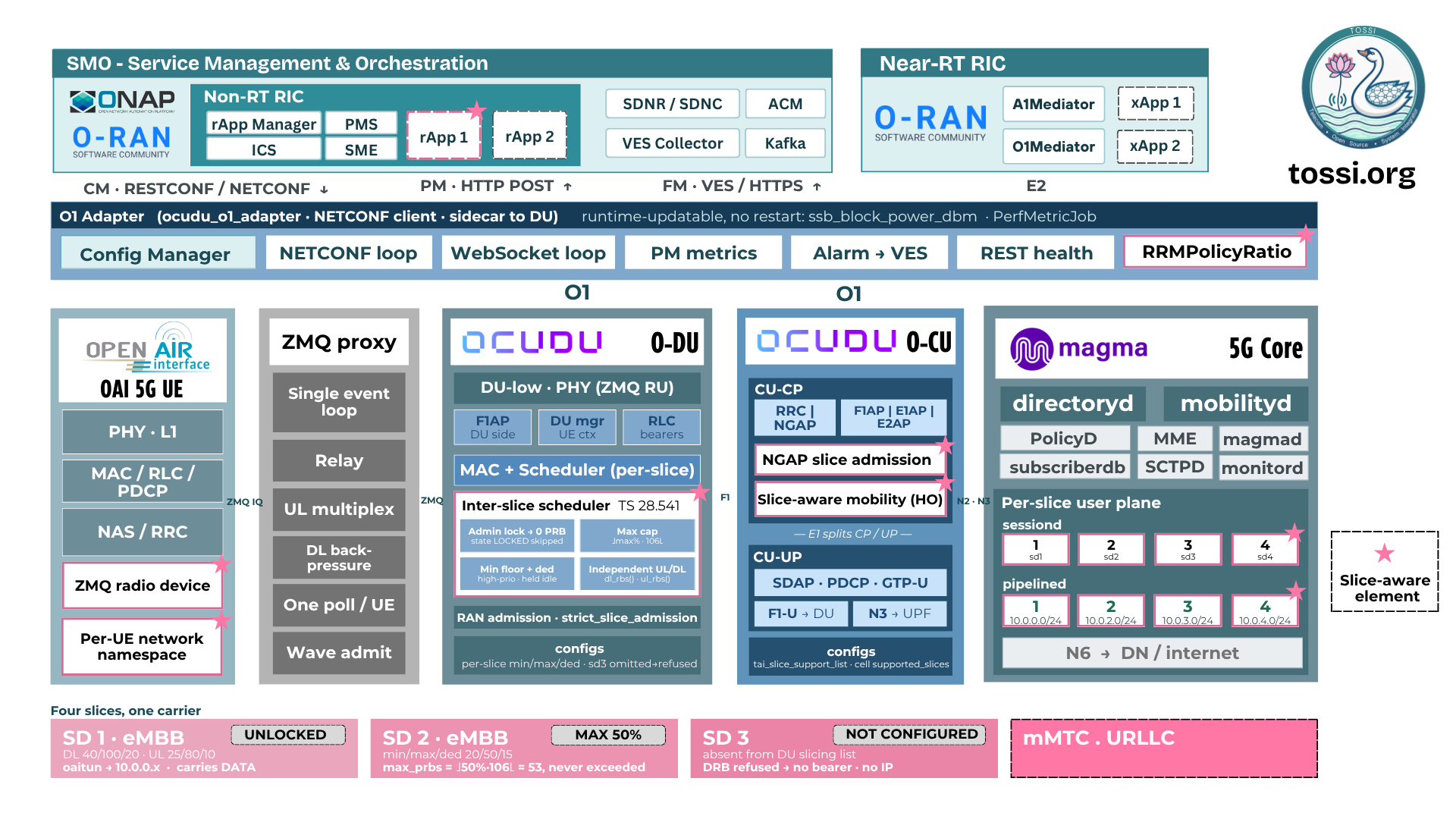
A limitation of many existing demonstrations is that slicing is validated within a single component rather than across the complete network. The new TOSSI ecosystem changes that by integrating all major building blocks into a unified platform that supports development, testing, validation, and management of network slices from end to end.
Enhancing the UE for Realistic Slice Validation
Network slicing research requires more than a single software UE connected to a network. To enable realistic experimentation, the OpenAirInterface UE environment has been significantly enhanced with:
- Multi-UE orchestration
- Multi-slice support using independent S-NSSAIs
- Traffic generation capabilities
- Unified monitoring and management dashboard
- Isolated network namespaces per UE
Researchers can now launch and manage multiple software UEs simultaneously, each configured with its own traffic profile and slice assignment. The environment is connected through a deterministic lockstep ZMQ proxy, ensuring synchronized interaction between multiple UEs and the RAN while supporting scalable experimentation.
These enhancements transform the UE from a simple connectivity tool into a comprehensive network slicing validation framework.
Extending OCUDU for Advanced Network Slicing
At the heart of the platform is OCUDU Open RAN, enhanced to support realistic slice-aware resource management and validation.
Advanced DU Scheduler Capabilities
The DU scheduler implements 3GPP TS 28.541 RRM Policy Ratio-based resource allocation, enabling:
- Minimum guaranteed resources per slice
- Maximum resource limits
- Dedicated resource reservations
- Administrative locking
- Independent uplink and downlink allocation policies
This allows researchers to evaluate how different slicing strategies perform under varying traffic and network conditions.
Slice-Aware CU Intelligence
The CU extends slicing functionality through:
- Slice-aware admission control
- Slice-aware mobility management
- Validation of supported slices during session establishment
- Handover verification against target cell slice capabilities
These enhancements ensure that slicing policies are enforced consistently throughout the RAN. The platform also introduces detailed per-slice resource utilization metrics, enabling developers to observe scheduler decisions and evaluate slice isolation and efficiency in real time.
Bringing the Core Network into the Picture
Network slicing validation is incomplete without the core network. This release integrates Magma Core, enabling validation across both control-plane and user-plane functions. Multiple slices can be established, exercised, and monitored from UE registration through user traffic generation, providing realistic end-to-end behavior across the complete network stack.
By incorporating a production-oriented open-source core, the platform enables more practical and reproducible slicing experiments.
Bringing Standard O-RAN Slice Management to the SMO
One of the most significant advancements in this release is the extension of the O1 management plane for network slicing. The OCUDU O1 Adapter now supports runtime slice configuration using standard O-RAN management interfaces.
Live Slice Configuration Updates
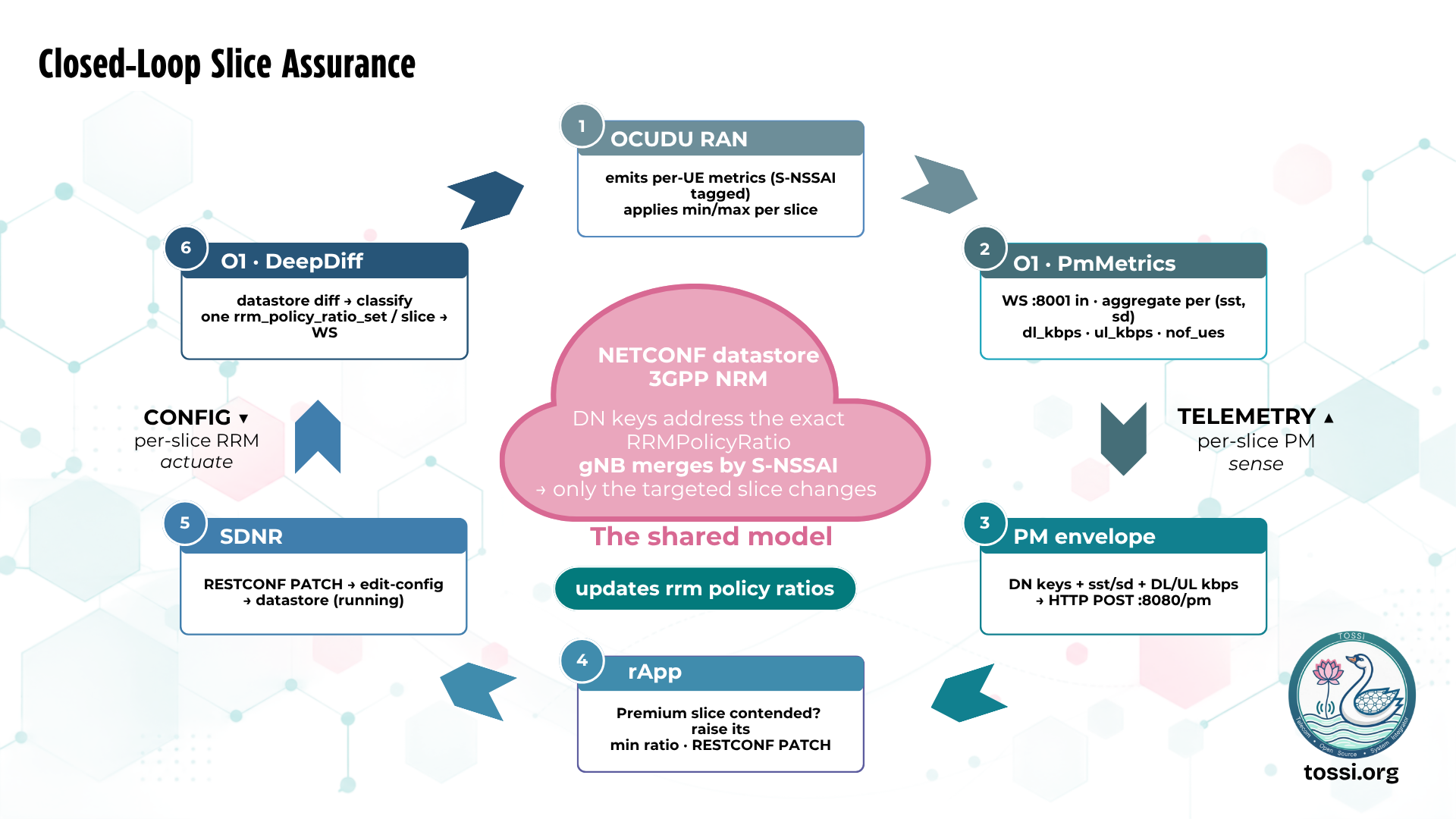
Administrators can dynamically modify resource allocation policies, RRM Policy Ratio parameters, and slice-specific operational settings. Changes are propagated through NETCONF and translated into live updates within the running RAN, eliminating the need for service restarts.
Per-Slice Performance Monitoring
The platform introduces slice-specific performance management metrics through standard O1 Performance Management interfaces:
- Throughput per slice
- Resource utilization per slice
- S-NSSAI-specific performance indicators
This creates the foundation for intelligent automation and closed-loop optimization.
Enabling the Next Generation of rApps
As Open RAN deployments mature, intelligent automation is expected to become increasingly important. Future networks will require applications capable of:
- Monitoring slice performance
- Predicting congestion
- Optimizing resource allocation
- Dynamically adjusting policies
- Maintaining SLA compliance
By exposing standardized O1 management interfaces and integrating SMO, Near-RT RIC, and Non-RT RIC components, this platform provides an ideal environment for developing and validating network slicing rApps. Researchers can focus on innovation rather than infrastructure integration. Operators gain a reproducible environment for evaluating slicing strategies before deployment into production networks.
Validating the Complete Slice Lifecycle
With this release, developers can validate every stage of the network slice lifecycle within a single open-source ecosystem:
- Slice creation and configuration
- UE attachment to multiple S-NSSAIs
- Traffic generation across multiple slices
- Admission control validation
- Radio resource allocation
- Slice isolation analysis
- Core network slice selection
- O1-based management and monitoring
- Per-slice telemetry collection
- Automation and rApp development
This level of end-to-end visibility is essential for advancing both network slicing research and operational deployment strategies.
Looking Ahead
Open RAN's long-term success depends not only on open interfaces but also on interoperable ecosystems that enable innovation across the entire network stack. The latest TOSSI release demonstrates how OCUDU, OpenAirInterface UE, Magma Core, ONAP SMO, and O-RAN RIC components can be integrated into a unified, open-source platform for end-to-end network slicing.
More importantly, it establishes the foundation for future work in:
- Closed-loop automation
- AI-driven network optimization
- Intelligent resource management
- Autonomous network slicing
- Production-grade rApps
As with all TOSSI releases, these enhancements are built on open-source software and designed to accelerate collaboration across the telecom ecosystem. The future of network slicing will not be built by individual components alone. It will be built through interoperable platforms that bring the entire ecosystem together. And with OCUDU at the center of the Open RAN stack, that future is becoming increasingly accessible to researchers, developers, and operators alike.