
AI will not transform Open RAN because of better models. It will transform Open RAN because of better infrastructure. OCUDU AI-RAN Release 1 is not another standalone AI model, it is an open, end-to-end framework for building, deploying, and continuously improving intelligent RAN applications, with intelligent uplink link adaptation as its first application.
Across the industry, AI-RAN has become one of the most discussed topics. Every major vendor is showcasing AI-powered scheduling, intelligent link adaptation, beam management, and network optimization. Yet most demonstrations have one thing in common: they stop at the machine-learning model.
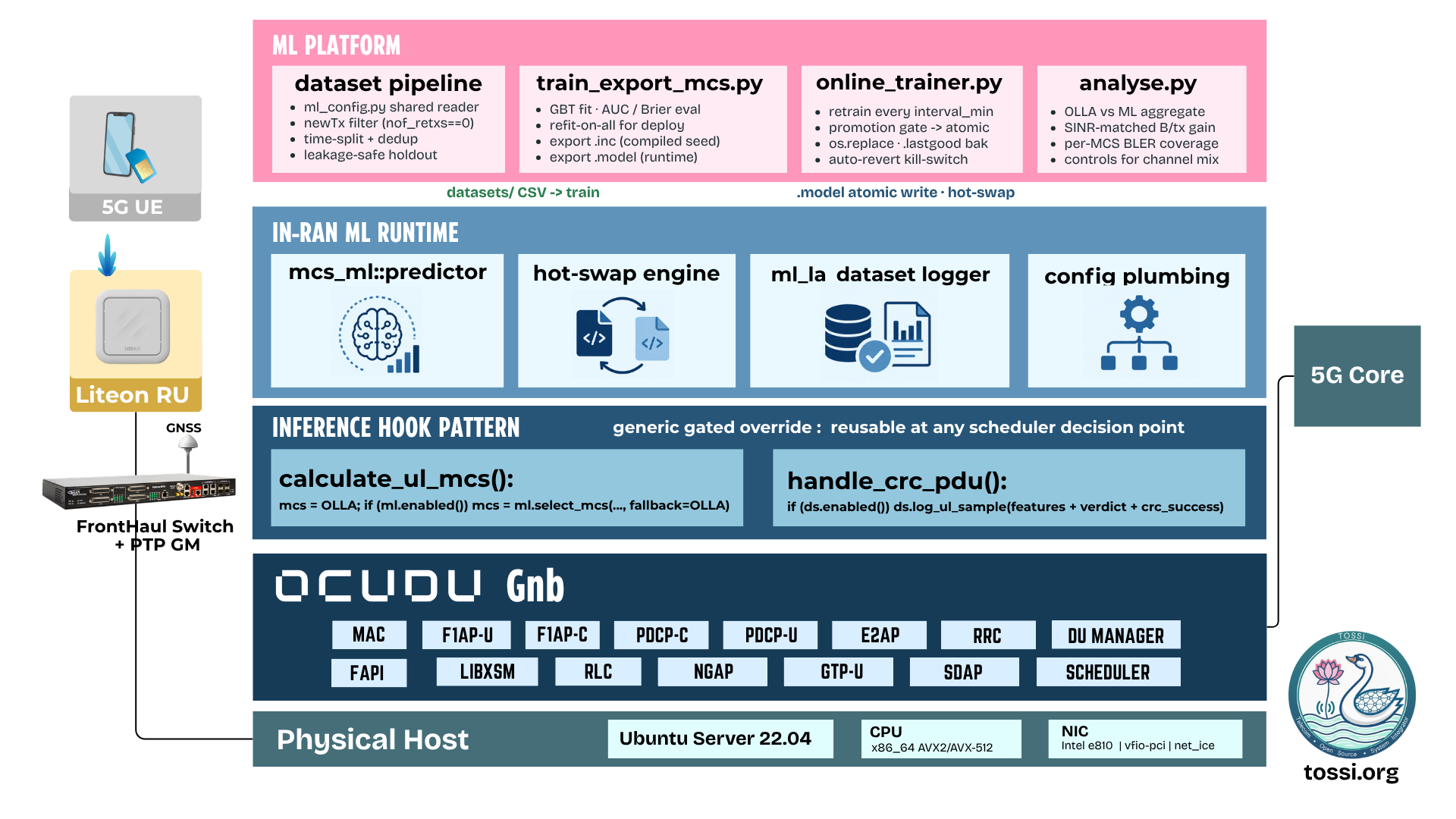
Real AI-RAN is far more than inference. A production-ready AI-RAN platform must collect data from live networks, generate high-quality datasets, train and validate models, safely deploy them into running systems, continuously improve them, and fall back gracefully whenever needed. Without this complete lifecycle, AI remains an isolated experiment rather than an operational capability.
That is the philosophy behind OCUDU AI-RAN Release 1, the first release in the TOSSI AI-RAN Series. Rather than introducing another standalone model, it introduces an open framework that lets the Open RAN community build, deploy, and continuously evolve intelligent RAN applications, laying the foundation for making AI a native capability of Open RAN.
AI Infrastructure Matters More Than AI Models
Machine-learning models will continue to evolve; today's best model will eventually be replaced by a better one. The infrastructure that lets those models be developed, deployed, and improved is what creates lasting value. So Release 1 is designed around the complete AI lifecycle rather than a single algorithm, bringing together every building block required for practical deployment:
- Live data collection from operational networks
- Integrated dataset generation
- Open model training and validation
- Runtime AI inference inside the DU scheduler
- Safe deployment mechanisms
- Continuous online learning
- Automatic rollback and operational fallback
Together, these capabilities transform AI from an isolated research project into deployable network infrastructure.
The First Application: Intelligent Link Adaptation
Every millisecond, the scheduler must answer a critical question: what is the highest Modulation and Coding Scheme (MCS) that can be transmitted while maintaining the desired Block Error Rate (BLER)? Traditionally this has relied on well-established algorithms such as Outer-Loop Link Adaptation (OLLA).
Release 1 introduces machine learning as an intelligent companion to those proven mechanisms. Using live radio measurements, the ML inference engine evaluates candidate MCS values and predicts the probability of successful transport-block decoding; the scheduler then selects the highest MCS expected to satisfy the configured BLER target.
Importantly, the framework does not replace OLLA, it works alongside it. Whenever confidence is insufficient or AI is unavailable, the scheduler immediately falls back to the conventional OLLA decision. This hybrid architecture delivers AI-driven optimization without compromising the reliability expected from carrier-grade deployments. AI should enhance operational confidence, not replace it.
For the full implementation, configuration, and deployment guide, see the ML-Based UL MCS Link Adaptation documentation.
Built on Real Networks, Not Just Simulations
One of the biggest challenges facing AI-RAN research is the gap between laboratory demonstrations and real-world deployment. To bridge it, Release 1 ships a pretrained seed model built from more than 900,000 real over-the-air uplink transmissions collected from live UE deployments. This gives researchers and developers an immediate starting point while grounding experimentation in realistic radio behavior instead of purely simulated environments.
Open AI Means Open Data
No two radio networks are the same. Spectrum, traffic patterns, user mobility, deployment density, and hardware configurations all influence network behavior, and a single pretrained model cannot optimize every environment. OCUDU therefore embraces an open approach: whether data originates from live deployments, laboratory experiments, proprietary environments, public datasets, third-party sources, or simulators, the framework lets organizations train models that reflect their own operational realities. Instead of locking users into one AI model, OCUDU provides the infrastructure to build better ones.
Making RAN Data AI-Ready
High-quality datasets remain one of the biggest barriers to AI innovation. Rather than requiring packet captures, custom instrumentation, or PHY modifications, OCUDU integrates dataset generation directly into the scheduler. Every decoded uplink transmission can automatically become a labeled training sample containing radio measurements, scheduler decisions, MCS selection, link-adaptation state, CRC outcomes, and additional scheduling context. With a single configuration change, operational networks become AI training platforms.
Networks That Learn
Radio environments change constantly, and static AI models eventually become outdated. Release 1 introduces an optional online-learning pipeline that lets networks continuously improve their intelligence: new scheduling data is collected, candidate models are trained, validated against production performance, promoted only when quality improves, and seamlessly deployed into a running DU, all without service interruption. Automatic promotion gates, rollback mechanisms, and OLLA fallback ensure operational stability remains the highest priority throughout the learning process.
Building an Open AI-RAN Platform
Although Release 1 focuses on ML-based MCS prediction, the broader vision extends far beyond link adaptation. The inference engine, training framework, and dataset pipeline are intentionally designed as reusable infrastructure that can support future AI-RAN applications, including:
- Intelligent scheduling
- Beam management
- Mobility optimization
- Network slicing
- Energy-efficient RAN operation
- Future AI-native radio capabilities
By separating AI infrastructure from AI algorithms, OCUDU lets the community innovate without rebuilding the underlying platform for every new use case.
The Beginning of an Open AI-RAN Ecosystem
Open RAN transformed network architecture through openness and interoperability. AI now has the opportunity to transform how those networks operate. For that transformation to succeed, AI cannot remain a collection of isolated demonstrations; it must become part of the network itself: open, modular, deployable, continuously learning, and community-driven.
That is the vision behind the TOSSI AI-RAN Series. OCUDU AI-RAN Release 1 is not simply introducing machine learning into the scheduler, it is introducing an open foundation upon which the next generation of intelligent RAN applications can be built. The future of Open RAN will not be defined solely by open interfaces. It will be defined by open intelligence.
Availability
- GitHub: TOSSI-Foundation/OCUDU-RAN (dev branch)
- Documentation: ML-Based UL MCS Link Adaptation (TOSSI Docs)