Transparent payload
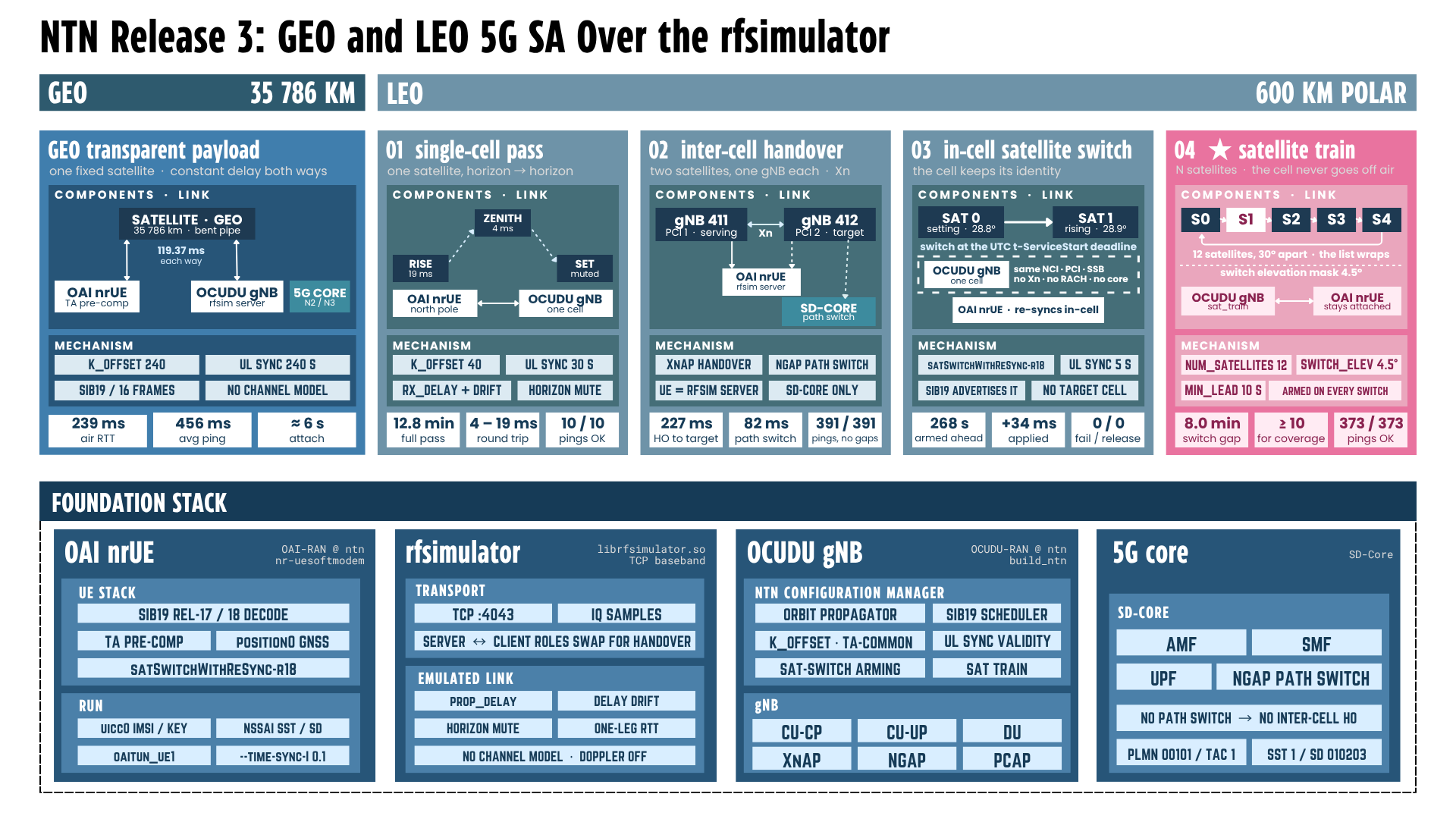
A fixed satellite at 35 786 km with 119.37 ms of propagation delay each way, carrying a full 5G Standalone attach.
DocumentationA complete non-terrestrial network environment for testing, experimentation and the development of advanced use cases. Geostationary and low-earth-orbit links, inter-satellite handover and continuous constellation coverage, running the standard 5G Standalone protocol stack end to end on a single Linux host.
A complete non-terrestrial environment on open source, from a single geostationary link to a constellation that keeps a cell in service indefinitely. Three capabilities are available today; three are on the roadmap.
A complete open implementation. Every protocol layer is production code, and the source is public.
A geostationary transparent payload and a 600 km low-earth orbit, sharing one configuration set and one harness.
XnAP handover between cells with NGAP Path Switch, and in-cell satellite switching that keeps the cell identity.
A visualisation and simulation platform covering orbit propagation, protocol state and measured performance in one view.
Network-verified device position through the Location Management Function, for regulatory and emergency use.
Applying the machine learning released for terrestrial RAN to orbital scheduling, link adaptation and handover prediction.
5G assumes a base station that is stationary and close by. In orbit, propagation delay rises from microseconds to hundreds of milliseconds, protocol timers expire, and a low-earth-orbit satellite stays in view for only a few minutes.
3GPP addressed this from Release 17 with SIB19 ephemeris, timing advance pre-compensation and K_offset, and in Release 18 with in-cell satellite switching. The Open NTN Testbed implements these mechanisms on OCUDU RAN, so operators, researchers and vendors can evaluate non-terrestrial behaviour against a standards-compliant implementation before committing to hardware.
One geostationary configuration and four low-earth-orbit scenarios, each exercising a distinct 3GPP mechanism. Measured results for each are in the documentation.
A fixed satellite at 35 786 km with 119.37 ms of propagation delay each way, carrying a full 5G Standalone attach.
DocumentationOne satellite tracked horizon to horizon at 600 km, with continuously changing delay and the link muted at setting.
Scenario 1Two satellites, each with its own gNB. XnAP moves the device between cells; NGAP Path Switch preserves the session.
Scenario 2The cell retains its NCI, PCI and SSB while the satellite changes. No target cell, no Xn, no random access.
Scenario 3Twelve satellites on one orbit. Each transfer schedules the next, keeping the cell in service indefinitely.
Scenario 4Every scenario, the mechanism it exercises and the result measured, over the shared foundation stack.
Non-terrestrial access became normative in Release 17 and has been extended since. The testbed implements the Release 17 baseline and the Release 18 in-cell satellite switch.

TS 38.300 · TS 38.331 · TS 38.213 · TS 38.101-5
TS 38.300 · TS 38.331 · TR 38.882
TR 22.865 · TS 22.261 · TR 23.700-29
FS_5GSAT_Ph4 · FS_6G_ARC · TR 38.914
The OAI rfsimulator replaces the air interface with a TCP socket and applies the propagation delay itself. Every protocol layer above it remains production code.
SIB19 Release 17 and 18 decoding, timing advance pre-compensation derived from its own GNSS position, and satSwitchWithReSync-r18.
IQ samples over TCP. It applies propagation delay, delay drift and horizon muting, and exchanges server and client roles for handover.
An NTN configuration manager that propagates the orbit, schedules SIB19, sets K_offset, and arms satellite switches and the constellation sequence.
SD-Core or OAI CN5G. Inter-cell handover requires NGAP Path Switch, which SD-Core supports and OAI CN5G does not.
The base stack, without the NTN-specific configuration, is documented in the rfsimulator Multi-UE Testbed.
The testbed is built in stages, each adding one capability to the one before it. Satellite handover is the current release.
A fixed 480 ms delay with full RRC, NAS and PDU session support.
A 600 km satellite with ephemeris-driven delay and delay rate. Service-link Doppler emulation is implemented but off by default.
Maintaining the connection as one satellite sets and the next rises, both between cells over Xn and within a single cell.
The gNB on board the satellite, with regulatory location, network-verified UE position, mapped Cell ID and earth-fixed tracking areas.
Coverage enhancements, store-and-forward, inter-satellite links, higher channel fidelity and an NTN digital twin for constellations.
Once regulatory location and the regenerative payload are in place, the testbed is directed towards two outcomes. The first is applying machine learning to non-terrestrial operation: TOSSI has already released AI-RAN work for terrestrial networks covering link adaptation, predictive CSI, scheduling and resource slicing, and the orbital case adds problems those methods are well suited to, including handover prediction from ephemeris and scheduling against a delay that is known in advance but never constant.
The second is a comprehensive dashboard for non-terrestrial network testing and simulation, consolidating orbit propagation, protocol state and measured performance into a single operational view. A first version already ships with the LEO testbed as a live tracker for satellite geometry and handover events.
Each scenario is documented end to end: the sources, the build, the configuration, the commands, and the log output that confirms correct operation. The implementation is open.
